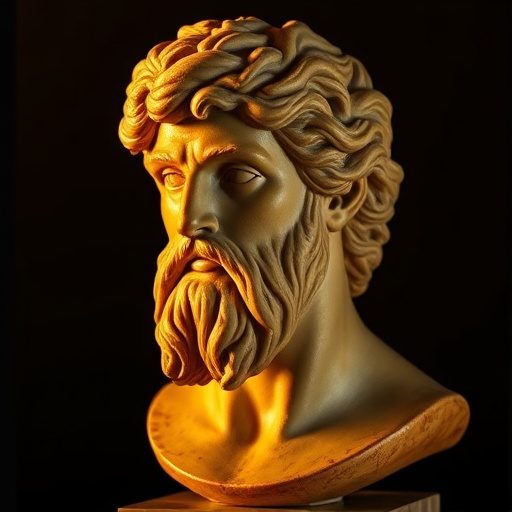
Pythagoras — "Abstain from the flesh of beasts that die of themselves."
Abstain from the flesh of beasts that die of themselves.
Abstain from the flesh of beasts that die of themselves.
Click any product to generate a realistic preview. Up to 3 at a time.
* Initial load can take up to 90 seconds — revising the preview in another color is nearly instant.
"Do not sit on a quart measure."
"Sooner throw a pearl at hazard than an idle or useless word; and do not say a little in many words, but a great deal in a few."
"Number is the within of all things."
"Do not look in a mirror by lamplight."
"If there be light, then there is darkness; if cold, heat; if height, depth; if solid, fluid; if hard, soft; if rough, smooth; if calm, tempest; if prosperity, adversity; if life, death."
Greek philosopher and mathematician whose school in Croton combined geometry (the Pythagorean theorem), number-mysticism, and a religious-vegetarian way of life. Closely associated with Thales of Miletus (earlier pre-Socratic and the first philosopher). For an intellectual contrast, see Heraclitus, pre-Socratic Greek philosopher of flux — Heraclitus called Pythagoras 'the chief of swindlers' — among the founding insults of the philosophical-rivalry tradition. Their 'all is flux' vs 'all is number' poles still organize the philosophy of mathematics today (Platonist vs anti-realist).
A Pythagorean dietary rule, part of their broader vegetarian practices.
Date: c. 570-495 BCE (attributed later)
Life & DeathFound in 1 providers: gemini
1 source checked
Don't eat animals that died on their own—only those deliberately killed for food. This reflects both practical wisdom and spiritual discipline: naturally dead animals may be diseased, decayed, or otherwise corrupted. More broadly, it advocates intentionality in consumption, rejecting the passive or accidental in favor of the deliberate. It frames diet as a moral and physical choice, not opportunism, linking what you eat to who you are.
Pythagoras led a strict ascetic brotherhood governed by elaborate dietary codes—most famously avoiding beans. He believed in metempsychosis, the transmigration of souls into animals, making consumption of certain flesh spiritually perilous. Eating carrion—creatures that died without ritual intention—violated his core principles of purity and conscious living. For Pythagoras, diet was not nutrition but spiritual practice, inseparable from mathematics and mysticism as disciplines for elevating the soul.
In 6th-century BC Greece, ritual purity governed food and religion together. Animals sacrificed to gods were slaughtered ceremonially—consuming carrion bypassed these sacred rites, making it spiritually transgressive. Orphic mystery cults, which heavily shaped Pythagoras, emphasized purification through dietary discipline. Without germ theory, naturally dead animals also posed genuine disease risks. This rule thus served dual purposes: maintaining religious cleanliness in a culture where food, sacrifice, and divine relationship were entirely inseparable.
AI-generated insights based on extensive research and information for context. Factual errors? Email [email protected].
Your cart is empty