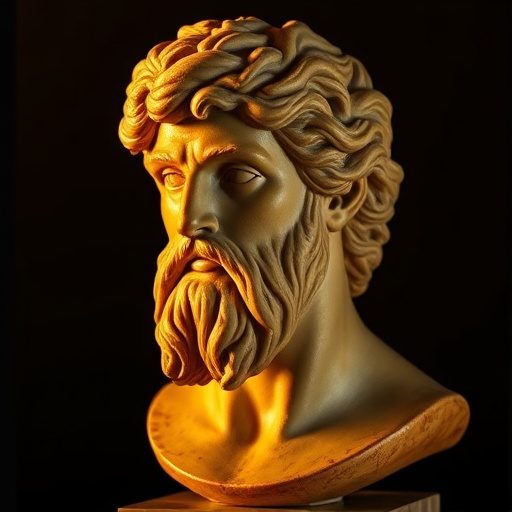
Pythagoras — "Number is the ruler of forms and ideas, and the cause of gods and daemons."
Number is the ruler of forms and ideas, and the cause of gods and daemons.
Number is the ruler of forms and ideas, and the cause of gods and daemons.
Click any product to generate a realistic preview. Up to 3 at a time.
* Initial load can take up to 90 seconds — revising the preview in another color is nearly instant.
"None can be free who is a slave to, and ruled by, his passions."
"Do not give sleep to your eyes nor slumber to your eyelids until you have balanced the account of your soul with what is right."
"A fool is known by his speech, and a wise man by silence."
"The Monad (Unity) is the principle of stability since it preserves the identity of any number that it interacts with."
"Five represents marriage because it is the sum of two and three (the Pythagoreans believed that even numbers were masculine and odd numbers were feminine)."
Greek philosopher and mathematician whose school in Croton combined geometry (the Pythagorean theorem), number-mysticism, and a religious-vegetarian way of life. Closely associated with Thales of Miletus (earlier pre-Socratic and the first philosopher). For an intellectual contrast, see Heraclitus, pre-Socratic Greek philosopher of flux — Heraclitus called Pythagoras 'the chief of swindlers' — among the founding insults of the philosophical-rivalry tradition. Their 'all is flux' vs 'all is number' poles still organize the philosophy of mathematics today (Platonist vs anti-realist).
A fundamental philosophical statement reflecting the Pythagorean belief that 'everything is number'.
Date: c. 570-495 BCE (attributed later)
Power & LeadershipFound in 2 providers: gemini,deepseek
2 sources checked
Numbers are the fundamental governing force behind all reality — shapes, concepts, and even divine or supernatural beings. Numerical relationships don't merely describe the world; they cause and control it. Every geometric form, every abstract idea, and every spiritual entity derives its existence from number. Pythagoras is making a radical claim: mathematics isn't a tool humans invented to measure things — it's the actual substance underlying everything that exists.
Pythagoras founded a semi-religious brotherhood in Croton devoted to number's cosmic significance. He discovered that musical harmony arises from simple integer ratios — the octave from 2:1, the fifth from 3:2 — which convinced him that number physically governs nature. His famous theorem linked geometry to arithmetic numerically. For Pythagoras, mathematics and theology were one discipline; numbers were sacred, living forces that structured both the physical cosmos and the realm of gods.
In 6th-century BCE Greece, the line between mathematics, philosophy, and religion had yet to be drawn. Philosophers like Thales and Anaximenes were debating which single substance — water, air, fire — constitutes reality. Pythagoras's answer, number, was audacious. Greek cosmology was densely populated with gods and daemons acting as intermediaries, so claiming number caused them was a theological revolution. Mystery religions were also flourishing, and Pythagoras's brotherhood functioned as one, blending ritual with mathematical initiation.
AI-generated insights based on extensive research and information for context. Factual errors? Email [email protected].
Your cart is empty