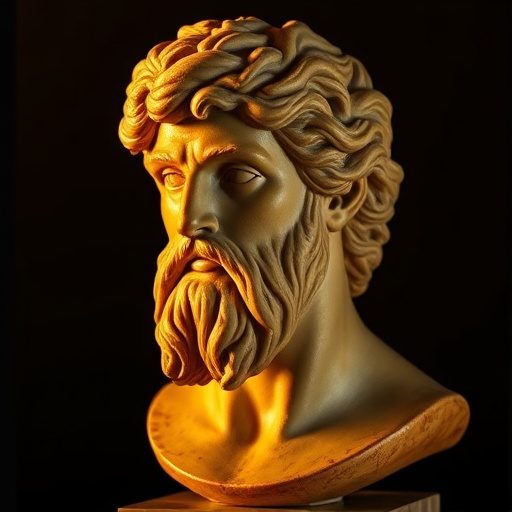
Pythagoras — "None can be free who is a slave to, and ruled by, his passions."
None can be free who is a slave to, and ruled by, his passions.
None can be free who is a slave to, and ruled by, his passions.
Click any product to generate a realistic preview. Up to 3 at a time.
* Initial load can take up to 90 seconds — revising the preview in another color is nearly instant.
"The soul of man is divided into three parts, intelligence, reason, and passion. Intelligence and passion are possessed by other animals, but reason by man alone."
"Avoid all things that will occasion envy."
"Do not speak a little on many subjects, but much on a few."
"The wise man should be prepared for everything that does not lie within his power."
"Five represents marriage because it is the sum of two and three (the Pythagoreans believed that even numbers were masculine and odd numbers were feminine)."
Greek philosopher and mathematician whose school in Croton combined geometry (the Pythagorean theorem), number-mysticism, and a religious-vegetarian way of life. Closely associated with Thales of Miletus (earlier pre-Socratic and the first philosopher). For an intellectual contrast, see Heraclitus, pre-Socratic Greek philosopher of flux — Heraclitus called Pythagoras 'the chief of swindlers' — among the founding insults of the philosophical-rivalry tradition. Their 'all is flux' vs 'all is number' poles still organize the philosophy of mathematics today (Platonist vs anti-realist).
A philosophical statement on self-control and freedom.
Date: c. 570-495 BCE (attributed later)
InspirationalFound in 1 providers: gemini
1 source checked
True freedom isn't just political or physical — it's internal. If your desires, anger, lust, or fear control your decisions, you aren't actually free regardless of your legal status. Self-mastery is the real measure of a free person. Someone who acts only from impulse is as constrained as any prisoner, just bound by invisible chains of appetite rather than iron ones.
Pythagoras founded a quasi-religious brotherhood in Croton that demanded strict discipline: vegetarianism, silence, mathematical study, and purification of the soul. He taught that the soul's highest purpose was rational order, mirroring the mathematical harmony he saw in the cosmos. For him, passions disrupted that harmony. His community practiced asceticism as philosophy made flesh — not abstract doctrine.
In 6th-century BCE Greece, city-states debated freedom intensely — slavery was ubiquitous, and only propertied male citizens held legal liberty. Yet Greek thinkers increasingly distinguished external freedom from internal virtue. Pythagorean philosophy emerged alongside Stoic precursors and Orphic mystery cults, all grappling with whether the soul could be sovereign. His framing redefines freedom as ethical self-governance, not civic status.
AI-generated insights based on extensive research and information for context. Factual errors? Email [email protected].
Your cart is empty