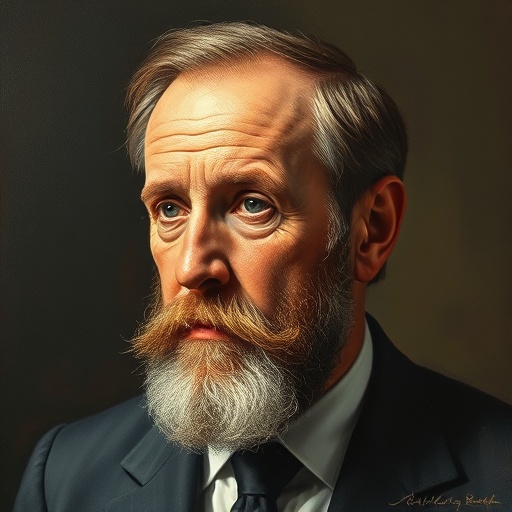
Niels Bohr — "We are all agreed that the only way of getting a correct impression of the world…"
We are all agreed that the only way of getting a correct impression of the world is to be a part of it.
We are all agreed that the only way of getting a correct impression of the world is to be a part of it.
Click any product to generate a realistic preview. Up to 3 at a time.
* Initial load can take up to 90 seconds — revising the preview in another color is nearly instant.
"We are not to think of atoms as things, but as connections."
"The purpose of science is not to answer ultimate questions, but to make progress in understanding."
"The aim of science is to purify our notions, not to increase the number of facts."
"When we measure something we are forcing an undetermined, undefined world to assume an experimental value. We are not measuring the world, we are creating it."
"We are suspended in language."
Found in 1 providers: grok
1 source checked
Understanding reality requires participation, not detached observation. You cannot truly know the world by standing outside it and watching; you have to engage, interact, and immerse yourself. Genuine comprehension emerges from being embedded in what you study, because the observer and the observed are connected. Pure objectivity from a distance gives a distorted view. Real insight comes from involvement, experience, and acknowledging that you are part of the system you are trying to understand.
Bohr revolutionized physics by showing that atomic observers cannot be separated from what they measure, a principle called complementarity. His quantum theory destroyed the classical idea of a neutral, detached scientist. He also lived this philosophy personally, mentoring physicists at his Copenhagen institute, engaging world leaders about nuclear weapons, and helping Jewish scientists escape Nazi occupation. For Bohr, participation, dialogue, and human involvement were inseparable from doing real physics and confronting reality honestly.
Bohr worked during the quantum revolution of the 1920s and 1930s, when physics shattered Newton's tidy, observer-independent universe. His Copenhagen interpretation clashed publicly with Einstein, who wanted reality to exist independently of measurement. World War II then forced scientists out of ivory towers into Manhattan Project labs and diplomatic rooms. Bohr advocated openness with the Soviets on atomic weapons, insisting that scientists had to participate in political reality, not retreat from it, mirroring his quantum philosophy.
AI-generated insights based on extensive research and information for context. Factual errors? Email [email protected].
Your cart is empty