What it means
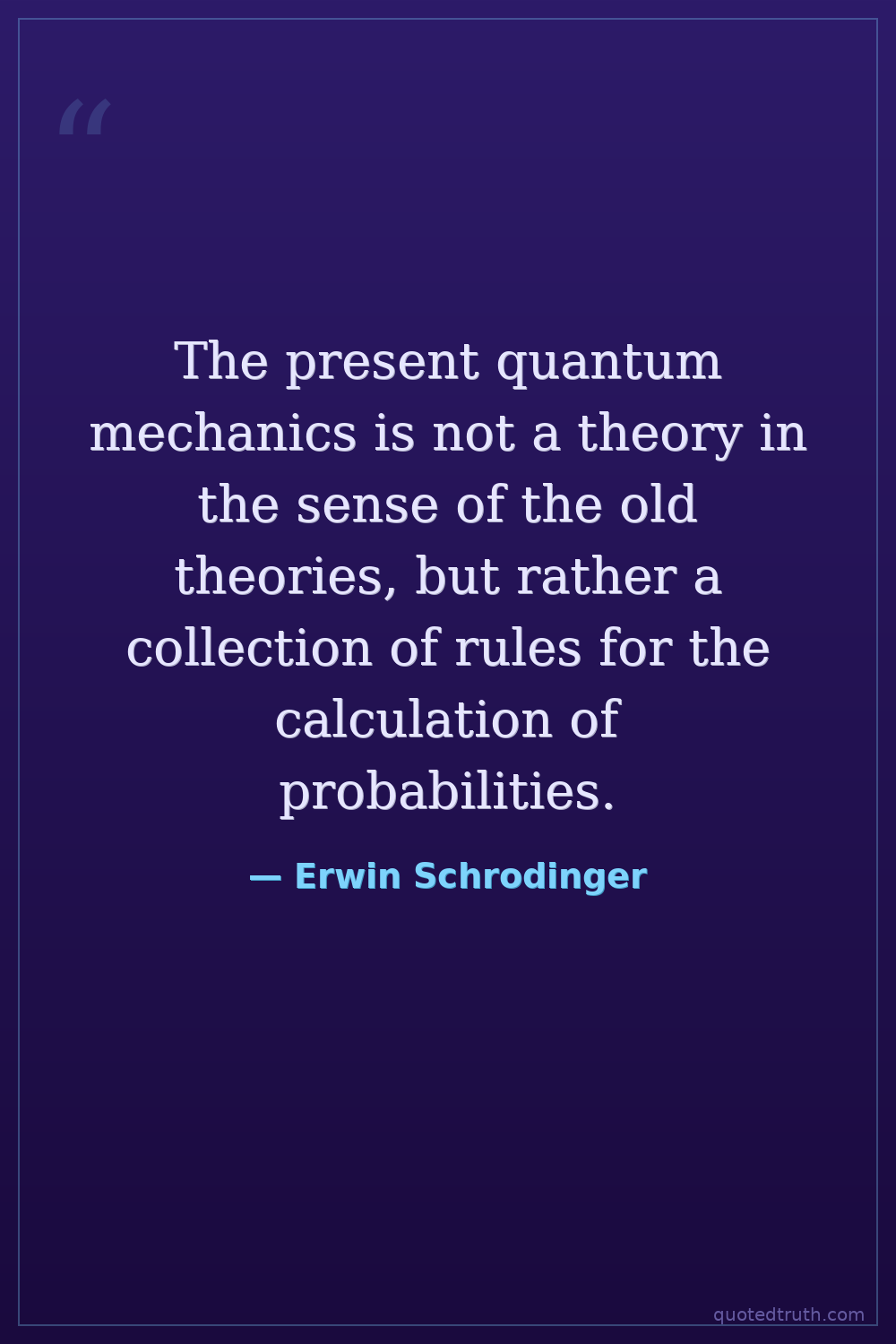
Quantum mechanics doesn't explain reality the way classical physics does — it doesn't tell you why or how things happen, only how likely they are to happen a certain way. Traditional theories gave causal mechanisms; quantum mechanics gives probabilities. Schrödinger is flagging that despite its predictive power, quantum mechanics lacks the explanatory depth of a real theory — it's a powerful calculating tool, not a complete picture of physical reality.
Relevance to Erwin Schrodinger
Schrödinger invented wave mechanics in 1926 hoping to give quantum theory a more intuitive, continuous physical picture — he hated pure probabilism. His famous Schrödinger's cat paradox was a direct protest against Copenhagen's probabilistic interpretation. He collaborated with Einstein, who shared his unease. This quote captures his lifelong dissatisfaction: he believed quantum mechanics was incomplete, a placeholder until physics found a deeper, truly explanatory theory of nature.
The era
In the 1920s–30s, physics was being revolutionized by quantum theory, which abandoned the determinism of Newton and even Einstein. The Copenhagen interpretation — championed by Bohr and Heisenberg — declared probability fundamental to nature, not merely a reflection of ignorance. Einstein's 'God does not play dice' captured widespread unease. Schrödinger's statement echoes that era's profound discomfort: brilliant physicists were simultaneously building and doubting a framework that worked without anyone fully understanding what it meant.
AI-generated insights based on extensive research and information for context. Factual errors? Email [email protected].