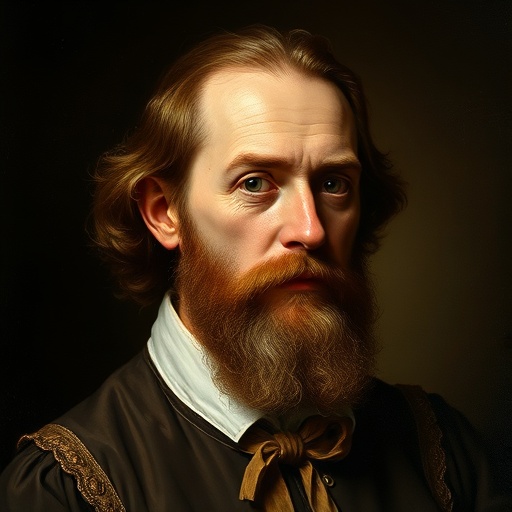
William Harvey — "The blood in the animal body is impelled in a circle, and is in a state of cease…"
The blood in the animal body is impelled in a circle, and is in a state of ceaseless motion.
The blood in the animal body is impelled in a circle, and is in a state of ceaseless motion.
Click any product to generate a realistic preview. Up to 3 at a time.
* Initial load can take up to 90 seconds — revising the preview in another color is nearly instant.
"The greatest pleasure is to discover something new."
"Nature is the best teacher."
"The egg is the common origin of all animals."
"All we know is still infinitely less than all that still remains unknown."
"The motion of the blood is constant and circular."
English physician whose On the Motion of the Heart and Blood in Animals (1628) demonstrated blood circulation, overturning 1,400 years of Galenic medicine. Closely associated with Francis Bacon (his contemporary in the new English empiricism). For an intellectual contrast, see Galenic medicine, the 2nd-century Greek medical tradition (humors, blood-as-consumed-fuel) — Harvey calculated that the heart pumps more blood per hour than the body could possibly produce as fuel — a single quantitative observation that demolished the entire Galenic-Aristotelian medical worldview. The cleanest example in medical history of arithmetic disproving 14 centuries of authority.
Found in 1 providers: deepseek
1 source checked
The blood inside a living body never stops moving — it flows continuously in a loop, pumping outward and returning in an endless cycle rather than being produced and consumed as previously thought. This describes circulation as a permanent, self-sustaining mechanical process driven by the heart, fundamentally redefining how life itself is sustained at a biological level.
Harvey spent decades meticulously dissecting animals and calculating blood volume to prove the heart's pumping action drives continuous circulation. Published in De Motu Cordis in 1628, this was his central discovery — overturning Galenic medicine he had trained under. He risked his medical reputation defending it against fierce establishment opposition, embodying his commitment to observation over inherited authority.
In the early 17th century, Galenic theory — that the liver continuously generated new blood consumed by the body — had dominated medicine for 1,400 years. Harvey worked during the Scientific Revolution when Galileo and Bacon were championing empirical observation over ancient texts. Anatomical dissection was newly permitted, and Harvey's quantitative approach — measuring blood volume to prove continuous recirculation — exemplified the era's radical methodological shift.
AI-generated insights based on extensive research and information for context. Factual errors? Email [email protected].
Your cart is empty