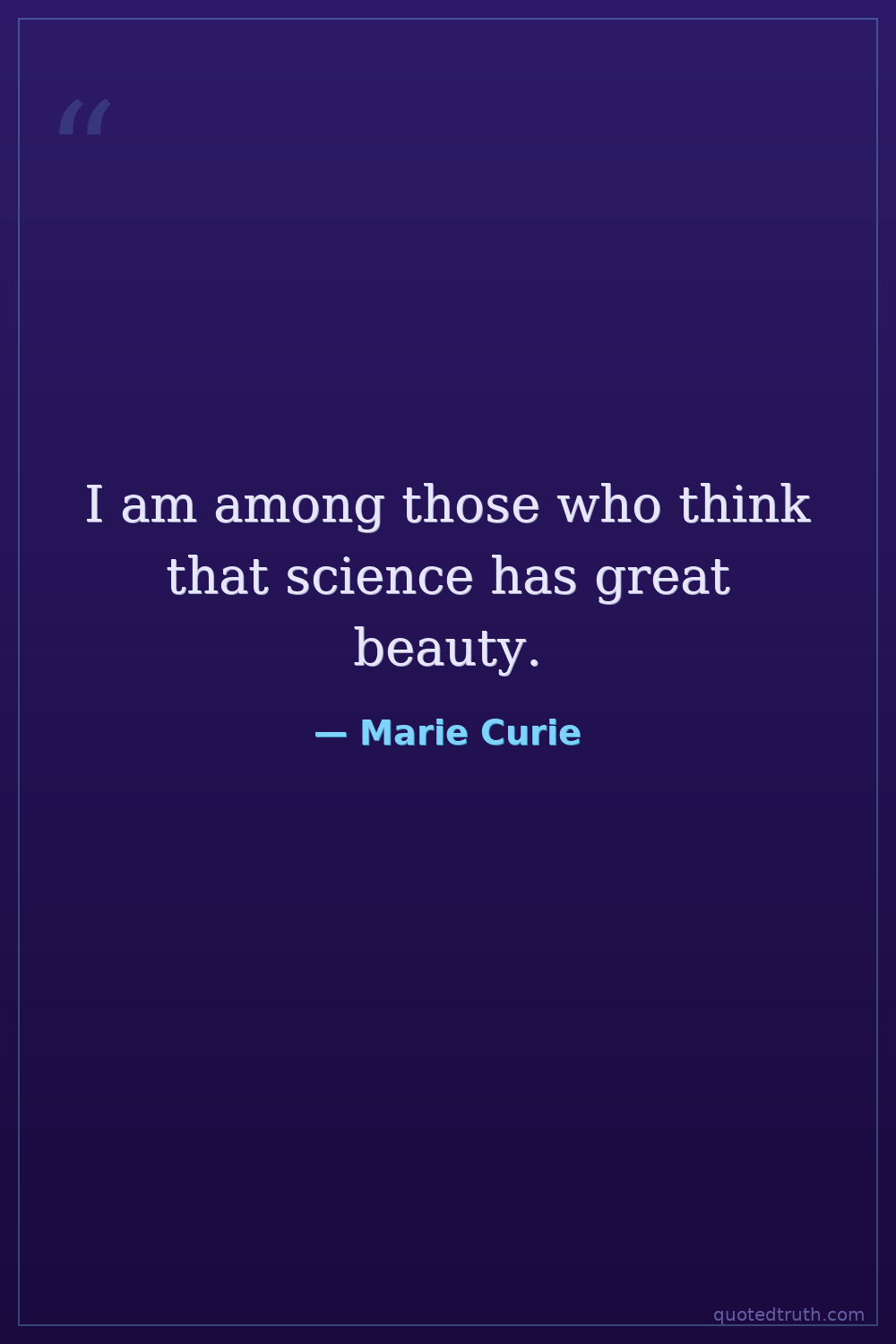
Marie Curie — "I am among those who think that science has great beauty."
I am among those who think that science has great beauty.
I am among those who think that science has great beauty.
Click any product to generate a realistic preview. Up to 3 at a time.
* Initial load can take up to 90 seconds — revising the preview in another color is nearly instant.
"There are cruel, ignorant people who have tried to make my work appear bad. But it is not bad. It is good. It is for the good of humanity."
"I have frequently been questioned, especially by women, of how I could reconcile family life with a scientific career. Well, it has not been easy."
"I am not afraid of anything. I am only afraid of not being able to do my work."
"I am not afraid of anything. I am only afraid of not being able to do my work. I am only afraid of not being able to discover new things. I am only afraid of not being able to contribute to the progre…"
"My husband and I were so closely united by our affection and our common work that we passed almost our whole time together."
Found in 2 providers: deepseek,grok
2 sources checked
The speaker declares an aesthetic appreciation for scientific work, placing themselves within a community who find beauty not only in art or nature but in the pursuit of understanding the physical world. Science, in this view, is not cold calculation or dry fact-gathering but a creative, awe-inspiring endeavor. Its elegance lies in discovering hidden patterns, revealing truth, and experiencing wonder at how the universe works.
Curie devoted her life to painstaking laboratory work, isolating radium and polonium through years of grueling physical labor processing tons of pitchblende. Despite the tedium and eventual harm to her health from radiation, she consistently spoke of research as a source of joy and wonder. As the first woman to win a Nobel and the only person to win in two sciences, she embodied someone who saw profound beauty where others saw only difficult, dangerous drudgery.
Curie worked during the late 19th and early 20th centuries, when science was rapidly reshaping worldviews through discoveries in physics, chemistry, and medicine. Women were largely excluded from serious research, and utilitarian justifications dominated funding arguments. Her insistence on science's aesthetic value pushed back against purely industrial or militaristic framings, aligning with a Romantic-era tradition that saw natural philosophy as a noble, almost spiritual pursuit worthy of lifelong devotion.
AI-generated insights based on extensive research and information for context. Factual errors? Email [email protected].
Your cart is empty