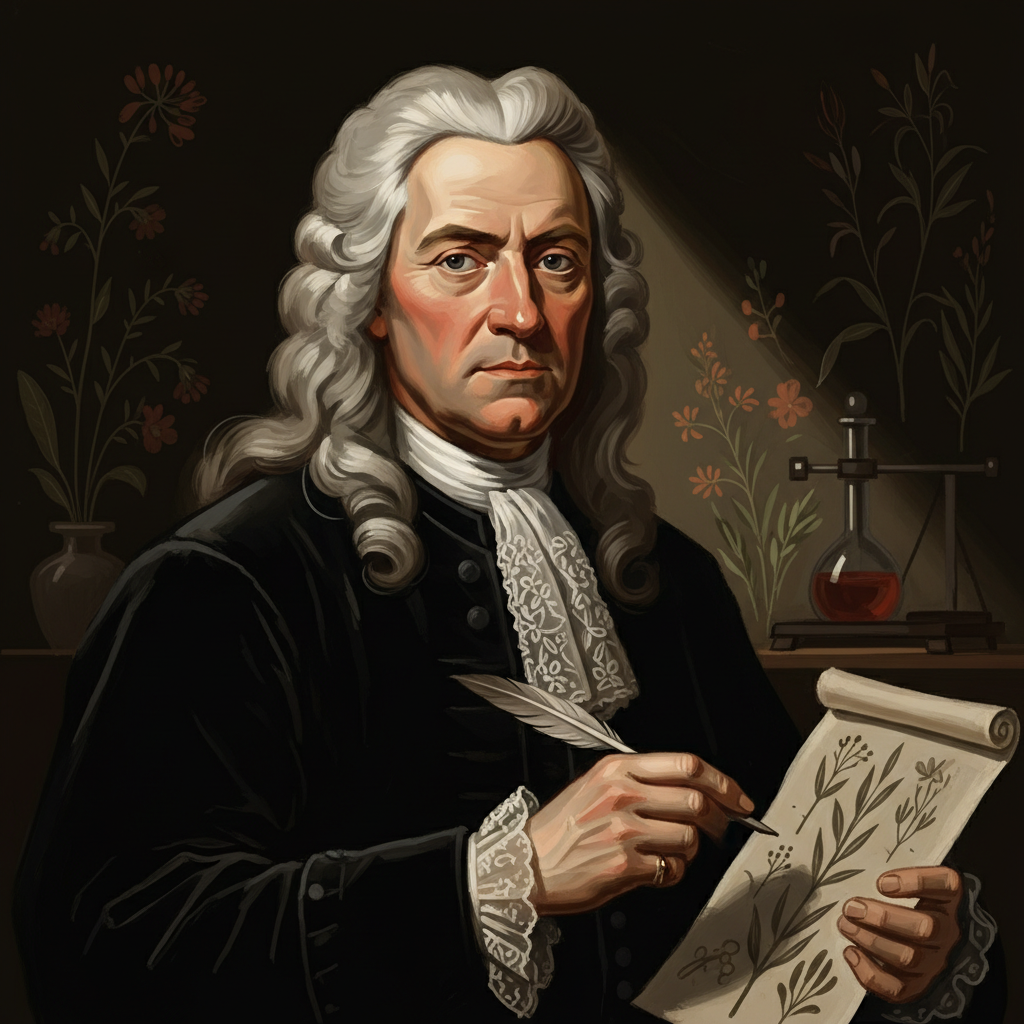
Carl Linnaeus — "I have seen the face of God."
I have seen the face of God.
I have seen the face of God.
Click any product to generate a realistic preview. Up to 3 at a time.
* Initial load can take up to 90 seconds — revising the preview in another color is nearly instant.
"The species are as numerous as the different forms which the Infinite Being produced in the beginning."
"The first step in wisdom is to know the things themselves; this notion consists in having a true idea of the objects; objects are distinguished and known by classifying them methodically and giving th…"
"Whoever wishes to be a good botanist must be a good observer."
"Nature's economy shall be the base for our own, for it is immutable, but ours is secondary. An economist without knowledge of nature is therefore like a physicist without knowledge of mathematics."
"The world is full of wonders, but man is the greatest wonder of all."
Swedish botanist and the father of modern taxonomy whose Systema Naturae (1735) introduced binomial nomenclature for naming all species. Closely associated with Joseph Banks (British naturalist who carried Linnaean classification on Cook's voyages). For an intellectual contrast, see Comte de Buffon, French naturalist and Histoire Naturelle author (1749-1788) — Buffon explicitly attacked Linnaean fixed-categories taxonomy as artificial and rejected the binomial system; his gradualist, environment-shaped natural history was the explicit alternative. Anticipates the fixed-species-vs-evolution debate Darwin would later resolve.
Attributed upon seeing a gorse bush in bloom for the first time in England.
Date: c. 1736
BiblicalFound in 1 providers: gemini
1 source checked
The speaker claims a direct, overwhelming encounter with the divine, so profound it feels like looking at God himself. It is not a literal sighting but a metaphor for witnessing something so beautiful, ordered, or awe-inspiring that it feels like proof of a creator. The phrase conveys reverence, humility, and a sense that reality contains hidden grandeur which, once glimpsed, permanently changes how a person understands existence.
Linnaeus was a devout Lutheran who viewed cataloging species as reading God's handiwork, famously saying 'God created, Linnaeus organized.' He reportedly uttered this line upon first seeing gorse in bloom in England, overwhelmed by its yellow brilliance. For him, the intricate order of plants and animals was literal evidence of divine design, and his taxonomic system was an act of worship, mapping creation's structure rather than merely naming it.
In early-modern 18th-century Europe, natural theology dominated science: studying nature was studying God's blueprint. The Enlightenment had not yet severed empirical inquiry from religious wonder, so naturalists like Linnaeus operated in a world where classifying beetles and glorifying the Creator were the same act. Global exploration was flooding Europe with new species, and scholars believed a complete catalog would reveal divine order, making botanical awe a spiritually charged and culturally respected response.
AI-generated insights based on extensive research and information for context. Factual errors? Email [email protected].
Your cart is empty