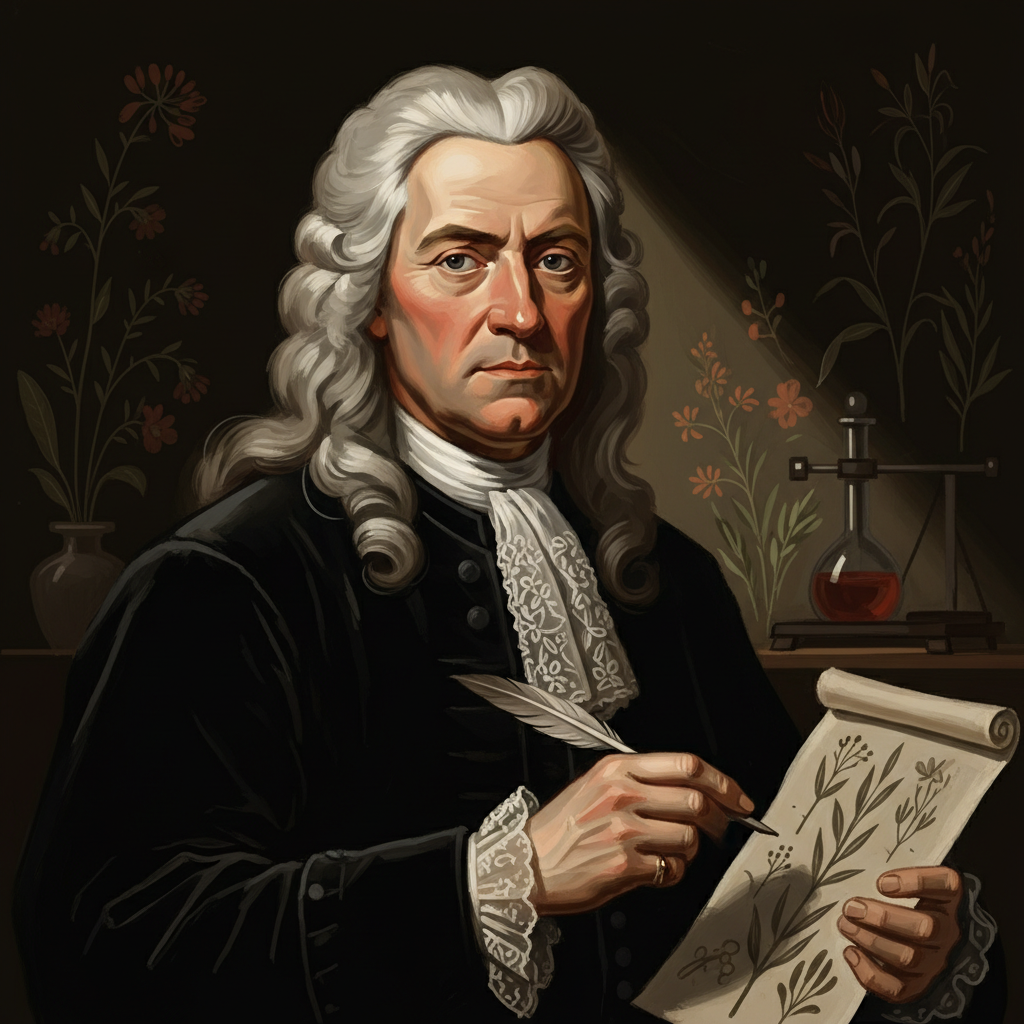
Carl Linnaeus — "There are no species in nature, only individuals."
There are no species in nature, only individuals.
There are no species in nature, only individuals.
Click any product to generate a realistic preview. Up to 3 at a time.
* Initial load can take up to 90 seconds — revising the preview in another color is nearly instant.
"Natura non facit saltus. (Nature makes no leaps.)"
"The greatest joy is to be useful to one's fellow men."
"In natural science the principles of truth ought to be confirmed by observation."
"The whole world is a collection of wonders."
"The stone grows, the plant grows and lives, the animal grows, lives and feels."
Swedish botanist and the father of modern taxonomy whose Systema Naturae (1735) introduced binomial nomenclature for naming all species. Closely associated with Joseph Banks (British naturalist who carried Linnaean classification on Cook's voyages). For an intellectual contrast, see Comte de Buffon, French naturalist and Histoire Naturelle author (1749-1788) — Buffon explicitly attacked Linnaean fixed-categories taxonomy as artificial and rejected the binomial system; his gradualist, environment-shaped natural history was the explicit alternative. Anticipates the fixed-species-vs-evolution debate Darwin would later resolve.
A surprising statement from the 'father of taxonomy', reflecting a deeper philosophical understanding of natural variation, often attributed to him or his students.
Date: c. 1770s
Nature & WorldFound in 1 providers: gemini
1 source checked
This statement rejects the idea that species are fixed, real categories existing in nature. Instead, only individual organisms truly exist, each slightly different from the next. Species labels are mental tools humans invent to organize the endless variation we observe, not actual divisions written into the natural world. What we call a species is a convenient grouping, while reality consists of unique living things that resist tidy boxes.
Coming from Linnaeus, the father of binomial nomenclature who classified thousands of plants and animals, this admission is striking. Despite building the hierarchical system biologists still use, he privately recognized its artificiality. His daily work cataloging specimens showed him endless variation between supposedly identical organisms, forcing a tension between the tidy Latin names he assigned and the messy uniqueness he actually encountered in herbarium sheets and gardens.
In the early modern 1700s, natural philosophy was shifting from medieval scholasticism toward systematic observation. Enlightenment thinkers hungered to catalog creation, and fixed species reflected theological belief that God created each kind separately. Linnaeus worked a century before Darwin, when questioning species boundaries flirted with heresy. Global exploration was flooding Europe with unfamiliar specimens, straining existing categories and forcing naturalists to confront how arbitrary their dividing lines between living things really were.
AI-generated insights based on extensive research and information for context. Factual errors? Email [email protected].
Your cart is empty