Carl Linnaeus — "Natura non facit saltus. (Nature makes no leaps.)"
Natura non facit saltus. (Nature makes no leaps.)
Natura non facit saltus. (Nature makes no leaps.)
Click any product to generate a realistic preview. Up to 3 at a time.
* Initial load can take up to 90 seconds — revising the preview in another color is nearly instant.
"The highest good is to know God and His works."
"I have created order out of chaos."
"Nature does not make leaps."
"The greatest happiness is to be able to contemplate nature."
"I demand of you, and of the whole world, that you show me a generic character... by which to distinguish between Man and Ape. I myself most assuredly know of none. But perhaps I should still do it acc…"
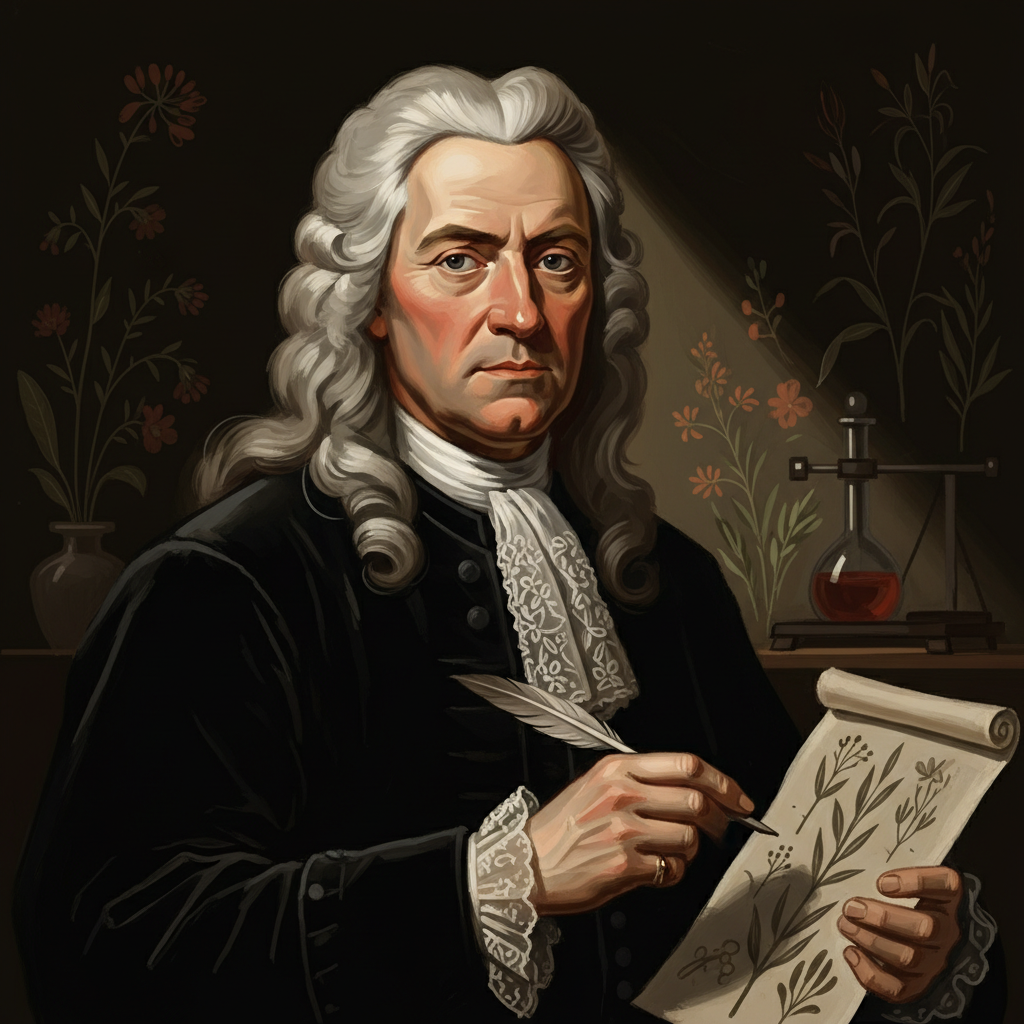
Swedish botanist and the father of modern taxonomy whose Systema Naturae (1735) introduced binomial nomenclature for naming all species. Closely associated with Joseph Banks (British naturalist who carried Linnaean classification on Cook's voyages). For an intellectual contrast, see Comte de Buffon, French naturalist and Histoire Naturelle author (1749-1788) — Buffon explicitly attacked Linnaean fixed-categories taxonomy as artificial and rejected the binomial system; his gradualist, environment-shaped natural history was the explicit alternative. Anticipates the fixed-species-vs-evolution debate Darwin would later resolve.
A principle he adhered to, suggesting gradual change and continuity in nature, though later challenged by evolutionary theory.
Date: c. 1750s
ShockingFound in 1 providers: grok
1 source checked
Nature makes no leaps asserts that change in the natural world is always gradual, never sudden. No gap exists between species or natural states — everything flows continuously into the next. There are no abrupt jumps between forms, conditions, or categories. Nature transitions smoothly, step by tiny step. This is a claim about continuity: the world's complexity unfolds through incremental progression, not discontinuous breaks or instantaneous transformations.
Linnaeus built the foundational system for classifying all life — the binomial nomenclature still used today. Cataloguing thousands of plants and animals, he observed smooth gradations between species and forms. This principle underpinned his taxonomic worldview: organisms aren't randomly distributed but arranged in orderly, continuous hierarchies. His meticulous fieldwork across Lapland and Europe reinforced his conviction that creation followed rational, unbroken patterns — making him both naturalist and living embodiment of this maxim.
In Linnaeus's 18th-century Europe, the Great Chain of Being — a theological and philosophical framework — held that all creation existed in an unbroken hierarchy from minerals to God. Enlightenment thinkers prized rational order in nature. Leibniz had stated the same principle philosophically decades earlier. Before Darwin overturned fixed species, naturalists saw continuous gradation as evidence of divine design. This saying captured the era's confidence that nature operated through reason, not chaos or arbitrary discontinuity.
AI-generated insights based on extensive research and information for context. Factual errors? Email [email protected].
Your cart is empty