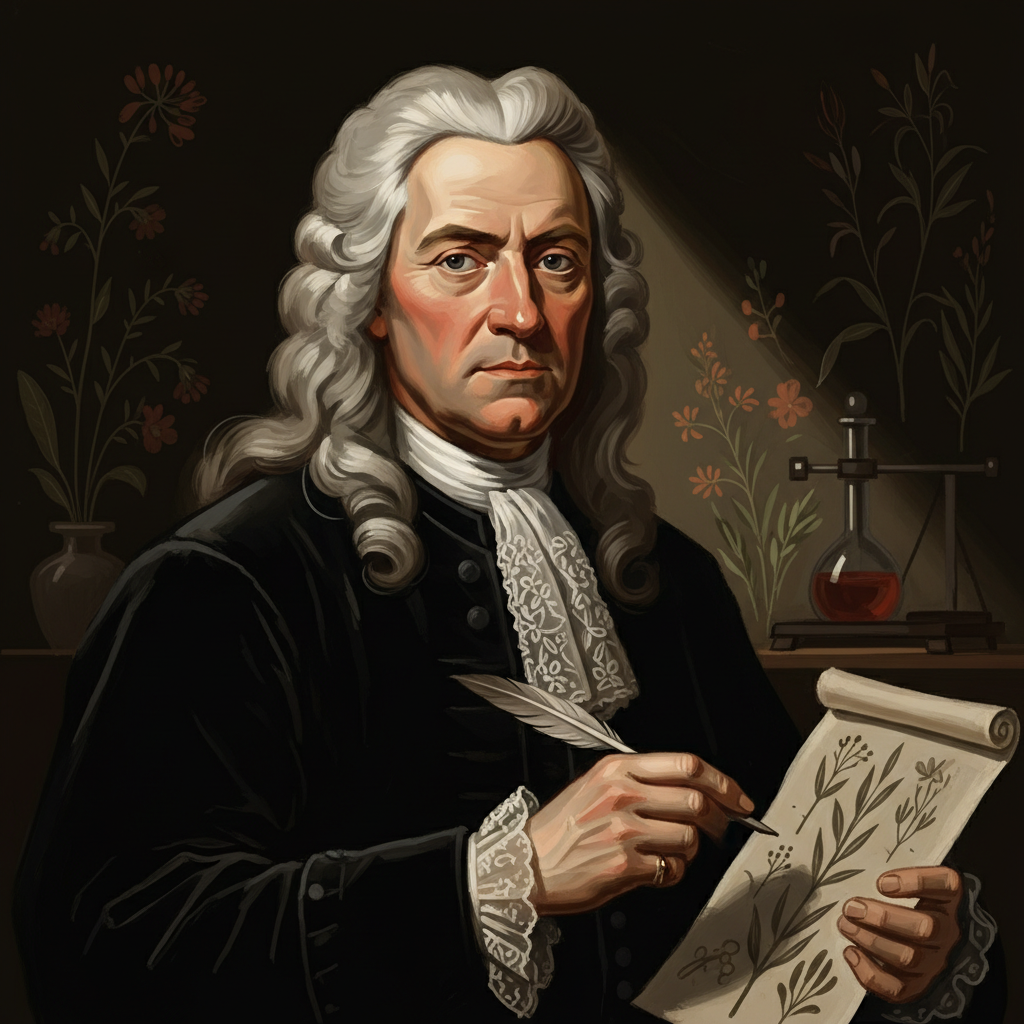
Carl Linnaeus — "If you do not know the names of things, the knowledge of them is lost, too."
If you do not know the names of things, the knowledge of them is lost, too.
If you do not know the names of things, the knowledge of them is lost, too.
Click any product to generate a realistic preview. Up to 3 at a time.
* Initial load can take up to 90 seconds — revising the preview in another color is nearly instant.
"I have seen no one who has been able to distinguish the species of plants better than I have."
"The African is lazy, crafty, negligent, and governed by caprice."
"A professor can never better distinguish himself in his work than by encouraging a clever pupil, for the true discoverers are among them, as comets amongst the stars."
"The earth is the theatre of God's glory."
"The flower's leaves...serve as bridal beds which the Creator has so gloriously prepared, adorned with such noble bed curtains, and perfumed with so many sweet scents to induce the young bridegroom to …"
Swedish botanist and the father of modern taxonomy whose Systema Naturae (1735) introduced binomial nomenclature for naming all species. Closely associated with Joseph Banks (British naturalist who carried Linnaean classification on Cook's voyages). For an intellectual contrast, see Comte de Buffon, French naturalist and Histoire Naturelle author (1749-1788) — Buffon explicitly attacked Linnaean fixed-categories taxonomy as artificial and rejected the binomial system; his gradualist, environment-shaped natural history was the explicit alternative. Anticipates the fixed-species-vs-evolution debate Darwin would later resolve.
Emphasizing the importance of nomenclature for scientific understanding.
Date: c. 1730s
EducationalFound in 1 providers: gemini
1 source checked
Names are the prerequisites for organized thought. Without consistent, shared labels, knowledge cannot be transmitted, compared, or built upon. A discovery without a name cannot be referenced, taught, or linked to related findings. This argues that naming is not superficial labeling but the fundamental act that converts raw observation into transmissible knowledge. Lose the name, and the thing effectively vanishes from collective understanding, even if it physically exists.
Linnaeus spent his life proving this principle. His binomial nomenclature system—genus plus species in Latin—gave every organism a universal, stable name regardless of local language. Before his Systema Naturae (1735) and Species Plantarum (1753), the same plant carried dozens of contradictory regional names across Europe, making scientific exchange nearly impossible. He believed that without a shared naming framework, natural history could never advance beyond fragmented local folklore.
The 18th century was the height of European natural history exploration. Ships returning from the Americas, Africa, and Asia brought thousands of undescribed species. European naturalists were overwhelmed—each nation, often each researcher, coined different names for identical organisms. Without coordination, knowledge duplicated and contradicted itself. Linnaeus's hierarchical classification and binomial naming solved a crisis of scientific communication, arriving precisely when global biology desperately needed universal standards.
AI-generated insights based on extensive research and information for context. Factual errors? Email [email protected].
Your cart is empty