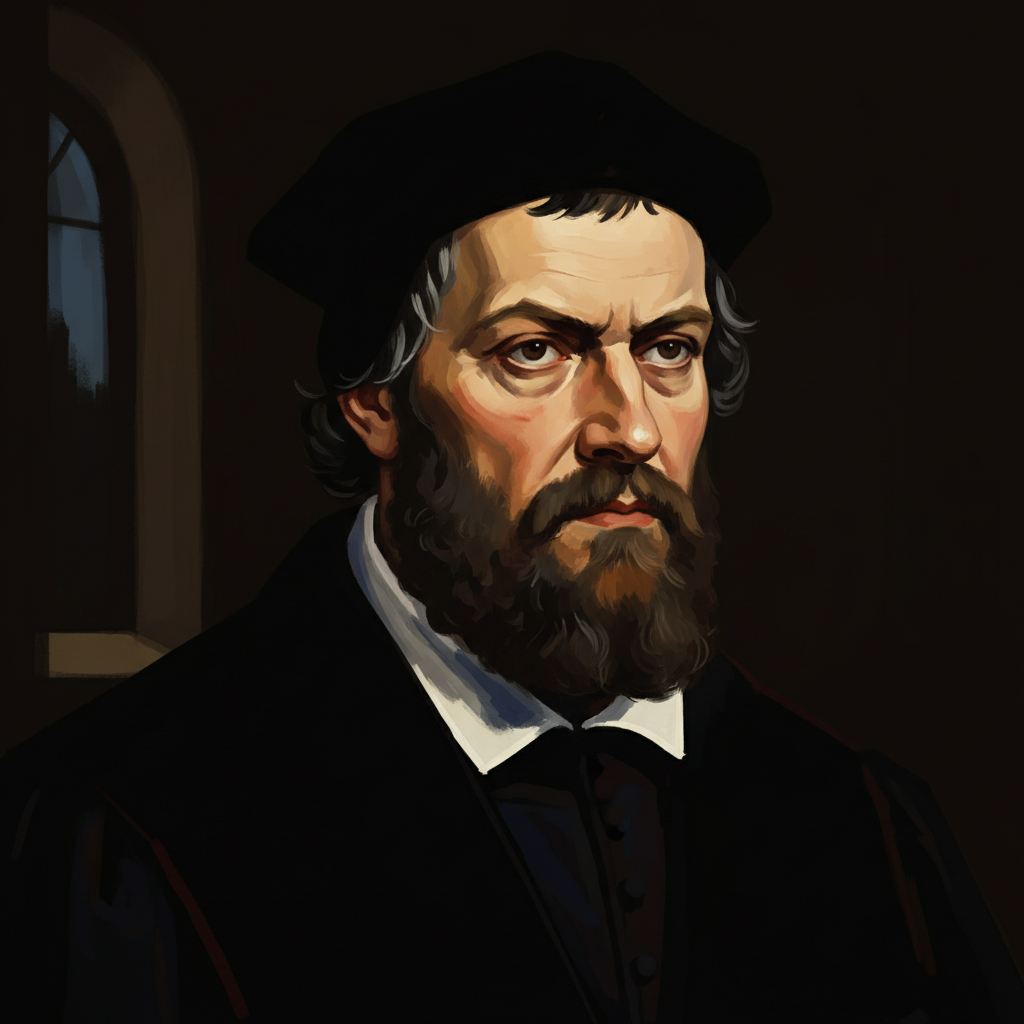
Martin Luther — "Here I stand; I can do no other. God help me. Amen."
Here I stand; I can do no other. God help me. Amen.
Here I stand; I can do no other. God help me. Amen.
Click any product to generate a realistic preview. Up to 3 at a time.
* Initial load can take up to 90 seconds — revising the preview in another color is nearly instant.
"I am a peasant, a son of a peasant; my father, grandfather, all my ancestors were genuine peasants."
"You are the worst rascal of all the rascals on earth!"
"When I am assailed by temptation, I find it good to eat, drink, and be merry, so that I may not be alone with the devil."
"I am like a ripe nut; I am ready to fall."
"If the earth is fit for laughter, then surely heaven is filled with it. Heaven is the birthplace of laughter."
German theologian whose 95 Theses (1517) launched the Protestant Reformation and broke the Catholic Church's monopoly on Western Christianity. Closely associated with Philipp Melanchthon (Lutheran systematizer) and John Calvin (later Reformer who built on Luther's break). For an intellectual contrast, see Pope Leo X, Renaissance pope (1513-1521) — Leo X's indulgence sales triggered Luther's break and Leo excommunicated him in 1521 — Luther's entire Reformation is structured as a direct answer to the indulgence-funded Vatican Leo represented.
Found in 2 providers: gemini,grok
2 sources checked
A declaration of unshakable conscience: the speaker has reached a position through careful thought and genuine conviction, and cannot abandon it even under pressure, threat, or demand to recant. Changing his mind is not a choice he can make; his beliefs bind him. He acknowledges he needs divine help to hold firm, accepting whatever consequences follow. It is the language of someone refusing to betray what he believes is true.
Luther reportedly spoke these words at the 1521 Diet of Worms, refusing to recant his writings before Emperor Charles V and Church officials. As a monk and theology professor who had nailed his 95 Theses in 1517, he had built his case from scripture and conscience. Facing excommunication and likely execution, he chose conviction over safety, embodying the Reformation principle that individual conscience bound by scripture outranks papal authority.
Early modern Europe was convulsing as the printing press spread dissenting ideas faster than Rome could suppress them. The Catholic Church's sale of indulgences, political entanglement with the Holy Roman Empire, and monopoly on salvation faced growing criticism. Heresy was a capital offense, and defying both pope and emperor usually meant burning. Luther's stand at Worms cracked that order open, fueling decades of religious war, national churches, and a new culture of individual biblical interpretation.
AI-generated insights based on extensive research and information for context. Factual errors? Email [email protected].
Your cart is empty