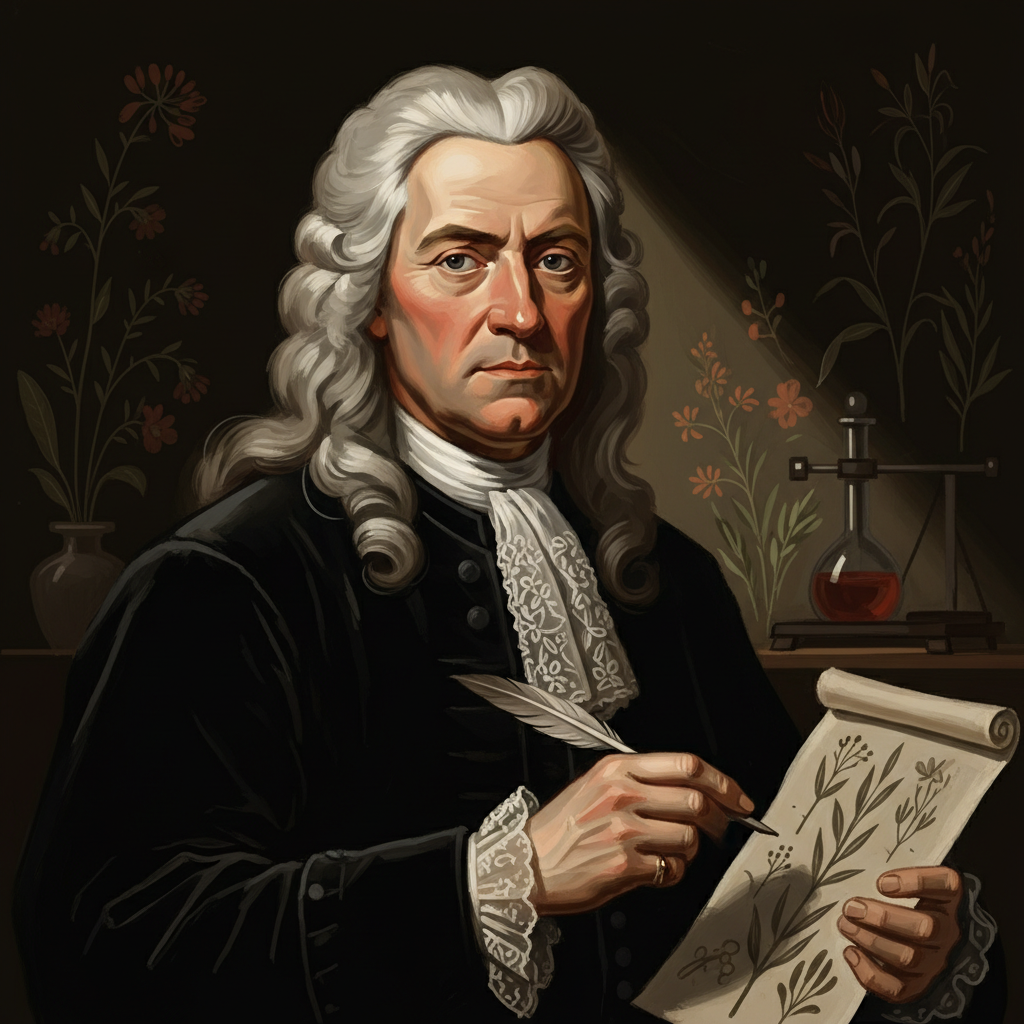
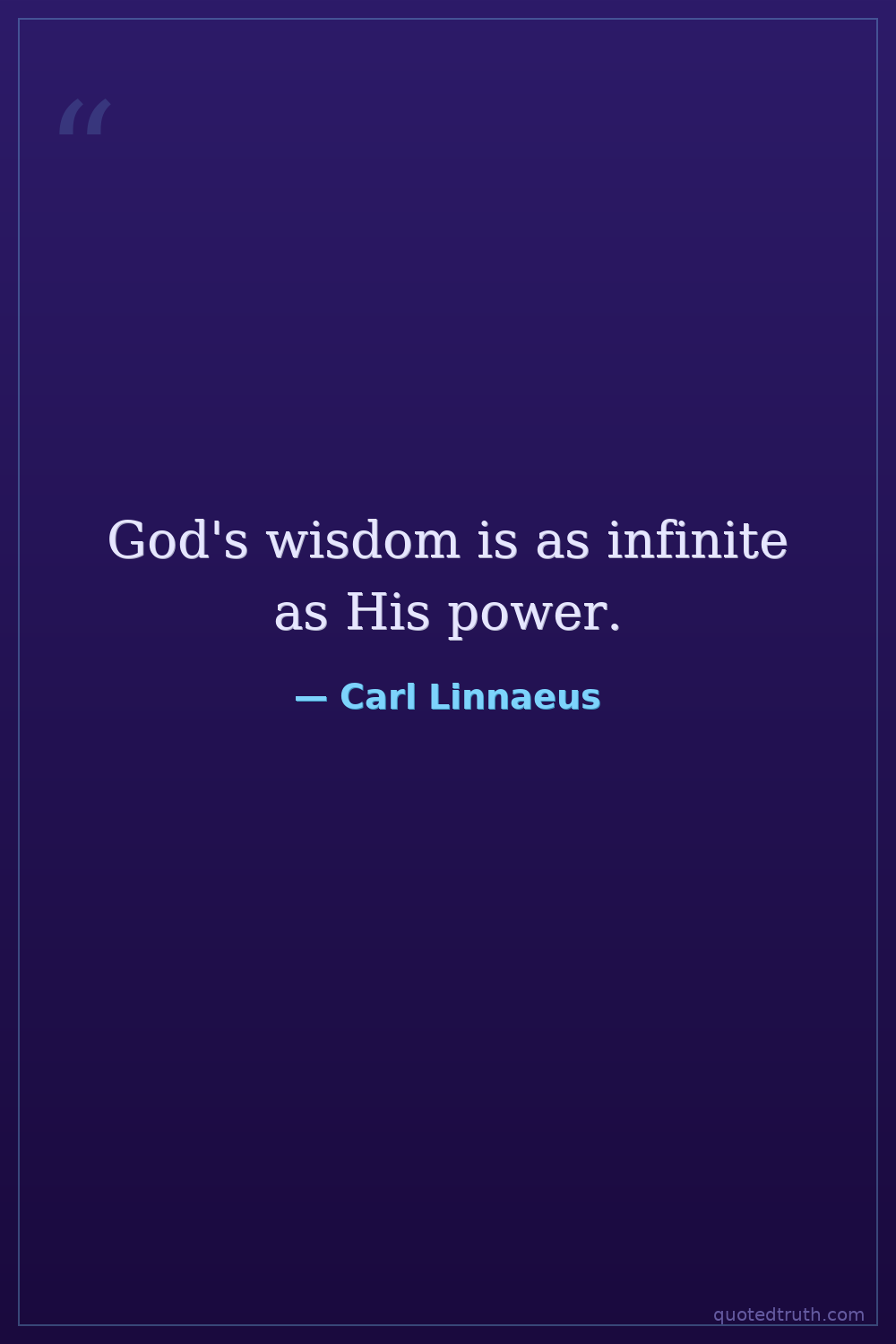
Carl Linnaeus — "God's wisdom is as infinite as His power."
God's wisdom is as infinite as His power.
God's wisdom is as infinite as His power.
Click any product to generate a realistic preview. Up to 3 at a time.
* Initial load can take up to 90 seconds — revising the preview in another color is nearly instant.
"The system of nature is a great chain of being."
"There are no species in nature, only individuals."
"The Asiatic is haughty, greedy, and governed by opinions."
"Every country has its own plants, and every plant has its own country."
"The stinking corpse flower smells like a rotting corpse to attract carrion beetles and flesh flies, which are its pollinators. Nature is both beautiful and repulsive."
Swedish botanist and the father of modern taxonomy whose Systema Naturae (1735) introduced binomial nomenclature for naming all species. Closely associated with Joseph Banks (British naturalist who carried Linnaean classification on Cook's voyages). For an intellectual contrast, see Comte de Buffon, French naturalist and Histoire Naturelle author (1749-1788) — Buffon explicitly attacked Linnaean fixed-categories taxonomy as artificial and rejected the binomial system; his gradualist, environment-shaped natural history was the explicit alternative. Anticipates the fixed-species-vs-evolution debate Darwin would later resolve.
Found in 1 providers: gemini
1 source checked
God's wisdom and power are equal and both without limit — neither outstrips the other. The universe isn't governed by brute force alone but by an intelligence as vast as its creative might. Behind every natural structure lies a reasoning mind, not accident. The world makes sense because a wisdom as boundless as its power designed it, making understanding nature an act of discovery rather than mere wonder.
Linnaeus (1707–1778) was a devout Lutheran who saw biological classification as reading God's blueprint for creation. He wrote 'Deus creavit, Linnaeus disposuit' — God created, Linnaeus organized — framing taxonomy as reverent discovery, not human invention. His Systema Naturae catalogued thousands of species as expressions of divine order. For him, the intricate logic of nature proved a wisdom behind creation as vast and purposeful as the power that made it.
Linnaeus worked during the 18th-century Enlightenment, when natural philosophy and Christian theology were not yet opposing forces. Natural theology — the idea that studying creation reveals God's attributes — was mainstream. Newton had shown nature obeys rational laws, reinforcing belief in a reasoning Creator. Scientists were often clergymen or devout believers. The era simultaneously expanded empirical knowledge and reaffirmed divine order, making Linnaeus's fusion of faith and science entirely representative of his time.
AI-generated insights based on extensive research and information for context. Factual errors? Email [email protected].
Your cart is empty