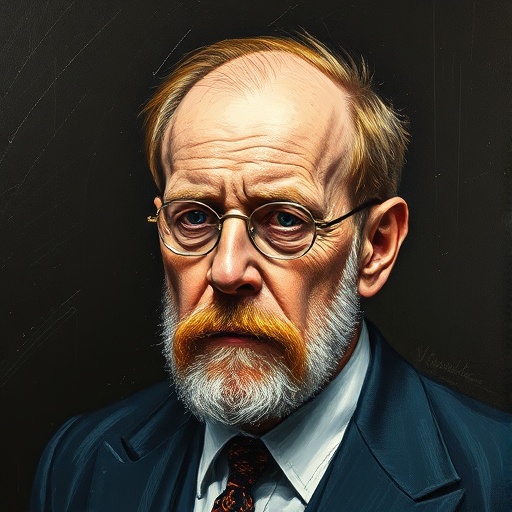
Werner Heisenberg — "The first gulp from the glass of natural sciences will turn you into an atheist,…"
The first gulp from the glass of natural sciences will turn you into an atheist, but at the bottom of the glass God is waiting for you.
The first gulp from the glass of natural sciences will turn you into an atheist, but at the bottom of the glass God is waiting for you.
Click any product to generate a realistic preview. Up to 3 at a time.
* Initial load can take up to 90 seconds — revising the preview in another color is nearly instant.
"The meaning of 'understanding' has changed in the course of the development of physics."
"The decision for a definite result is taken only when the measurement is made."
"The path to the nucleus is easy to find, but the nucleus itself is hard to reach."
"The idea of an objective real world whose smallest parts exist objectively in the same sense as stones or trees exist, independently of whether or not we observe them... is impossible."
"Modern physics has, in a certain sense, revived Plato's philosophy of forms in the atomic world."
Found in 3 providers: grok,deepseek,gemini
3 sources checked
Shallow engagement with science tends to make people reject religion, since early discoveries seem to replace divine explanations with natural laws. But deep, sustained study eventually reveals order, mystery, and limits to knowledge that point beyond physical mechanisms. The more you learn, the more you encounter questions science cannot answer, leading many thinkers back to belief in something greater than matter itself.
Heisenberg founded quantum mechanics and formulated the uncertainty principle, discovering that reality at the subatomic level defies strict determinism. His deep work exposed him to the strange, observer-dependent nature of existence, which pushed him toward philosophical and spiritual reflection. Raised Lutheran, he remained openly religious throughout his career, writing that physics ultimately raises questions it cannot solve, leaving room for faith alongside rigorous scientific inquiry.
Heisenberg worked during the early-to-mid 20th century, when quantum theory shattered the mechanistic worldview inherited from Newton. Scientists were confronting genuine randomness, wave-particle duality, and the collapse of classical certainty. Simultaneously, logical positivism pushed many intellectuals toward atheism, while World War II and its horrors prompted deep questioning of meaning. This tension between materialist science and lingering spiritual questions shaped an era of profound philosophical debate among physicists.
AI-generated insights based on extensive research and information for context. Factual errors? Email [email protected].
Your cart is empty