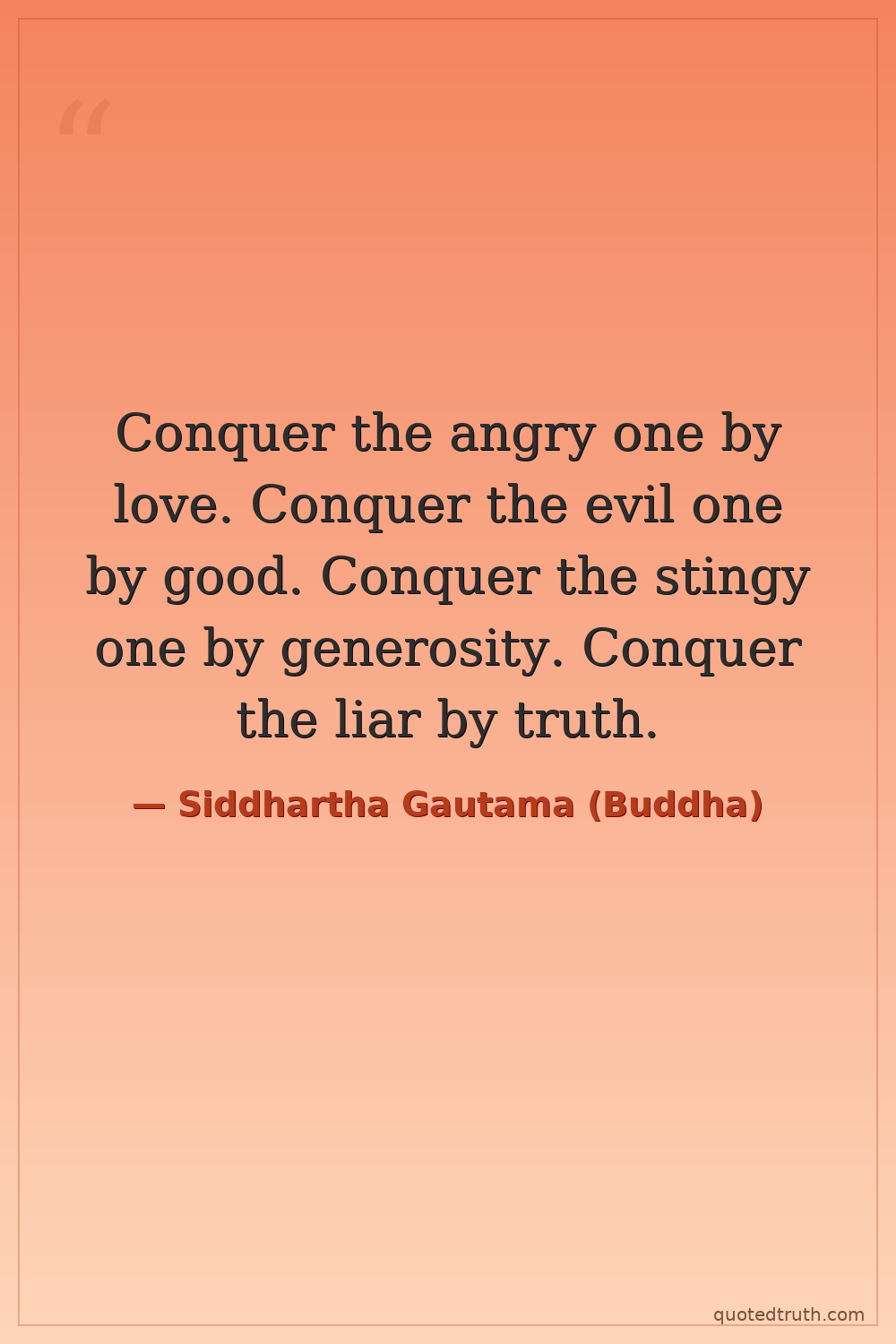
Siddhartha Gautama (Buddha) — "Conquer the angry one by love. Conquer the evil one by good. Conquer the stingy …"
Conquer the angry one by love. Conquer the evil one by good. Conquer the stingy one by generosity. Conquer the liar by truth.
Conquer the angry one by love. Conquer the evil one by good. Conquer the stingy one by generosity. Conquer the liar by truth.
Click any product to generate a realistic preview. Up to 3 at a time.
* Initial load can take up to 90 seconds — revising the preview in another color is nearly instant.
"Let them not do the slightest thing that the wise would later reprove."
"Let him not despise what he has received, nor should he envy others. He who envies others does not obtain peace of mind."
"It is during our darkest moments that we must focus to see the light."
"There is nothing more dreadful than the habit of doubt. Doubt separates people. It is a poison that disintegrates friendships and breaks up pleasant relations."
"All that we are is the result of what we have thought: it is founded on our thoughts, it is made up of our thoughts. If a man speaks or acts with an evil thought, pain follows him, as the wheel follow…"
Found in 2 providers: grok,gemini
2 sources checked
Meet destructive behavior with its opposite rather than mirroring it. When someone attacks you with anger, respond with love; when someone acts cruelly, respond with kindness; when someone is selfish, give freely; when someone deceives, speak honestly. Returning fire with fire only multiplies the original harm, while responding with the opposing virtue breaks the cycle and can transform the situation and the person causing it.
This captures the Buddha's core ethical teaching of non-retaliation, central to his Noble Eightfold Path and doctrine of metta (loving-kindness). Born a prince who renounced wealth and power, Siddhartha experienced firsthand how craving and aversion generate suffering. After his enlightenment under the Bodhi tree, he spent 45 years teaching that negative states cannot be extinguished by more negativity, only by cultivating their opposites within oneself.
In 5th-century BCE northern India, the dominant Vedic culture emphasized ritual sacrifice, strict caste duty, and retributive justice administered by Brahmin priests and warrior kings. Constant warfare between small kingdoms like Magadha and Kosala made vengeance a civic virtue. The Buddha's message of conquering through opposing virtues was radical, aligning with the broader Shramana movement that rejected Vedic ritualism and offered an inward ethical path open to all castes.
AI-generated insights based on extensive research and information for context. Factual errors? Email [email protected].
Your cart is empty