Siddhartha Gautama (Buddha) — "Health is the greatest gift, contentment the greatest wealth, faithfulness the b…"
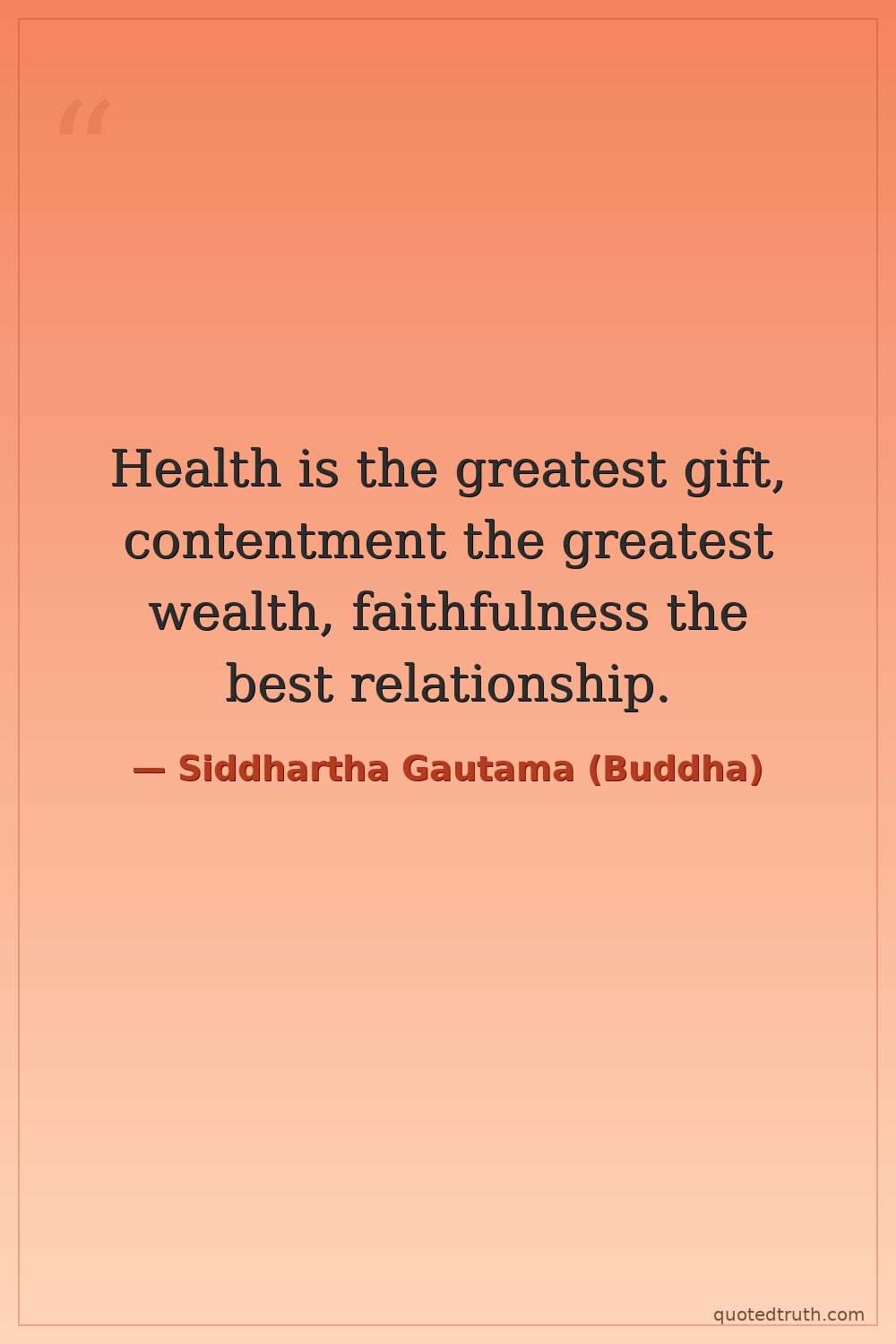
Health is the greatest gift, contentment the greatest wealth, faithfulness the best relationship.
Health is the greatest gift, contentment the greatest wealth, faithfulness the best relationship.
Click any product to generate a realistic preview. Up to 3 at a time.
* Initial load can take up to 90 seconds — revising the preview in another color is nearly instant.
"We are what we think. All that we are arises with our thoughts. With our thoughts, we make the world."
"If you meet the Buddha on the road, kill him."
"It is in the nature of things that joy arises in a person free from remorse."
"Even as a tree, though cut down, sprouts again if its roots are undamaged and strong, so also, if the roots of craving are not destroyed, suffering ever springs up again and again."
"May all beings be happy and safe, and may their hearts be filled with joy."
Found in 2 providers: grok,gemini
2 sources checked
This saying ranks three quiet goods above the loud ones people usually chase. A working body beats any luxury you can buy, because illness makes everything else meaningless. Being satisfied with what you already have outperforms piling up more money, since wanting never ends. And a partner or friend who actually stays loyal is worth more than a dazzling but unreliable one. Real wellbeing comes from inner steadiness, not external acquisition.
Siddhartha walked away from a palace, arranged marriage, and guaranteed kingship after seeing sickness, old age, and death outside the walls. His whole teaching centers on craving as the root of suffering, so praising contentment over wealth is literally his thesis. As a wandering teacher dependent on alms and on a sangha of loyal followers, he lived the three goods he names: a disciplined body, a mind free of want, and trustworthy companions on the path.
He taught in the Ganges plain around the 5th century BCE, during the Second Urbanisation when new cities, merchant wealth, and coined money were reshaping north India. Brahmin ritualism and Vedic sacrifice dominated religion, while śramaṇa movements like Jains and Ājīvikas competed for seekers. Disease was untreatable, famine common, and arranged kinship alliances defined loyalty. Naming health, contentment, and faithfulness as supreme directly undercut the era's obsession with sacrifice, accumulated riches, and dynastic marriage.
AI-generated insights based on extensive research and information for context. Factual errors? Email [email protected].
Your cart is empty