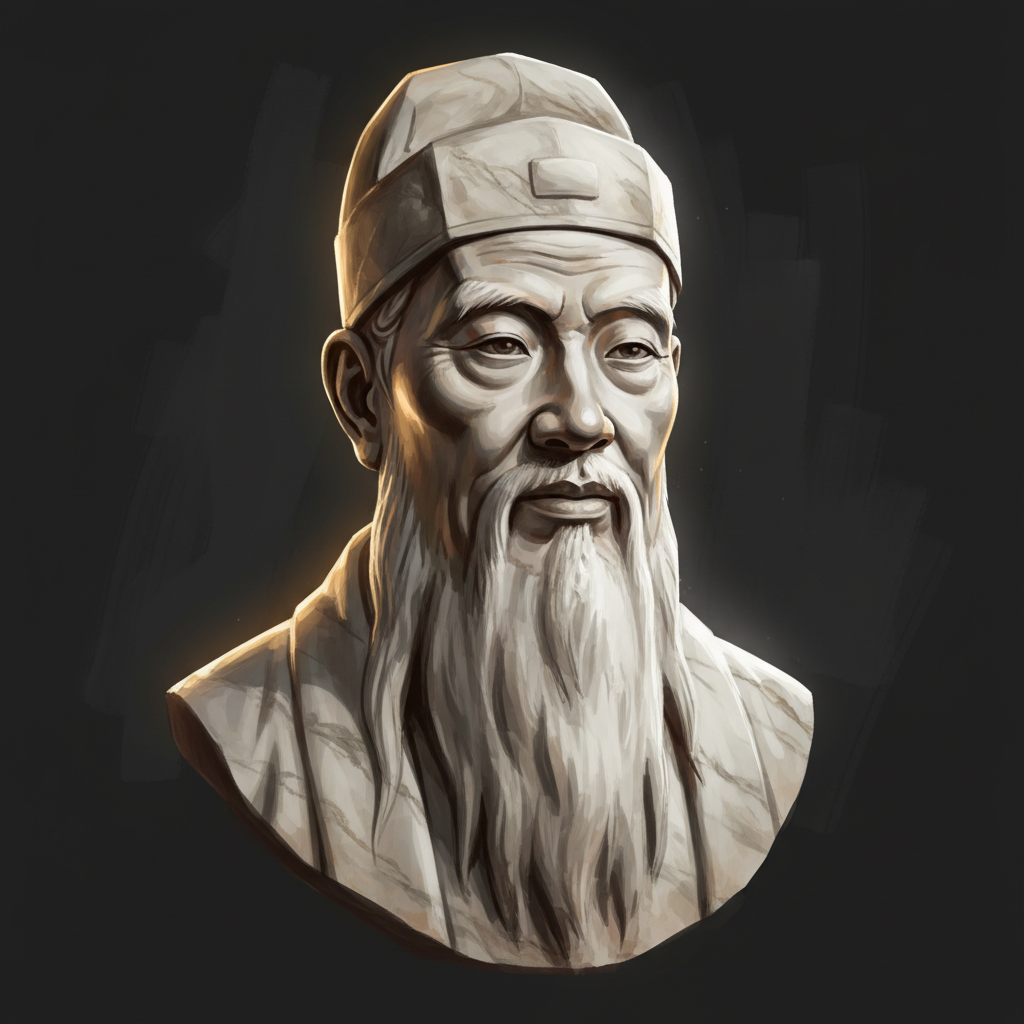
Confucius — "I transmit, but don't innovate. I am faithful to and love the ancients."
I transmit, but don't innovate. I am faithful to and love the ancients.
I transmit, but don't innovate. I am faithful to and love the ancients.
Click any product to generate a realistic preview. Up to 3 at a time.
* Initial load can take up to 90 seconds — revising the preview in another color is nearly instant.
"If a man does not say 'What shall I do? What shall I do?', I can do nothing with him."
"A man without constancy cannot be a diviner or a physician."
"The Master said, 'He who offends against Heaven has none to whom he can pray.'"
"The superior man is universally benevolent, but not clannish."
"Without knowing the force of words, it is impossible to know men."
Chinese philosopher and teacher whose teachings (compiled by his students in the Analects) became the foundational ethical framework of East Asian civilization for 2,500 years. Closely associated with Mencius (his most-influential follower a century later). For an intellectual contrast, see Laozi, near-contemporary Chinese sage and Tao Te Ching author — Confucius systematized social order through ritual and family hierarchy; Laozi's Taoist effortless-action philosophy argued such systems were the disease, not the cure. The two founding poles of Chinese moral philosophy — every East Asian moral tradition since has positioned itself between them.
The standard scholarly entry points to Confucius's work: Philip J. Ivanhoe (Georgetown, Chinese philosophy) — Confucian Moral Self Cultivation (2000); Edward Slingerland (UBC, Asian Studies) — Effortless Action: Wu-wei as Conceptual Metaphor (2003); Tu Weiming (Harvard, Confucian scholar) — Confucian Thought: Selfhood as Creative Transformation (1985). These are the works graduate seminars cite when teaching Confucius.
Found in 1 providers: grok
1 source checked
The speaker claims to pass along wisdom rather than invent new ideas, framing their role as a careful preserver of inherited knowledge. They express deep reverence for the teachings, rituals, and examples of earlier generations, trusting that old sources hold truths worth relaying faithfully. Rather than seeking originality or personal fame, they see value in humble stewardship, studying the past closely and conveying it accurately so others can benefit from what has already been proven wise.
Confucius spent his life collecting, editing, and teaching classical texts like the Book of Songs, Book of Documents, and historical annals, presenting himself as a conduit for earlier sages rather than an original thinker. He revered the Duke of Zhou and the early Zhou kings as moral exemplars. This humility about innovation shaped his teaching method and reputation: students remembered him as a devoted transmitter whose authority came from mastering tradition, not from claiming personal revelation.
Confucius lived during the late Spring and Autumn period (6th–5th century BCE), when Zhou royal authority had collapsed and rival states fought constantly, eroding ritual order and social trust. Intellectuals searched for stability amid chaos. By anchoring his teaching in ancient precedent, Confucius offered a conservative remedy: restore the rites, music, and virtues of the early Zhou dynasty. In an age desperate for legitimacy and moral direction, invoking the ancients carried weight that novel doctrines could not match.
AI-generated insights based on extensive research and information for context. Factual errors? Email [email protected].
Your cart is empty