Confucius — "The Master said, 'He who offends against Heaven has none to whom he can pray.'"
The Master said, 'He who offends against Heaven has none to whom he can pray.'
The Master said, 'He who offends against Heaven has none to whom he can pray.'
Click any product to generate a realistic preview. Up to 3 at a time.
* Initial load can take up to 90 seconds — revising the preview in another color is nearly instant.
"The Master said, 'If the will be set on virtue, there will be no practice of wickedness.'"
"The Master said, 'If a man is able to govern his country with the rules of propriety, what difficulty will he have? If he cannot govern his country with the rules of propriety, what has he to do with …"
"The superior man is slow in speech but quick in action."
"The Master said, 'A man who is not a man of benevolence—what has he to do with ceremonies? A man who is not a man of benevolence—what has he to do with music?'"
"In a state governed by the Way, poverty and low station are cause for shame; in a state bereft of the Way, wealth and high rank are cause for shame."
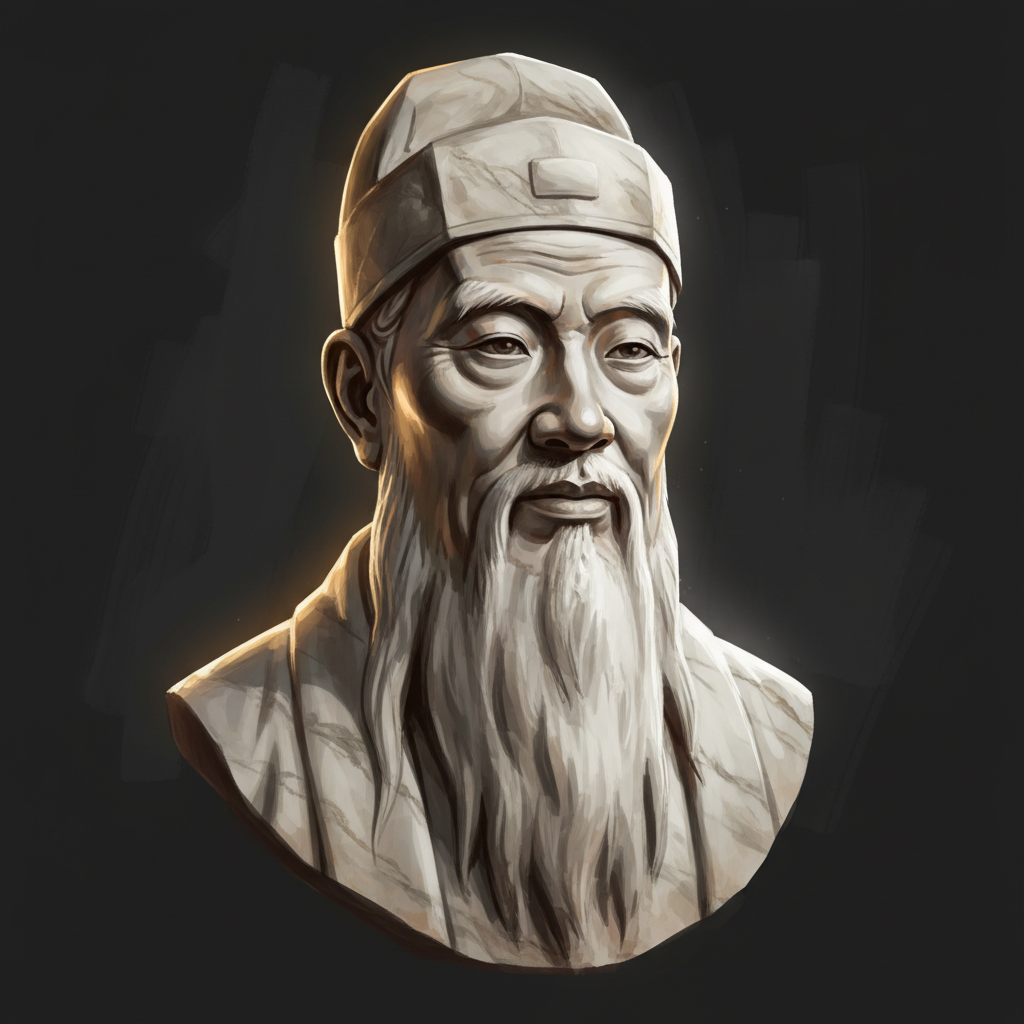
Chinese philosopher and teacher whose teachings (compiled by his students in the Analects) became the foundational ethical framework of East Asian civilization for 2,500 years. Closely associated with Mencius (his most-influential follower a century later). For an intellectual contrast, see Laozi, near-contemporary Chinese sage and Tao Te Ching author — Confucius systematized social order through ritual and family hierarchy; Laozi's Taoist effortless-action philosophy argued such systems were the disease, not the cure. The two founding poles of Chinese moral philosophy — every East Asian moral tradition since has positioned itself between them.
The standard scholarly entry points to Confucius's work: Philip J. Ivanhoe (Georgetown, Chinese philosophy) — Confucian Moral Self Cultivation (2000); Edward Slingerland (UBC, Asian Studies) — Effortless Action: Wu-wei as Conceptual Metaphor (2003); Tu Weiming (Harvard, Confucian scholar) — Confucian Thought: Selfhood as Creative Transformation (1985). These are the works graduate seminars cite when teaching Confucius.
Found in 1 providers: grok
1 source checked
If you violate the deepest moral order of the universe, no ritual or appeal to lesser powers can save you. Heaven here stands for the ultimate standard of right and wrong, not a negotiable deity. When you betray that standard, prayer becomes meaningless because you have cut yourself off from the very source you would be praying to. Integrity with the highest principle is non-transferable; no intermediary can patch it.
Confucius made Heaven (Tian) the moral anchor of his entire system, treating it as the source of proper conduct rather than a bargaining partner. As a teacher who refused to flatter corrupt rulers for position, he lived this line: he walked away from courts where virtue was compromised rather than pray for favor. His belief that rectitude mattered more than ritual shortcuts is stamped directly into this saying.
Confucius lived in the Spring and Autumn period (roughly 551-479 BCE), when Zhou authority was collapsing and nobles bribed spirits through elaborate sacrifices to legitimize power grabs. Rulers routinely prayed for heavenly blessing on unjust wars and usurpations. Against this backdrop of transactional religion, Confucius's line was a sharp rebuke: ritual without moral substance is empty, and no sacrifice can buy off cosmic accountability.
AI-generated insights based on extensive research and information for context. Factual errors? Email [email protected].
Your cart is empty