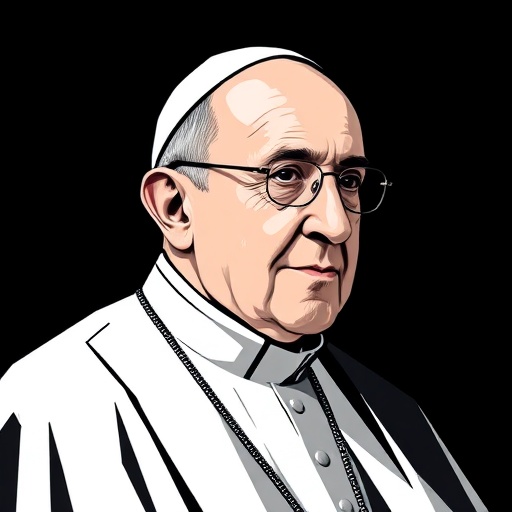
Pope Francis — "I am a disaster, but I am a disaster that asks for help."
I am a disaster, but I am a disaster that asks for help.
I am a disaster, but I am a disaster that asks for help.
Click any product to generate a realistic preview. Up to 3 at a time.
* Initial load can take up to 90 seconds — revising the preview in another color is nearly instant.
"The Lord has redeemed all of us, all of us, with the Blood of Christ: all of us, not just Catholics. Everyone! 'Father, the atheists?' Even the atheists. Everyone!"
"A good Catholic doesn't interfere in politics, but a good Christian does."
"A person once asked me, in a provocative manner, if I approved of homosexuality. I replied with another question: 'Tell me: when God looks at a gay person, does he endorse the existence of this person…"
"The Church sometimes has locked itself up in small things, in small-minded rules."
"The Lord is always with us, even when we are sinners."
First Latin American and Jesuit pope (2013-), who has steered the Catholic Church toward pastoral inclusion on LGBTQ pastoral care, divorced Catholics, and climate. Closely associated with Pope John XXIII (the Vatican II reformer pope) and Cardinal Walter Kasper (his theological ally on pastoral reform). For an intellectual contrast, see Cardinal Raymond Burke, American traditionalist cardinal, former head of the Vatican Apostolic Signatura — Burke is the public face of Catholic traditionalism that views Francis's pastoral approach as doctrinally dangerous — he has formally challenged Amoris Laetitia and other Francis reforms.
Found in 1 providers: grok
1 source checked
This quote embraces radical self-awareness without self-destruction. Admitting 'I am a disaster' strips away pretense and pride. But the second clause transforms confession into agency: asking for help is the courageous act. It rejects both denial and despair as responses to personal failure. Instead, it champions humility as an active choice — recognizing one's limits and turning outward rather than collapsing inward. Weakness acknowledged becomes strength exercised.
Jorge Mario Bergoglio chose the name Francis after the humble saint of Assisi, signaling a papacy built on admitted weakness before God. He has spoken candidly about spiritual failures during his difficult years as Jesuit provincial in Argentina. He lives in a modest guesthouse, goes to confession regularly, and maintains a personal spiritual director — embodying the belief that even the most powerful figures need help and accountability.
Pope Francis leads during an era defined by institutional crises: clergy abuse scandals, Vatican financial corruption, and a global church fracturing over doctrine. Simultaneously, the 2010s–2020s saw a cultural shift toward valuing vulnerability, with mental health awareness surging and authenticity outperforming polished perfection in public discourse. Against social media's culture of curated success, a pope openly admitting personal failure while modeling help-seeking behavior carries striking countercultural weight.
AI-generated insights based on extensive research and information for context. Factual errors? Email [email protected].
Your cart is empty