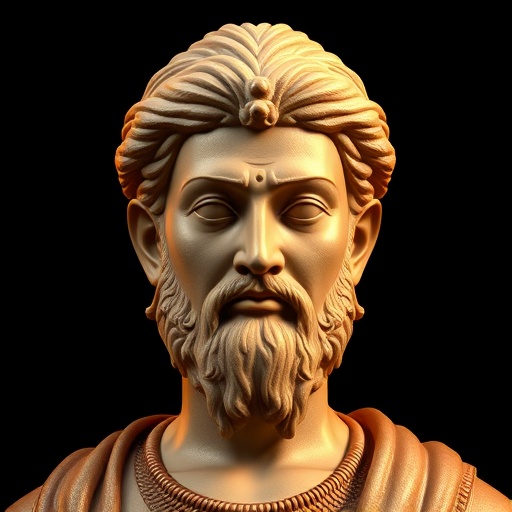
Mahavira — "The greatest mistake of a man is to think that he is not a man."
The greatest mistake of a man is to think that he is not a man.
The greatest mistake of a man is to think that he is not a man.
Click any product to generate a realistic preview. Up to 3 at a time.
* Initial load can take up to 90 seconds — revising the preview in another color is nearly instant.
"The ignorant are caught in the cycle of birth and death."
"The soul is the master of its own destiny."
"Look at the birds, how they live in the present, with no thought for the morrow."
"The path of purification is the path of non-violence, self-control, and penance."
"Have compassion towards all living beings. Hatred leads to destruction."
24th and last Tirthankara of Jainism, whose teachings of strict ahimsa (non-violence), aparigraha (non-attachment), and karma reshaped ancient Indian religion. Closely associated with The Buddha (near-contemporary moral revolutionary, also reacting against Vedic ritualism). For an intellectual contrast, see Vedic Brahmanical ritual sacrifice, the animal-sacrifice-centered Vedic religion of his era — Mahavira's ahimsa demanded total non-violence, including not eating root vegetables that kill the plant — a maximum-distance ethical move from the Vedic priestly tradition that ritually sacrificed cattle and horses. The two cleanest poles of ancient Indian religious ethics.
Found in 1 providers: grok
1 source checked
Self-abandonment is the deepest failure a person can commit. This quote insists that every human being carries inherent worth, moral agency, and spiritual capacity—and refusing to claim that is worse than any external harm done to you. To think yourself less than fully human is to surrender your power to grow, choose, and take responsibility. Don't excuse yourself from accountability or potential by denying your own humanity.
Mahavira taught that every soul—regardless of caste or birth—possesses infinite potential for liberation. He renounced a princely life to demonstrate that human willpower and discipline could achieve moksha. Jainism's core doctrine holds that each person is capable of becoming a Jina, a spiritual conqueror. This quote directly mirrors that belief: denying your own humanity denies your soul's divine potential, which for Mahavira was the gravest spiritual error possible.
Mahavira lived around 599–527 BCE in the Gangetic plains of ancient India, during an era when the Brahminic caste system assigned spiritual worth by birth. The Sramana movement—which also produced Buddhism—directly challenged this hierarchy. Lower castes were systematically taught they lacked spiritual capacity. Mahavira's assertion that every human could achieve liberation was radical. The quote counters the era's prevailing ideology that most people were spiritually lesser by nature.
AI-generated insights based on extensive research and information for context. Factual errors? Email [email protected].
Your cart is empty