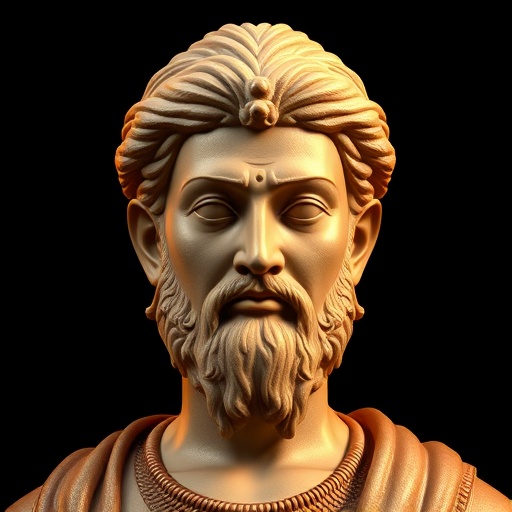
Mahavira — "The soul is the master of its own destiny."
The soul is the master of its own destiny.
The soul is the master of its own destiny.
Click any product to generate a realistic preview. Up to 3 at a time.
* Initial load can take up to 90 seconds — revising the preview in another color is nearly instant.
"The soul is neither male nor female."
"The soul is the only thing worth knowing."
"One should always speak the truth, but not utter an unpleasant truth."
"The greatest mistake of a soul is non-restraint."
"The soul is its own friend and its own enemy."
24th and last Tirthankara of Jainism, whose teachings of strict ahimsa (non-violence), aparigraha (non-attachment), and karma reshaped ancient Indian religion. Closely associated with The Buddha (near-contemporary moral revolutionary, also reacting against Vedic ritualism). For an intellectual contrast, see Vedic Brahmanical ritual sacrifice, the animal-sacrifice-centered Vedic religion of his era — Mahavira's ahimsa demanded total non-violence, including not eating root vegetables that kill the plant — a maximum-distance ethical move from the Vedic priestly tradition that ritually sacrificed cattle and horses. The two cleanest poles of ancient Indian religious ethics.
Found in 1 providers: grok
1 source checked
Each person is entirely responsible for their own fate. No god, no priest, no external force decides where your life or soul ends up — your choices, actions, and moral conduct do. Blame and credit belong to you alone. In modern terms: radical personal accountability. You are not a victim of circumstance or divine will; you are the author of your own spiritual and moral trajectory.
Mahavira renounced his royal life at thirty and spent twelve years in severe asceticism before achieving enlightenment through self-discipline alone. Jainism explicitly rejects a creator god — no deity rewards or punishes souls. Liberation, moksha, requires only the individual's own effort: right knowledge, right faith, right conduct. This quote is not metaphor for Mahavira; it is the literal architecture of his entire philosophy and the life he demonstrated it through.
Mahavira lived in 6th-century BCE India when Brahmin priests held near-total religious authority, claiming exclusive power to intercede with gods through ritual and sacrifice. Caste determined one's spiritual fate. The Shramana movement, which included Mahavira and the Buddha, directly challenged this monopoly. Asserting that every soul governs itself bypassed priests entirely and offered liberation to merchants, warriors, and outcasts equally — a genuinely subversive claim in that rigid hierarchical world.
AI-generated insights based on extensive research and information for context. Factual errors? Email [email protected].
Your cart is empty