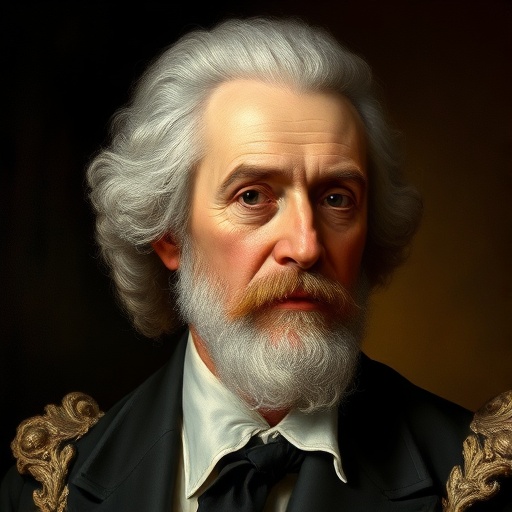
Antoine Lavoisier — "It is impossible for me to write anything without feeling myself inspired by a s…"
It is impossible for me to write anything without feeling myself inspired by a sort of scientific enthusiasm.
It is impossible for me to write anything without feeling myself inspired by a sort of scientific enthusiasm.
Click any product to generate a realistic preview. Up to 3 at a time.
* Initial load can take up to 90 seconds — revising the preview in another color is nearly instant.
"I have been so lucky in life, that I have had nothing to do but to collect the fruits of the labours of others."
"It is not often that a man has the opportunity to be useful to his fellow citizens without any personal risk."
"I am a chemist, not a politician."
"I have endeavored to make chemistry a science of reasoning, and not of memory."
"The scientist should be a judge, not an advocate."
In a letter to his wife, Marie-Anne Pierrette Paulze Lavoisier
Date: c. 1770s
Self-DeprecatingFound in 1 providers: grok
1 source checked
Science-driven passion fuels all worthwhile intellectual work. The writer cannot separate the act of writing from the feeling of being energized by curiosity and discovery. This is not performative excitement but a deep, involuntary connection between genuine engagement and creative output. Real intellectual work flows from authentic enthusiasm — without that internal spark, the words feel hollow. Inspiration here means scientific drive, not mystical muse — a compulsion built from love of understanding.
Lavoisier dismantled phlogiston theory, identified oxygen's role in combustion, named hydrogen, and codified modern chemical nomenclature in his landmark Traité Élémentaire de Chimie (1789). He financed his own laboratory, conducted meticulous quantitative experiments, and collaborated closely with his wife Marie-Anne as scientific partner. This quote captures the authentic drive behind his prolific output. His enthusiasm wasn't rhetorical — it was the force that separated his rigorous, systematic chemistry from the guesswork that preceded it.
Lavoisier lived at the height of the Enlightenment, when France's philosophes — Voltaire, Diderot, d'Alembert — made reason and empirical inquiry civic virtues. The Encyclopédie catalogued all human knowledge; the Académie des Sciences elevated scientific writing to a public act of civilization-building. Chemistry was actively shedding alchemical mysticism. In this climate, expressing scientific enthusiasm wasn't vanity — it was expected of serious intellectuals who believed passionate inquiry could transform human understanding and society itself.
AI-generated insights based on extensive research and information for context. Factual errors? Email [email protected].
Your cart is empty