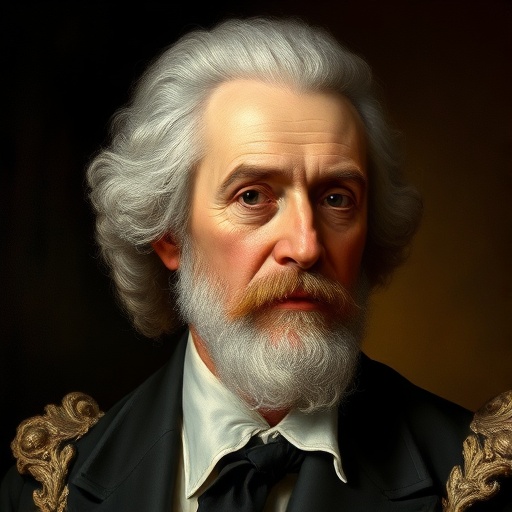
Antoine Lavoisier — "I have endeavored to make chemistry a science of reasoning, and not of memory."
I have endeavored to make chemistry a science of reasoning, and not of memory.
I have endeavored to make chemistry a science of reasoning, and not of memory.
Click any product to generate a realistic preview. Up to 3 at a time.
* Initial load can take up to 90 seconds — revising the preview in another color is nearly instant.
"I am a chemist, not a politician."
"I have always found that the more I learned, the more I realized how much I did not know."
"Chemistry is a science of facts and experiments, and not of opinions."
"It took them only an instant to cut off that head, but France may not produce another like it in a century."
"It is only by means of experiments that we can arrive at the truth."
Found in 1 providers: grok
1 source checked
Chemistry should be built on logical principles and systematic reasoning, not rote memorization of isolated facts and procedures. True understanding means grasping underlying laws so knowledge can be applied and extended. A practitioner who reasons can solve new problems; one who only memorizes is helpless when conditions change. Science advances when people understand why things happen, not merely catalog what happens.
Lavoisier dismantled phlogiston theory—the dominant but wrong framework of his day—through rigorous experimental logic and precise mass measurements. He named oxygen and hydrogen, reformed chemical nomenclature to reflect actual composition, and wrote the Traité Élémentaire de Chimie (1789), organizing chemistry around testable principles rather than alchemical tradition. His career was a sustained campaign to replace inherited recipes and mystical lore with quantitative, reproducible reasoning.
Lavoisier worked during the late-18th-century Enlightenment, when rational inquiry was reshaping every discipline. Chemistry remained entangled with alchemy—a tradition of secretive recipes and memorized procedures lacking theoretical foundation. The Scientific Revolution had already mathematized physics and astronomy; chemistry lagged behind. His era celebrated systematizers like Linnaeus and Euler, and the broader intellectual culture demanded that every field prove itself through reason, making his mission to rationalize chemistry both timely and radical.
AI-generated insights based on extensive research and information for context. Factual errors? Email [email protected].
Your cart is empty