What it means
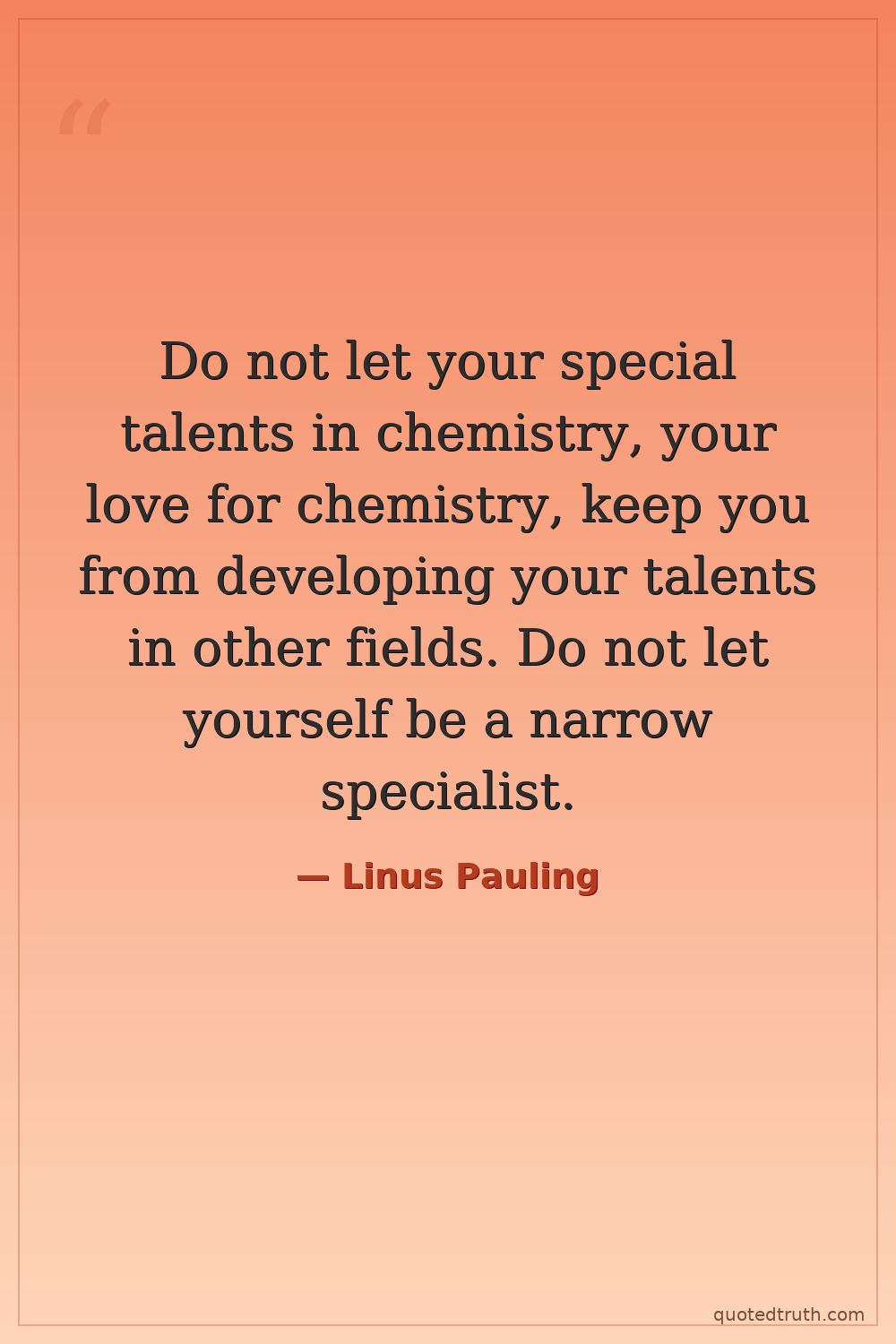
Having mastery in one domain should not prevent cultivating curiosity and capability elsewhere. True depth, Pauling argues, must coexist with breadth — a narrow technician solves narrow problems, but a polymath asks better questions and finds unexpected connections. Specialization risks producing expertise without wisdom. The richest intellectual life, and the most meaningful contributions, emerge when deep skill in one area is paired with genuine engagement across many others.
Relevance to Linus Pauling
Pauling lived this principle: he won Nobel Prizes in two unrelated fields — Chemistry (1954) for elucidating the chemical bond, and Peace (1962) for opposing nuclear testing. He pioneered quantum mechanics applications in chemistry, contributed foundational work to molecular biology and protein structure, then pivoted to orthomolecular medicine and anti-war activism. His scientific authority gave his peace arguments credibility. Few scientists have so deliberately refused the boundaries of their own discipline.
The era
Pauling's career spanned the mid-20th century's explosion of scientific specialization. Post-WWII research culture rewarded narrow expertise, producing the hyper-specialized silos that still define academia today. The Manhattan Project's scientists had mastered physics but many grappled publicly with having built a weapon of mass destruction — proof that technical brilliance without ethical breadth could be catastrophic. Pauling's own peace activism was a direct response to this danger, embodying science's responsibility beyond the laboratory.
AI-generated insights based on extensive research and information for context. Factual errors? Email [email protected].