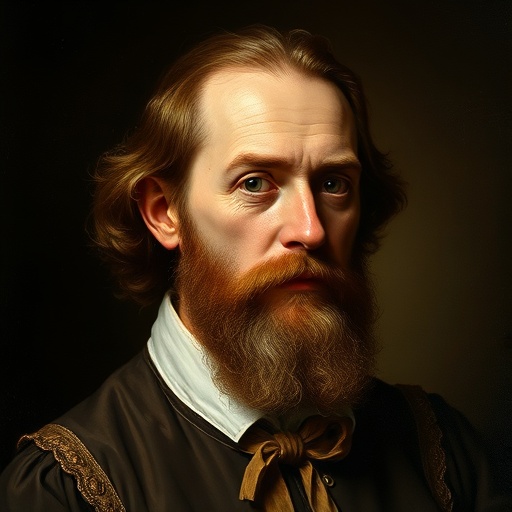
William Harvey — "Nature is nowhere accustomed to exhibit herself more openly than in her failures…"
Nature is nowhere accustomed to exhibit herself more openly than in her failures.
Nature is nowhere accustomed to exhibit herself more openly than in her failures.
Click any product to generate a realistic preview. Up to 3 at a time.
* Initial load can take up to 90 seconds — revising the preview in another color is nearly instant.
"The heart is a pump, and the blood is a fluid."
"It is a thing alike wonderful and incredible, to observe how the blood, from the very beginning of its motion, is distributed from the heart through the whole body, and then returns to the heart again…"
"It is not by words, but by facts and arguments, that we must seek for truth."
"The knowledge of man is as the waters, some shallow and some deep."
"The heart is the beginning of life, the first to live, and the last to die."
English physician whose On the Motion of the Heart and Blood in Animals (1628) demonstrated blood circulation, overturning 1,400 years of Galenic medicine. Closely associated with Francis Bacon (his contemporary in the new English empiricism). For an intellectual contrast, see Galenic medicine, the 2nd-century Greek medical tradition (humors, blood-as-consumed-fuel) — Harvey calculated that the heart pumps more blood per hour than the body could possibly produce as fuel — a single quantitative observation that demolished the entire Galenic-Aristotelian medical worldview. The cleanest example in medical history of arithmetic disproving 14 centuries of authority.
Suggesting that studying anomalies and pathological cases reveals fundamental truths about normal function.
Date: c. 1650s (attributed)
Nature & WorldFound in 1 providers: gemini
1 source checked
The natural world reveals its true workings most clearly when things go wrong. Abnormalities, diseases, and malfunctions strip away the ordinary surface and expose underlying mechanisms that function invisibly when healthy. Studying breakdowns and exceptions teaches more about how systems actually operate than observing normal function alone — failure is nature's most honest demonstration of its own design.
Harvey spent decades dissecting animals and cadavers, observing hearts that beat irregularly, valves that failed, and vessels that bled abnormally. His discovery of blood circulation came partly from recognizing that Galenic theory couldn't explain what he witnessed in diseased and dying specimens. His empirical, hands-on methodology depended on treating anatomical failures as data rather than inconveniences.
The early modern period saw medicine breaking from ancient Greek authorities like Galen and Aristotle. Anatomists like Vesalius had recently exposed classical errors through direct dissection. Harvey worked during a revolution in natural philosophy — Bacon's empiricism, the Scientific Revolution's demand for observation over tradition — where failures and anomalies became legitimate evidence, not embarrassments to be explained away by inherited dogma.
AI-generated insights based on extensive research and information for context. Factual errors? Email [email protected].
Your cart is empty