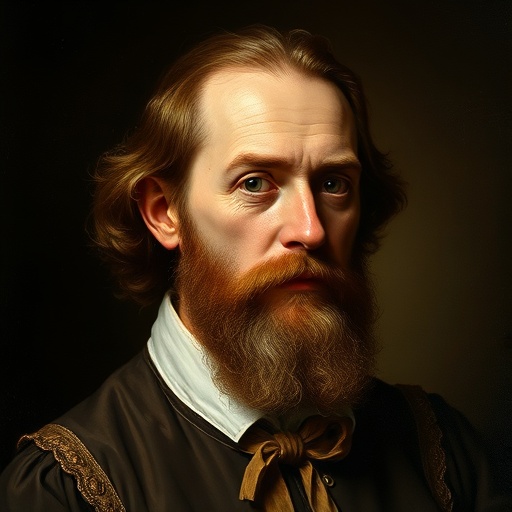
William Harvey — "The human body is a machine, but it is also a living soul."
The human body is a machine, but it is also a living soul.
The human body is a machine, but it is also a living soul.
Click any product to generate a realistic preview. Up to 3 at a time.
* Initial load can take up to 90 seconds — revising the preview in another color is nearly instant.
"The art of medicine is to be learned only by experience and observation."
"The world is full of wonders, but man is the greatest wonder of all."
"The senses are the primary source of all knowledge."
"The heart does not draw the blood, but propels it."
"I profess to learn and to teach anatomy not from books but from dissections."
English physician whose On the Motion of the Heart and Blood in Animals (1628) demonstrated blood circulation, overturning 1,400 years of Galenic medicine. Closely associated with Francis Bacon (his contemporary in the new English empiricism). For an intellectual contrast, see Galenic medicine, the 2nd-century Greek medical tradition (humors, blood-as-consumed-fuel) — Harvey calculated that the heart pumps more blood per hour than the body could possibly produce as fuel — a single quantitative observation that demolished the entire Galenic-Aristotelian medical worldview. The cleanest example in medical history of arithmetic disproving 14 centuries of authority.
A dualistic view of human nature, combining mechanistic understanding with spiritual belief.
Date: Uncertain (attributed)
BiblicalFound in 1 providers: gemini
1 source checked
The quote says we can understand the body through mechanics — pumps, pipes, chemical reactions — but that framework alone fails to capture what a person actually is. Life carries something beyond measurable function: experience, consciousness, inner being. It warns against reducing humans entirely to biology or physics, insisting the 'machine' model, however useful scientifically, remains incomplete without acknowledging something deeper and less quantifiable about living creatures.
Harvey famously described the heart as a pump and mapped blood's continuous circulation in 1628 — one of medicine's most mechanistic breakthroughs. Yet Harvey was steeped in Aristotelian natural philosophy, which held that vital spirits animated the blood. He used mechanical metaphors as explanatory tools without abandoning the idea that life required something irreducible. This quote reflects that duality precisely: the pioneering mechanist who never fully surrendered to pure materialism.
The 17th century saw Descartes declare animals mere automata and the Scientific Revolution reduce nature to mathematical laws. Harvey's 1628 discovery of circulation fit naturally into this mechanistic worldview. Simultaneously the Church remained powerful, the soul was theological doctrine, and vitalism still dominated medicine. This tension between emerging mechanistic science and entrenched spiritual frameworks was the defining intellectual conflict of Harvey's era, making any balancing of 'machine' and 'soul' both timely and genuinely provocative.
AI-generated insights based on extensive research and information for context. Factual errors? Email [email protected].
Your cart is empty