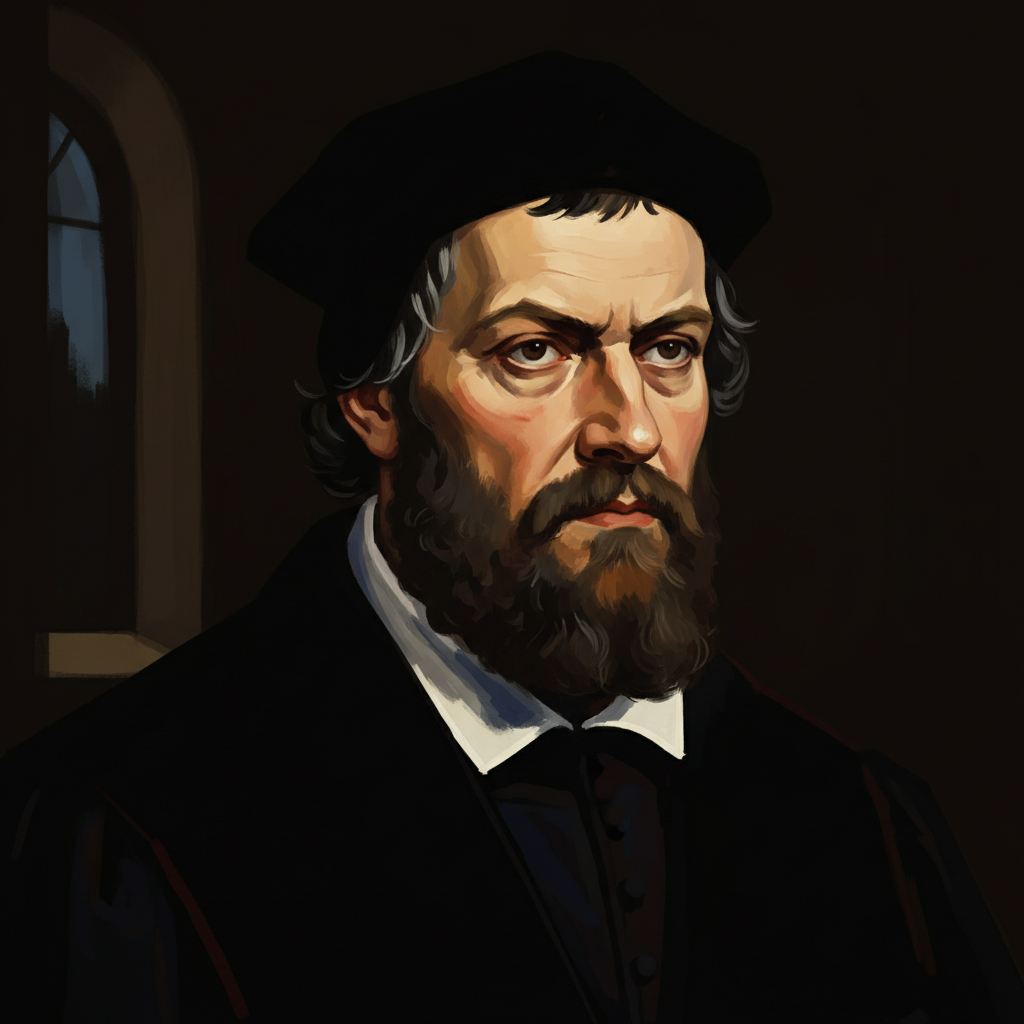
Martin Luther — "I am a peasant's son; my father, grandfather, and great-grandfather were genuine…"
I am a peasant's son; my father, grandfather, and great-grandfather were genuine peasants. So I am a peasant and shall remain one.
I am a peasant's son; my father, grandfather, and great-grandfather were genuine peasants. So I am a peasant and shall remain one.
Click any product to generate a realistic preview. Up to 3 at a time.
* Initial load can take up to 90 seconds — revising the preview in another color is nearly instant.
"If you wish to make a good prayer, go into your closet, lock the door, and throw the key out the window."
"The world is like a drunken peasant. If you lift him into the saddle on one side, he will fall off on the other."
"Reason is the Devil's greatest whore."
"Mankind has a free will; but it is free to milk cows and to build houses, nothing more."
"When I am assailed by temptation, I merely eat and drink more, and laugh and joke, and so kill the thoughts."
German theologian whose 95 Theses (1517) launched the Protestant Reformation and broke the Catholic Church's monopoly on Western Christianity. Closely associated with Philipp Melanchthon (Lutheran systematizer) and John Calvin (later Reformer who built on Luther's break). For an intellectual contrast, see Pope Leo X, Renaissance pope (1513-1521) — Leo X's indulgence sales triggered Luther's break and Leo excommunicated him in 1521 — Luther's entire Reformation is structured as a direct answer to the indulgence-funded Vatican Leo represented.
Found in 1 providers: grok
1 source checked
Luther insists on his humble rural roots and refuses to pretend otherwise, even after rising to enormous fame. He says his family were ordinary farmers, he was born one of them, and he will keep that identity for life. It is a declaration that status, titles, or public acclaim will not change who he fundamentally is or where he came from.
Luther came from Eisleben peasant stock; his father Hans worked copper mines after leaving farming. Though he became Europe's most famous theologian, Luther kept coarse, earthy German speech, ate plain food, and wrote in the vernacular so plowmen could read Scripture. This peasant self-image fueled his contempt for papal luxury, his trust in common believers, and his translation of the Bible into language ordinary Germans actually spoke.
In early-modern Europe, rigid estates separated nobility, clergy, and peasantry, and climbing out of peasant rank usually meant disowning it. The 1525 German Peasants' War erupted partly over such inequality, and Luther's movement spread fastest among commoners resentful of Rome's wealth. Declaring peasant identity was politically charged: it aligned him with the laity he was empowering through vernacular Scripture while rejecting the aristocratic airs expected of a celebrated doctor of theology.
AI-generated insights based on extensive research and information for context. Factual errors? Email [email protected].
Your cart is empty