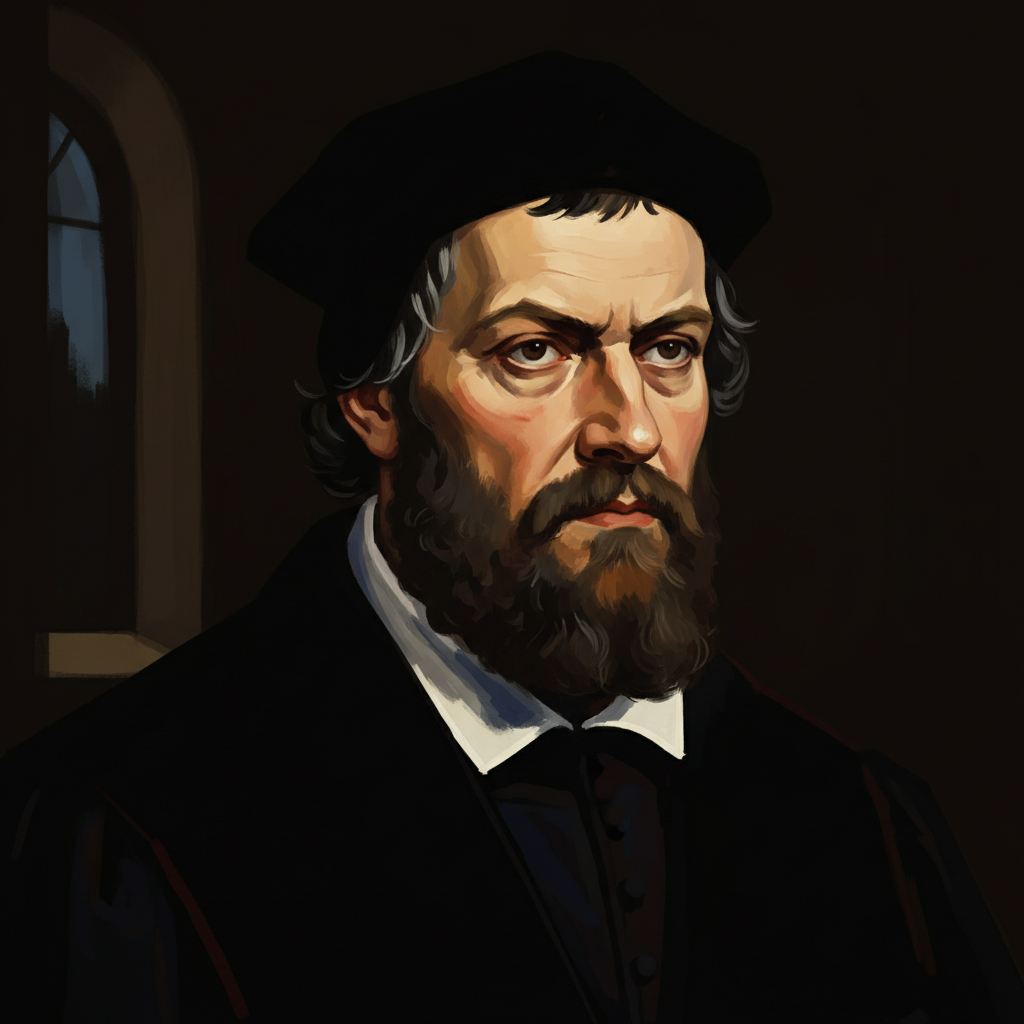
Martin Luther — "If you wish to make a good prayer, go into your closet, lock the door, and throw…"
If you wish to make a good prayer, go into your closet, lock the door, and throw the key out the window.
If you wish to make a good prayer, go into your closet, lock the door, and throw the key out the window.
Click any product to generate a realistic preview. Up to 3 at a time.
* Initial load can take up to 90 seconds — revising the preview in another color is nearly instant.
"Reason is the Devil's greatest whore; by nature and manner of being she is a noxious whore; she is a prostitute, the Devil's appointed whore; whore eaten by scab and leprosy who should be trodden unde…"
"A woman must be a woman and cannot be a man. She, too, is God's creature and her divine station is that she should bear and care for and rear children."
"Grace remits sin, and peace quiets the conscience. Sin and conscience torment us, but Christ has overcome these fiends now and forever. Only Christians possess this victorious knowledge given from abo…"
"I would not smell the foul odor of your name."
"The greater the sinner, the greater the grace."
German theologian whose 95 Theses (1517) launched the Protestant Reformation and broke the Catholic Church's monopoly on Western Christianity. Closely associated with Philipp Melanchthon (Lutheran systematizer) and John Calvin (later Reformer who built on Luther's break). For an intellectual contrast, see Pope Leo X, Renaissance pope (1513-1521) — Leo X's indulgence sales triggered Luther's break and Leo excommunicated him in 1521 — Luther's entire Reformation is structured as a direct answer to the indulgence-funded Vatican Leo represented.
Found in 1 providers: grok
1 source checked
Real prayer requires complete privacy and total commitment. Shut yourself away from distractions and audiences, then remove any option of quick escape. The thrown-away key is hyperbole: dont give yourself an easy exit. Stay in that solitary space long enough to actually engage, rather than rushing through a performance or bailing the moment it feels uncomfortable. Sincerity, not visibility, makes prayer work.
Luther was an Augustinian monk who spent years in cloistered prayer cells before breaking with Rome in 1517. He despised the theatrical public piety of indulgence preachers and corrupt clergy, insisting faith was a personal matter between a believer and God. This line echoes his translation of Matthew 6:6 and his conviction that inward devotion, not ritual display, defined genuine Christian life.
Early-modern Europe was saturated with ostentatious religious performance: pilgrimages, public penances, paid Masses, and indulgence sales funding St. Peters Basilica. Luthers 1517 Ninety-Five Theses ignited the Reformation precisely against this showy, transactional piety. The printing press spread his call for private, scripture-centered faith across German lands, fracturing Christendom and reshaping how ordinary people understood their direct relationship with God without clerical mediation.
AI-generated insights based on extensive research and information for context. Factual errors? Email [email protected].
Your cart is empty