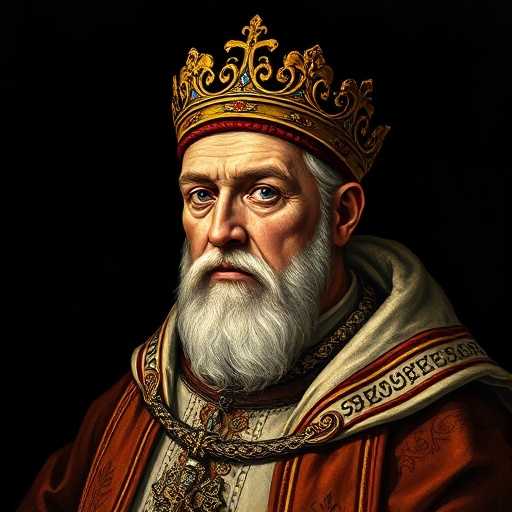
Pope Urban II — "Let no one who is rich hold back, and let no poor man hesitate, for God will be …"
Let no one who is rich hold back, and let no poor man hesitate, for God will be his guide and provider.
Let no one who is rich hold back, and let no poor man hesitate, for God will be his guide and provider.
Click any product to generate a realistic preview. Up to 3 at a time.
* Initial load can take up to 90 seconds — revising the preview in another color is nearly instant.
"Consider that the Holy Spirit has inspired you, and that the Lord has chosen you, that you may show to the world what true valor is, and what a glorious victory may be obtained by those who fight for …"
"Let no one imagine that this expedition is for the sake of plunder, but for the remission of sins."
"Let the Holy Sepulchre of the Lord our Saviour, which is possessed by unclean nations, incite you to action."
"Let those who have been hired as mercenaries for trivial pay, now earn an eternal reward."
"The land which you inhabit is too narrow for your large population; it scarcely furnishes food enough for its cultivators. Hence it is that you murder and devour one another."
Pope (1088-1099) whose Council of Clermont speech (November 1095) launched the First Crusade — the founding event of nine centuries of Christian-Muslim military conflict. Closely associated with Pope Gregory VII (his predecessor on papal-imperial reform). For an intellectual contrast, see Saladin, Kurdish-Muslim Sultan of Egypt and Syria (1138-1193) — Saladin recaptured Jerusalem in 1187, undoing the First Crusade Urban II launched 92 years earlier. Saladin's chivalrous treatment of Christian prisoners became the canonical Muslim counter-image to Crusader brutality. The cleanest before/after pairing of the Crusades' moral arc.
Found in 1 providers: grok
1 source checked
This is a universal call to action that erases class barriers: wealthy people should not let comfort make them passive, and poor people should not let lack of resources stop them from acting. God himself will serve as guide and financial backer for those who commit. The message is that this cause is so divinely backed that economic status is irrelevant—participation is both possible and obligatory for all believers.
Urban II was a Cluniac monk turned pope who delivered his famous call to crusade at Clermont in 1095. Trained in the Gregorian reform tradition, he believed the Church could and should direct all of Christian society—rich nobles and landless peasants alike. His promise of divine providence was tactical: it addressed the real logistical fear among the poor while compelling wealthy lords who might hesitate to risk their estates.
In 1095, the Seljuk Turks had disrupted Christian pilgrimage routes to Jerusalem, and Byzantine Emperor Alexios I had begged Rome for military help. European feudal society was stratified and violent—lords warred constantly among themselves. Urban's speech redirected that aggression outward. The phrase Deus vult became the crusaders' battle cry. Promising God's provision made the expedition feel spiritually insured rather than financially reckless, crucial for mobilizing both noble and peasant volunteers.
AI-generated insights based on extensive research and information for context. Factual errors? Email [email protected].
Your cart is empty