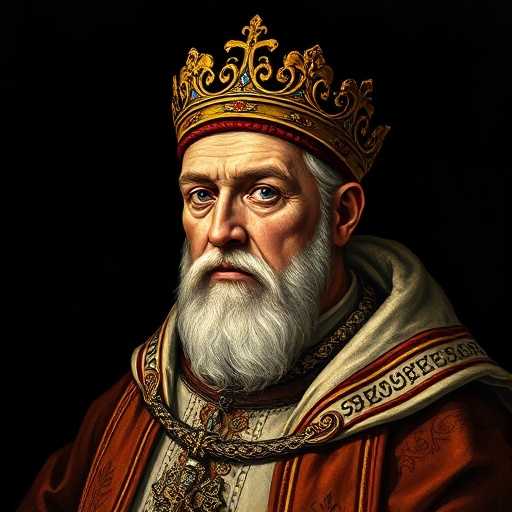
Pope Urban II — "That royal city, Jerusalem, situated in the middle of the world, is now held cap…"
That royal city, Jerusalem, situated in the middle of the world, is now held captive by its enemies.
That royal city, Jerusalem, situated in the middle of the world, is now held captive by its enemies.
Click any product to generate a realistic preview. Up to 3 at a time.
* Initial load can take up to 90 seconds — revising the preview in another color is nearly instant.
"The way to the Holy Sepulchre is now open, a way which was closed before."
"Deus vult! (God wills it!)"
"They destroy the altars, after having defiled them with their uncleanness. They circumcise the Christians, and the blood of the circumcision they either spread upon the altars or pour into the vases o…"
"But if you are hindered by love of children, parents and wives, remember what the Lord says in the Gospel, 'He that loveth father or mother more than me, is not worthy of me.'"
"We desire that you should know that the Lord is with you."
Pope (1088-1099) whose Council of Clermont speech (November 1095) launched the First Crusade — the founding event of nine centuries of Christian-Muslim military conflict. Closely associated with Pope Gregory VII (his predecessor on papal-imperial reform). For an intellectual contrast, see Saladin, Kurdish-Muslim Sultan of Egypt and Syria (1138-1193) — Saladin recaptured Jerusalem in 1187, undoing the First Crusade Urban II launched 92 years earlier. Saladin's chivalrous treatment of Christian prisoners became the canonical Muslim counter-image to Crusader brutality. The cleanest before/after pairing of the Crusades' moral arc.
Found in 1 providers: grok
1 source checked
Jerusalem, a city of supreme religious importance, has fallen under the control of hostile forces who prevent Christian pilgrims from accessing its sacred sites. The city that Christians regard as the spiritual center of the world is no longer in the hands of those who revere it, making its liberation a moral and religious imperative for all faithful Christians.
Urban II delivered this precise sentiment at the Council of Clermont in 1095, using it as the emotional and theological cornerstone of his call to crusade. As pope, he wielded Jerusalem's symbolic centrality to Christendom as his most powerful argument, successfully mobilizing European nobles and commoners alike to undertake military pilgrimage, demonstrating his mastery of sacred geography as political persuasion.
The Seljuk Turks had captured Jerusalem in 1073 and were disrupting Christian pilgrimage routes to the Holy Land. Byzantine Emperor Alexios I had appealed to Rome for military aid against Turkish expansion. Western Europe, shaped by feudal warrior culture and penitential theology, was primed to respond to a call framing military violence as spiritual redemption, making Urban's appeal extraordinarily effective.
AI-generated insights based on extensive research and information for context. Factual errors? Email [email protected].
Your cart is empty