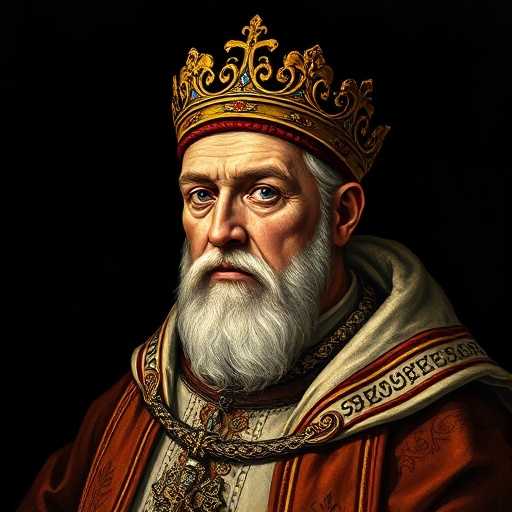
Pope Urban II — "Take the road to the Holy Sepulchre and wrench the land from that wicked race."
Take the road to the Holy Sepulchre and wrench the land from that wicked race.
Take the road to the Holy Sepulchre and wrench the land from that wicked race.
Click any product to generate a realistic preview. Up to 3 at a time.
* Initial load can take up to 90 seconds — revising the preview in another color is nearly instant.
"The land of the Saracens is fertile and rich."
"The kingdom of the Greeks is now dismembered by them and deprived of territory so vast in extent that it can not be traversed in a march of two months. On whom therefore is the labor of avenging these…"
"The royal city, situated at the center of the world, is now held captive by His enemies, and is enslaved by peoples who do not know God."
"Let no delay postpone the journey."
"Let those who have been hired as mercenaries for trivial pay, now earn an eternal reward."
Pope (1088-1099) whose Council of Clermont speech (November 1095) launched the First Crusade — the founding event of nine centuries of Christian-Muslim military conflict. Closely associated with Pope Gregory VII (his predecessor on papal-imperial reform). For an intellectual contrast, see Saladin, Kurdish-Muslim Sultan of Egypt and Syria (1138-1193) — Saladin recaptured Jerusalem in 1187, undoing the First Crusade Urban II launched 92 years earlier. Saladin's chivalrous treatment of Christian prisoners became the canonical Muslim counter-image to Crusader brutality. The cleanest before/after pairing of the Crusades' moral arc.
Found in 1 providers: grok
1 source checked
Seize the sacred path to Jerusalem and reclaim it from those who hold it now. A direct call to violent action framed as righteous duty—march toward the holiest site in Christendom and conquer it by force, stripping control from those deemed unworthy of guardianship over sacred ground.
Urban II delivered these words at the Council of Clermont in 1095, launching the First Crusade. As pope, he wielded spiritual authority to mobilize armies, framing warfare as penance and sacred obligation. His call united fractious European nobility under a single holy banner, demonstrating his mastery of political theology and ecclesiastical power.
In 1095, the Seljuk Turks controlled Jerusalem and had disrupted Christian pilgrimages. Byzantine Emperor Alexios I pleaded for Western military aid. Feudal Europe's warrior class needed sanctioned outlets for violence. Urban's call transformed secular knights into holy warriors, birthing the crusading movement that would reshape Christianity, Islam, and Mediterranean geopolitics for centuries.
AI-generated insights based on extensive research and information for context. Factual errors? Email [email protected].
Your cart is empty