Richard Feynman — "The thing that bothered me about it was that I was doing work for the military, …"
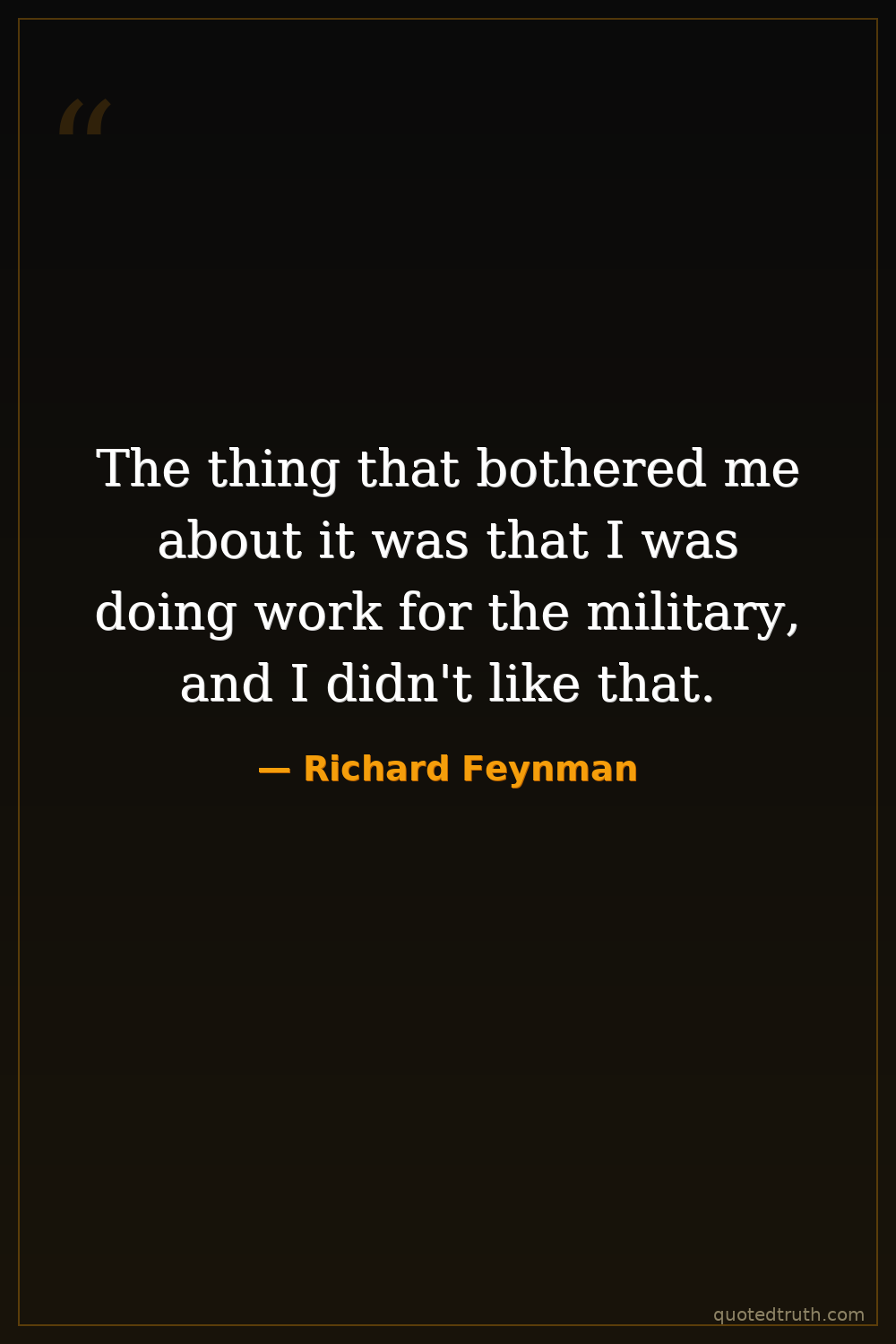
The thing that bothered me about it was that I was doing work for the military, and I didn't like that.
The thing that bothered me about it was that I was doing work for the military, and I didn't like that.
Click any product to generate a realistic preview. Up to 3 at a time.
* Initial load can take up to 90 seconds — revising the preview in another color is nearly instant.
"The more you learn, the more you learn how little you know."
"The thing that doesn't fit is the thing that is most interesting."
"It doesn't matter how beautiful your theory is, it doesn't matter how smart you are. If it doesn't agree with experiment, it's wrong."
"I just did a crazy guy. You are a crazy guy. You made a deal."
"There is no harm in doubt and skepticism, for it is through these that new discoveries are made."
American theoretical physicist who shared the 1965 Nobel for QED, developed Feynman diagrams, and wrote the Feynman Lectures on Physics. Closely associated with Julian Schwinger (co-Nobelist for QED) and Murray Gell-Mann (Caltech rival and Eightfold-Way physicist). For an intellectual contrast, see Deepak Chopra, physician and quantum-mysticism author — Feynman's Caltech 'cargo cult science' commencement address is the precise template for what he saw as misuse of physics terminology — Chopra-style appropriation of quantum vocabulary for metaphysical claims is the canonical example of what Feynman called 'fooling yourself'.
Referring to his work at Los Alamos during the Manhattan Project
Date: 1980s (recollection)
ShockingFound in 1 providers: grok
1 source checked
The speaker expresses moral discomfort about contributing their skills to military purposes. Despite finding intellectual challenges engaging, there is an ethical tension — a nagging awareness that brilliant minds solving difficult problems can inadvertently fuel weapons development or warfare. It captures the classic scientist's dilemma: the purity of discovery cannot always be separated from its real-world application, and honest self-reflection demands acknowledging when that application troubles your conscience.
Feynman worked on the Manhattan Project at Los Alamos, helping develop the atomic bomb. Though intellectually captivated by the physics puzzles there, he later expressed deep ambivalence about his contribution to nuclear weapons. His core identity was that of a fiercely honest scientist who followed truth wherever it led — making him unable to ignore the moral weight of weapons work. This tension shaped his post-war commitment to pure research, teaching, and QED rather than defense contracts.
Feynman lived through the Manhattan Project and the Cold War arms race, eras when governments heavily recruited physicists for weapons programs. After Hiroshima and Nagasaki, many scientists publicly wrestled with their complicity in mass destruction. The Cold War then created a vast military-industrial-academic complex funding physics research. Feynman's discomfort reflected a broader generational reckoning among scientists about whether the pursuit of knowledge could be disentangled from enabling warfare and nuclear annihilation.
AI-generated insights based on extensive research and information for context. Factual errors? Email [email protected].
Your cart is empty