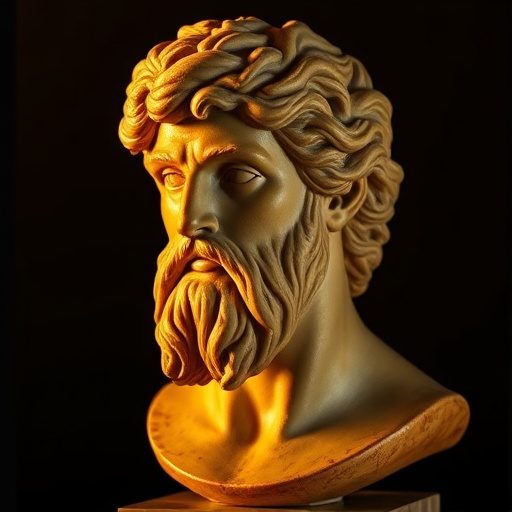
Pythagoras — "Do not speak without light."
Do not speak without light.
Do not speak without light.
Click any product to generate a realistic preview. Up to 3 at a time.
* Initial load can take up to 90 seconds — revising the preview in another color is nearly instant.
"Truth is so great a perfection, that if God would render himself visible to men, he would choose light for his body and truth for his soul."
"Don't help with a burden but put it on."
"Sacrifice an odd number to the celestial gods, and to the infernal an even."
"Don't put a god's image on a ring."
"Don't piss towards the sun."
Greek philosopher and mathematician whose school in Croton combined geometry (the Pythagorean theorem), number-mysticism, and a religious-vegetarian way of life. Closely associated with Thales of Miletus (earlier pre-Socratic and the first philosopher). For an intellectual contrast, see Heraclitus, pre-Socratic Greek philosopher of flux — Heraclitus called Pythagoras 'the chief of swindlers' — among the founding insults of the philosophical-rivalry tradition. Their 'all is flux' vs 'all is number' poles still organize the philosophy of mathematics today (Platonist vs anti-realist).
A 'symbol,' possibly meaning to speak only with knowledge or after reflection.
Date: c. 570 – c. 495 BC
ShockingFound in 1 providers: grok
1 source checked
Never speak on matters you do not clearly understand. Wait until you have genuine knowledge, evidence, or insight before offering an opinion, instruction, or judgment. Speaking in darkness means guessing, rumoring, or bluffing your way through a subject. Speaking with light means your words rest on verified understanding. The saying urges intellectual honesty: silence is better than confident ignorance, and clarity of mind must precede clarity of speech.
Pythagoras founded a school demanding years of silent study before initiates could speak in discussions. New members observed for up to five years, earning the right to speak only after proving disciplined comprehension. His devotion to mathematics, geometry, and harmonic ratios reflected a belief that truth required rigorous examination before expression. This saying mirrors that pedagogy exactly: words must be earned through knowledge, not tossed out casually, matching his reputation for precision in reasoning.
In 6th-century BCE Greece, public speech carried enormous weight in emerging city-states where oratory shaped politics, law, and reputation. Sophists would soon profit teaching persuasive speech regardless of truth. Pythagoras, working in Croton among philosophical rivals and political factions, pushed back against this culture by demanding verification over rhetoric. Oral tradition dominated knowledge transmission, so a careless statement could propagate unchecked for generations. His warning responded to a world where confident voices often outweighed careful ones.
AI-generated insights based on extensive research and information for context. Factual errors? Email [email protected].
Your cart is empty