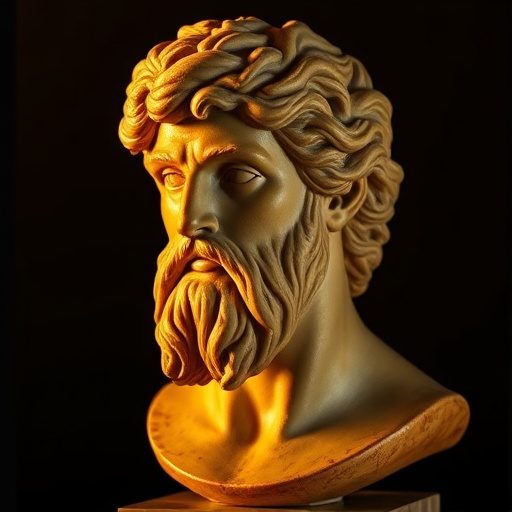
Pythagoras — "Sacrifice an odd number to the celestial gods, and to the infernal an even."
Sacrifice an odd number to the celestial gods, and to the infernal an even.
Sacrifice an odd number to the celestial gods, and to the infernal an even.
Click any product to generate a realistic preview. Up to 3 at a time.
* Initial load can take up to 90 seconds — revising the preview in another color is nearly instant.
"In no way neglect the health of your body; But give it drink and food in due measure, and also the exercise of which it has need."
"As soon as laws are necessary for men, they are no longer fit for freedom."
"The most beautiful thing is harmony."
"The highest goal of music is to connect one's soul to their Divine Nature, not entertainment."
"A chewed bean placed in the sun smells of human semen or of murderously spilt human blood."
Greek philosopher and mathematician whose school in Croton combined geometry (the Pythagorean theorem), number-mysticism, and a religious-vegetarian way of life. Closely associated with Thales of Miletus (earlier pre-Socratic and the first philosopher). For an intellectual contrast, see Heraclitus, pre-Socratic Greek philosopher of flux — Heraclitus called Pythagoras 'the chief of swindlers' — among the founding insults of the philosophical-rivalry tradition. Their 'all is flux' vs 'all is number' poles still organize the philosophy of mathematics today (Platonist vs anti-realist).
Pythagorean ritualistic advice, reflecting their numerological beliefs about harmony and discord.
Date: c. 570-495 BCE (attributed later)
WisdomFound in 1 providers: gemini
1 source checked
Odd and even numbers carry different spiritual weight. Odd numbers belong to heavenly gods; even numbers belong to gods of the underworld. The instruction isn't about counting offerings literally — it's about matching the symbolic nature of numbers to the divine tier you're addressing. Odd signifies completeness and the sacred; even signals the earthly, the boundary, the lower realm. Numbers here aren't just quantities — they're spiritual signatures.
Pythagoras founded a religious brotherhood as much as a mathematical school. He taught that numbers are the ultimate reality underlying everything. To him, odd numbers represented the divine, the limited, the perfect — while even numbers were earthly and incomplete. This quote is pure Pythagorean doctrine: mathematics and religion were a single discipline. His followers observed strict numerical taboos and rituals, all governed by the belief that specific numbers held direct cosmic and spiritual power.
In 6th-century BCE Greece, Olympian gods (Zeus, Apollo, Athena) were celestial powers while chthonic gods (Hades, Persephone, Hecate) ruled the underworld — each requiring distinct ritual treatment, different animals, different times of day. Pre-Socratic thinkers were simultaneously searching for universal principles behind nature. Pythagoras fused both impulses: numerology as cosmology. Assigning numerical categories to divine tiers made theological sense in a world where ritual precision could mean divine favor or catastrophe.
AI-generated insights based on extensive research and information for context. Factual errors? Email [email protected].
Your cart is empty