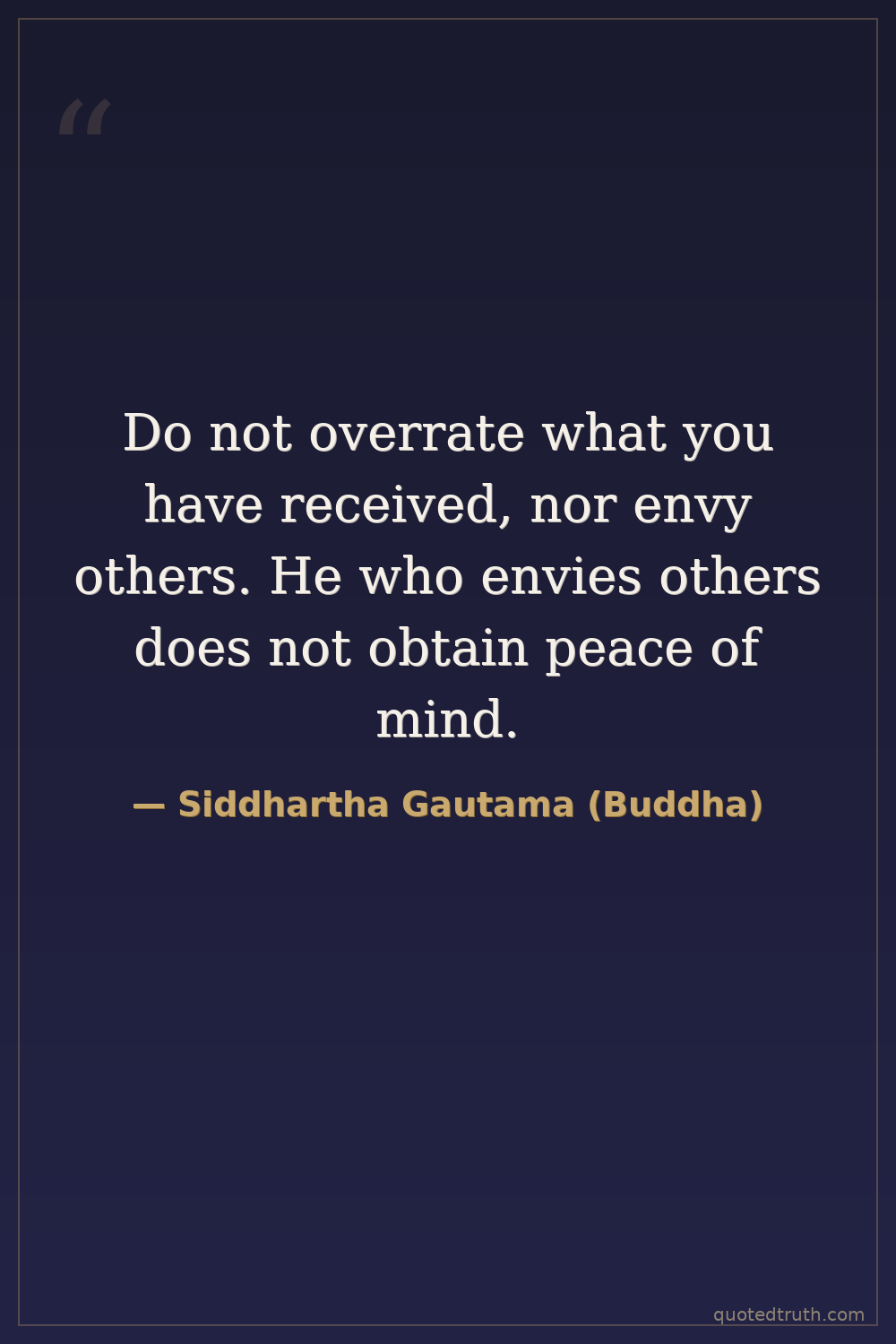
Siddhartha Gautama (Buddha) — "Do not overrate what you have received, nor envy others. He who envies others do…"
Do not overrate what you have received, nor envy others. He who envies others does not obtain peace of mind.
Do not overrate what you have received, nor envy others. He who envies others does not obtain peace of mind.
Click any product to generate a realistic preview. Up to 3 at a time.
* Initial load can take up to 90 seconds — revising the preview in another color is nearly instant.
"Whoever doesn't flare up at someone who's angry wins a battle that's hard to win."
"If you knew what I know about the power of giving, you would not let a single meal pass without sharing it in some way."
"Even as a tree, though cut down, sprouts again if its roots are undamaged and strong, so also, if the roots of craving are not destroyed, suffering ever springs up again and again."
"If anything is worth doing, do it with all your heart."
"Just as a solid rock is not shaken by the storm, even so the wise are not affected by praise or blame."
Found in 1 providers: gemini
1 source checked
Don't inflate the value of what you already possess, and don't resent what others have. Envy poisons the mind, keeping you locked in comparison and dissatisfaction. True calm comes from accepting your situation without measuring it against someone else's. When you stop ranking yourself against others, the restless craving fades and inner stillness becomes possible. Gratitude paired with non-comparison is the path to a settled mind.
The Buddha abandoned royal wealth as Prince Siddhartha to seek liberation, making him uniquely qualified to critique both overvaluing possessions and coveting what others have. His core teaching identified craving (tanha) as the root of suffering, and envy is craving wearing another face. After enlightenment under the Bodhi tree, he taught that equanimity, not accumulation, produces peace, embodying this lesson in his own renunciation.
In 5th-6th century BCE northern India, the Ganges plain was urbanizing rapidly, creating new merchant wealth alongside rigid Vedic caste hierarchies that fixed status by birth. Rival shramana movements questioned Brahmin authority and material values. Comparison and social ranking saturated daily life. The Buddha's message that peace comes from releasing comparison, not climbing the ladder, was radical in a society where spiritual worth was measured by ritual purity, lineage, and possessions.
AI-generated insights based on extensive research and information for context. Factual errors? Email [email protected].
Your cart is empty