Siddhartha Gautama (Buddha) — "Whoever doesn't flare up at someone who's angry wins a battle that's hard to win…"
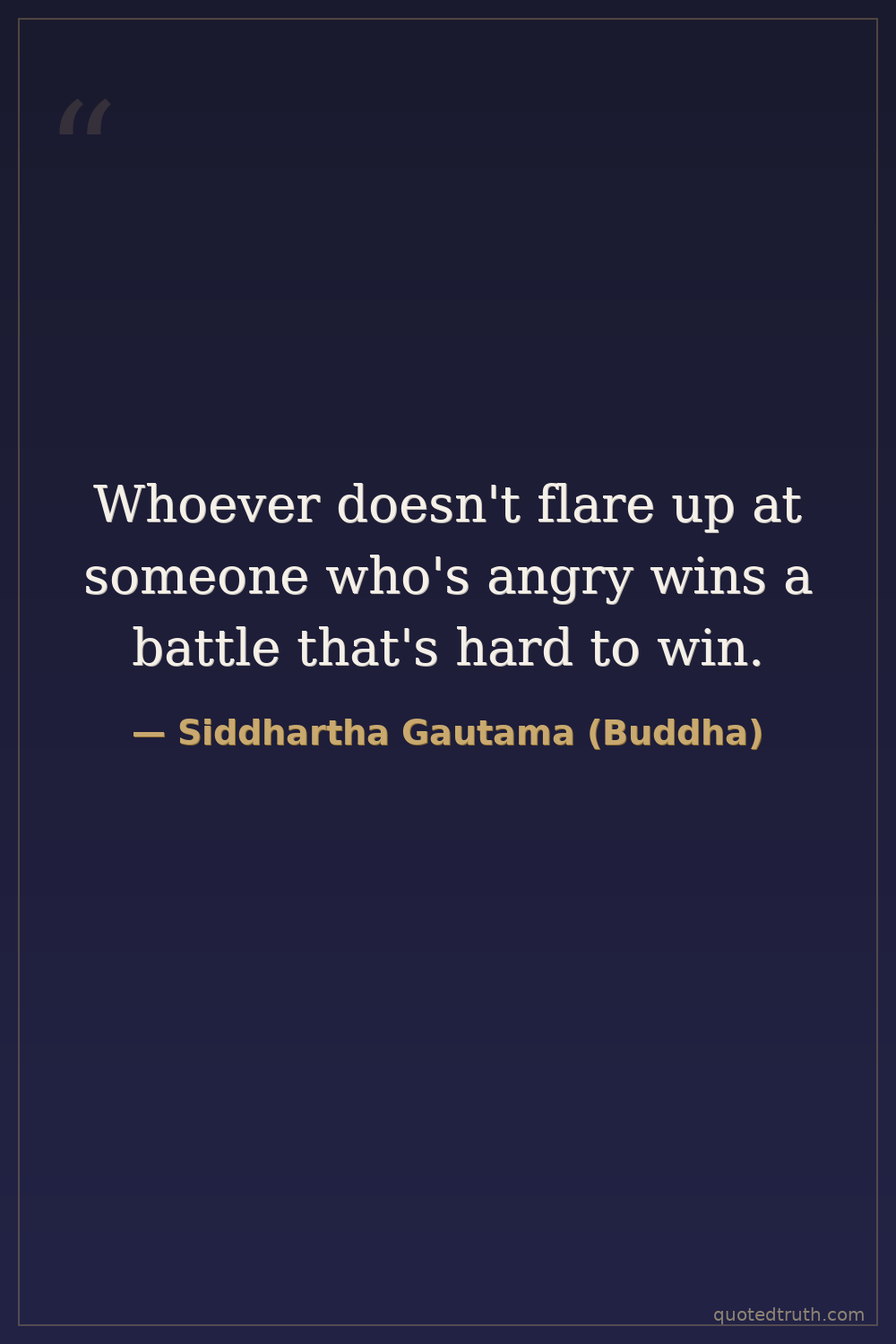
Whoever doesn't flare up at someone who's angry wins a battle that's hard to win.
Whoever doesn't flare up at someone who's angry wins a battle that's hard to win.
Click any product to generate a realistic preview. Up to 3 at a time.
* Initial load can take up to 90 seconds — revising the preview in another color is nearly instant.
"Thousands of candles can be lighted from a single candle, and the life of the candle will not be shortened. Happiness never decreases by being shared."
"Just as a candle cannot burn without fire, men cannot live without a spiritual life."
"To conquer oneself is a greater task than conquering others."
"The only way to ease our pain is to experience it fully."
"Let them not do the slightest thing that the wise would later reprove."
Found in 1 providers: gemini
1 source checked
Staying calm when someone else is furious is one of the toughest forms of self-control. Matching anger with anger escalates conflict and hands your emotions to the other person. Refusing to retaliate, by contrast, breaks the cycle and leaves you in command of yourself. The saying frames restraint not as weakness or passivity but as a genuine victory, harder than any external fight because the real opponent is your own reactive impulse.
The Buddha abandoned his royal inheritance at twenty-nine to seek release from suffering, and after his awakening he taught that craving and aversion are the roots of human misery. Non-retaliation is a direct extension of his doctrine of metta (loving-kindness) and khanti (patience), both core virtues he modeled when insulted by rivals. Having trained as an ascetic and meditator, he treated mastery of one's own mind as the supreme achievement, greater than any warrior's conquest.
In the 5th century BCE Gangetic plain, kshatriya warrior culture prized martial honor and swift retaliation, while competing sramana movements debated ethics beyond the Vedic sacrificial order. Kingdoms like Magadha and Kosala were expanding through conquest, and personal feuds were settled with violence. The Buddha's teaching reframed heroism inward, offering householders and monks alike a counter-ideal to the era's revenge codes and positioning self-conquest above the battlefield victories celebrated by kings and epics.
AI-generated insights based on extensive research and information for context. Factual errors? Email [email protected].
Your cart is empty