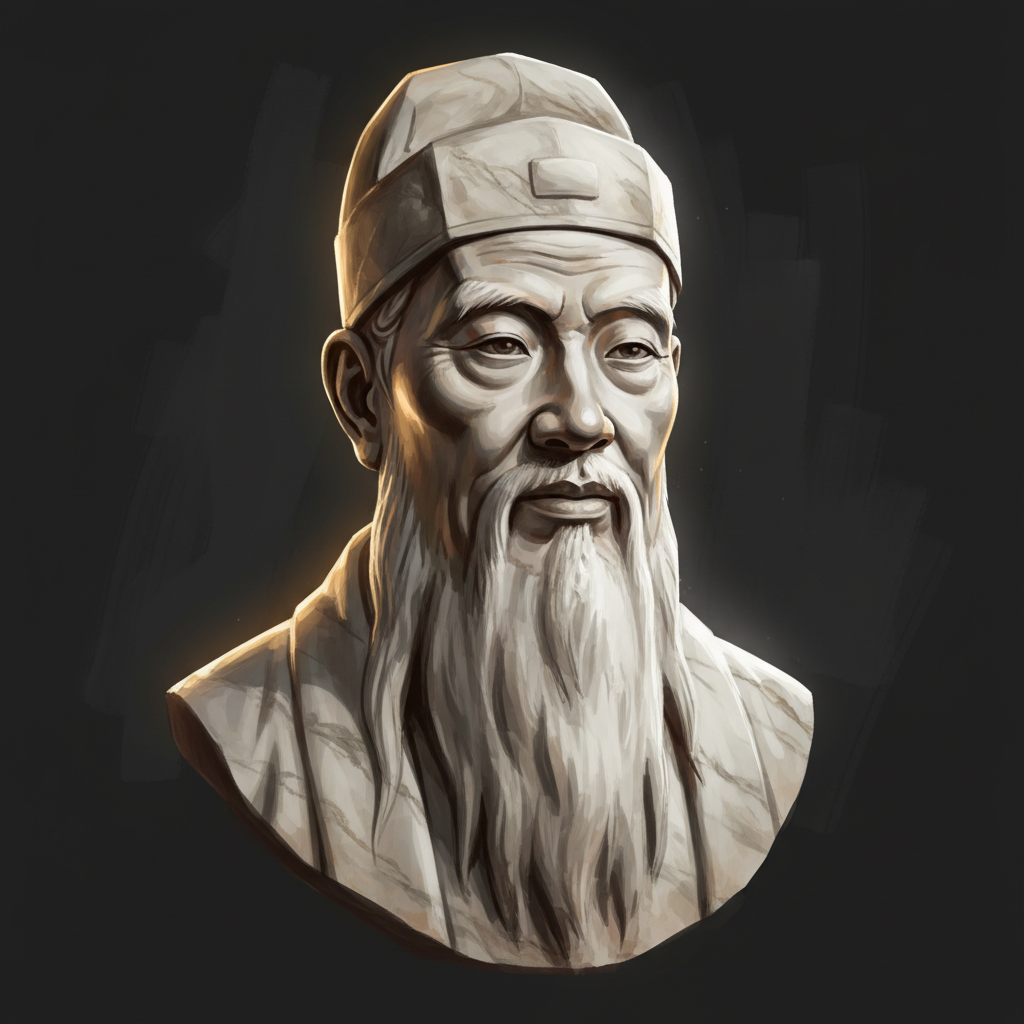
Confucius — "He who knows all the answers has not been asked all the questions."
He who knows all the answers has not been asked all the questions.
He who knows all the answers has not been asked all the questions.
Click any product to generate a realistic preview. Up to 3 at a time.
* Initial load can take up to 90 seconds — revising the preview in another color is nearly instant.
"The Master said, 'He who offends against Heaven has none to whom he can pray.'"
"The superior man is universally benevolent, but not clannish."
"He who exercises government by means of his virtue may be compared to the North Star, which keeps its place and all the stars turn towards it."
"The superior man has a proper pride, but is not proud."
"To govern is to rectify. If you lead the people by being rectified yourself, who will dare not be rectified?"
Chinese philosopher and teacher whose teachings (compiled by his students in the Analects) became the foundational ethical framework of East Asian civilization for 2,500 years. Closely associated with Mencius (his most-influential follower a century later). For an intellectual contrast, see Laozi, near-contemporary Chinese sage and Tao Te Ching author — Confucius systematized social order through ritual and family hierarchy; Laozi's Taoist effortless-action philosophy argued such systems were the disease, not the cure. The two founding poles of Chinese moral philosophy — every East Asian moral tradition since has positioned itself between them.
The standard scholarly entry points to Confucius's work: Philip J. Ivanhoe (Georgetown, Chinese philosophy) — Confucian Moral Self Cultivation (2000); Edward Slingerland (UBC, Asian Studies) — Effortless Action: Wu-wei as Conceptual Metaphor (2003); Tu Weiming (Harvard, Confucian scholar) — Confucian Thought: Selfhood as Creative Transformation (1985). These are the works graduate seminars cite when teaching Confucius.
Found in 1 providers: gemini
1 source checked
Claiming to have every answer simply means you haven't faced hard enough questions yet. Real wisdom isn't a fixed stockpile of solutions; it's shaped and tested by the problems life throws at you. The more deeply you probe any subject, the more gaps and uncertainties appear. So confidence in total knowledge usually reveals a narrow experience, not a broad mind. Humility grows naturally as questioning deepens.
Confucius built his teaching around lifelong learning and humble self-examination, famously saying real knowing is recognizing what you don't know. As a traveling teacher who spent decades seeking rulers willing to practice virtue, he faced constant rejection and unresolved questions about governance, ritual, and human nature. His method relied on dialogue with students, not pronouncements. This saying matches his insistence that the gentleman keeps studying, keeps questioning, and never mistakes certainty for understanding.
Confucius lived during the Spring and Autumn period (roughly 551–479 BCE), when the Zhou dynasty was fracturing into warring states and old rituals were collapsing. Competing thinkers offered rival cures for social chaos, and rulers demanded confident advisers with ready answers. In that marketplace of certainties, Confucius's emphasis on questioning, studying ancient models, and admitting ignorance stood out. His saying pushed back against the era's appetite for glib experts promising quick fixes to moral and political disorder.
AI-generated insights based on extensive research and information for context. Factual errors? Email [email protected].
Your cart is empty