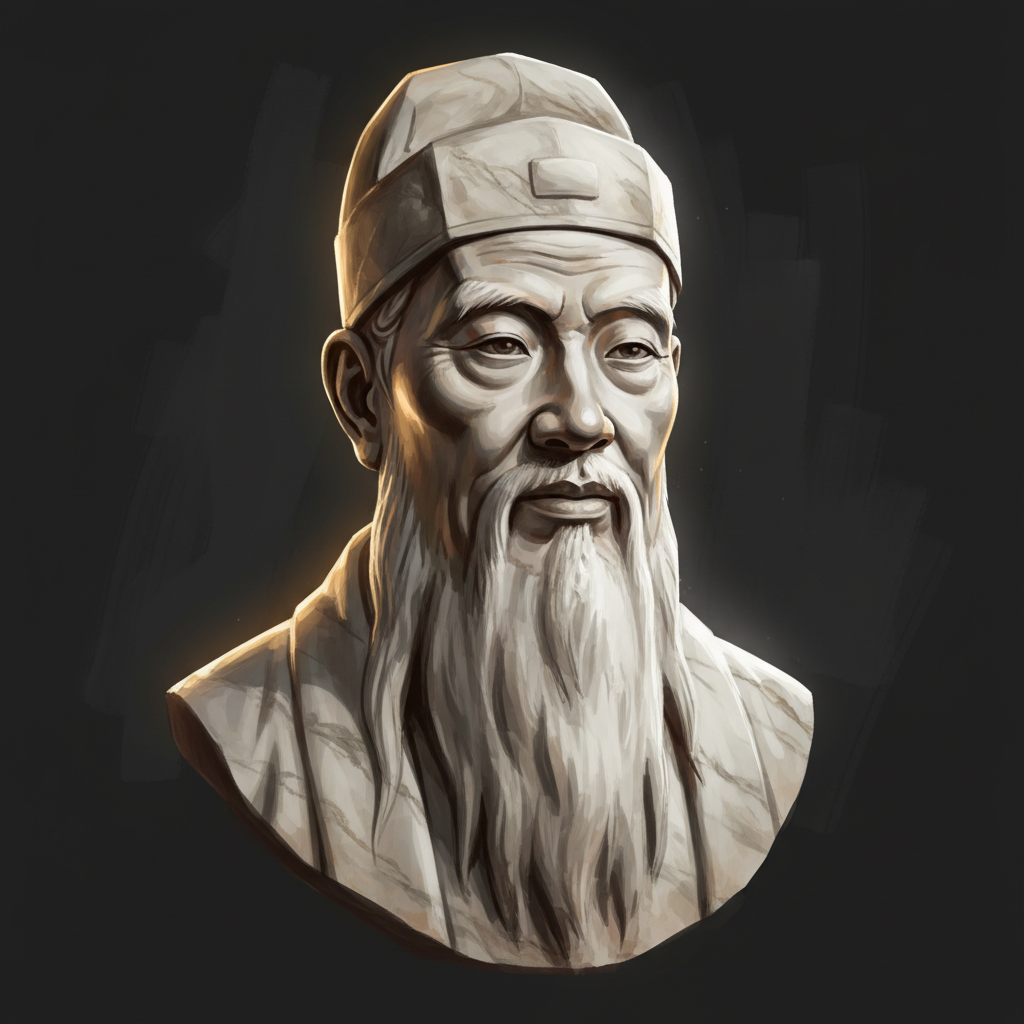
Confucius — "What you do not want done to yourself, do not do to others."
What you do not want done to yourself, do not do to others.
What you do not want done to yourself, do not do to others.
Click any product to generate a realistic preview. Up to 3 at a time.
* Initial load can take up to 90 seconds — revising the preview in another color is nearly instant.
"The Master said, 'To see what is right, and not to do it, is want of courage.'"
"The Master said, 'He who acts with a constant view to his own advantage will be much murmured against.'"
"Be strict with yourself but least reproachful of others and complaint is kept afar."
"The gentleman is not concerned that he is not acknowledged, but rather that he should do something worthy of being acknowledged."
"I have never seen anyone who loved virtue as much as they loved sex."
Chinese philosopher and teacher whose teachings (compiled by his students in the Analects) became the foundational ethical framework of East Asian civilization for 2,500 years. Closely associated with Mencius (his most-influential follower a century later). For an intellectual contrast, see Laozi, near-contemporary Chinese sage and Tao Te Ching author — Confucius systematized social order through ritual and family hierarchy; Laozi's Taoist effortless-action philosophy argued such systems were the disease, not the cure. The two founding poles of Chinese moral philosophy — every East Asian moral tradition since has positioned itself between them.
The standard scholarly entry points to Confucius's work: Philip J. Ivanhoe (Georgetown, Chinese philosophy) — Confucian Moral Self Cultivation (2000); Edward Slingerland (UBC, Asian Studies) — Effortless Action: Wu-wei as Conceptual Metaphor (2003); Tu Weiming (Harvard, Confucian scholar) — Confucian Thought: Selfhood as Creative Transformation (1985). These are the works graduate seminars cite when teaching Confucius.
Found in 1 providers: gemini
1 source checked
Treat others the way you would want to be treated. Before acting toward someone, pause and ask whether you would accept that same treatment if the roles were reversed. If the answer is no, don't do it. This single test, applied honestly, filters out cruelty, dishonesty, and exploitation. It makes empathy the baseline for every decision involving another person, turning moral judgment into a simple self-check.
Confucius built his entire ethical system around ren, usually translated as humaneness or benevolence toward others. He worked as a teacher and government advisor trying to reform rulers who abused their subjects, and he insisted that proper relationships, between ruler and subject, parent and child, friend and friend, depended on mutual consideration. This saying, often called the Silver Rule, captures his conviction that moral cultivation begins with restraint and imagining yourself in another's position.
Confucius lived during the Spring and Autumn period of ancient China, roughly 551 to 479 BCE, when the Zhou dynasty was fracturing and rival states waged constant war. Rulers executed subjects on whim, nobles betrayed each other, and ordinary people suffered from taxation and conscription. Against this backdrop of casual cruelty, Confucius proposed that social order could be rebuilt through personal virtue and reciprocal obligation rather than force, making his reciprocity principle a direct political intervention.
AI-generated insights based on extensive research and information for context. Factual errors? Email [email protected].
Your cart is empty