Confucius — "He who exercises government by means of his virtue may be compared to the North …"
He who exercises government by means of his virtue may be compared to the North Star, which keeps its place and all the stars turn towards it.
He who exercises government by means of his virtue may be compared to the North Star, which keeps its place and all the stars turn towards it.
Click any product to generate a realistic preview. Up to 3 at a time.
* Initial load can take up to 90 seconds — revising the preview in another color is nearly instant.
"The cautious seldom err."
"The Master said, 'A man who is not a man of benevolence—what has he to do with ceremonies? A man who is not a man of benevolence—what has he to do with music?'"
"The superior man is slow in speech but quick in action."
"To worship ancestors whom one does not know is to be presumptuous."
"The wise find pleasure in water; the virtuous find pleasure in mountains. The wise are active; the virtuous are tranquil. The wise are joyful; the virtuous are long-lived."
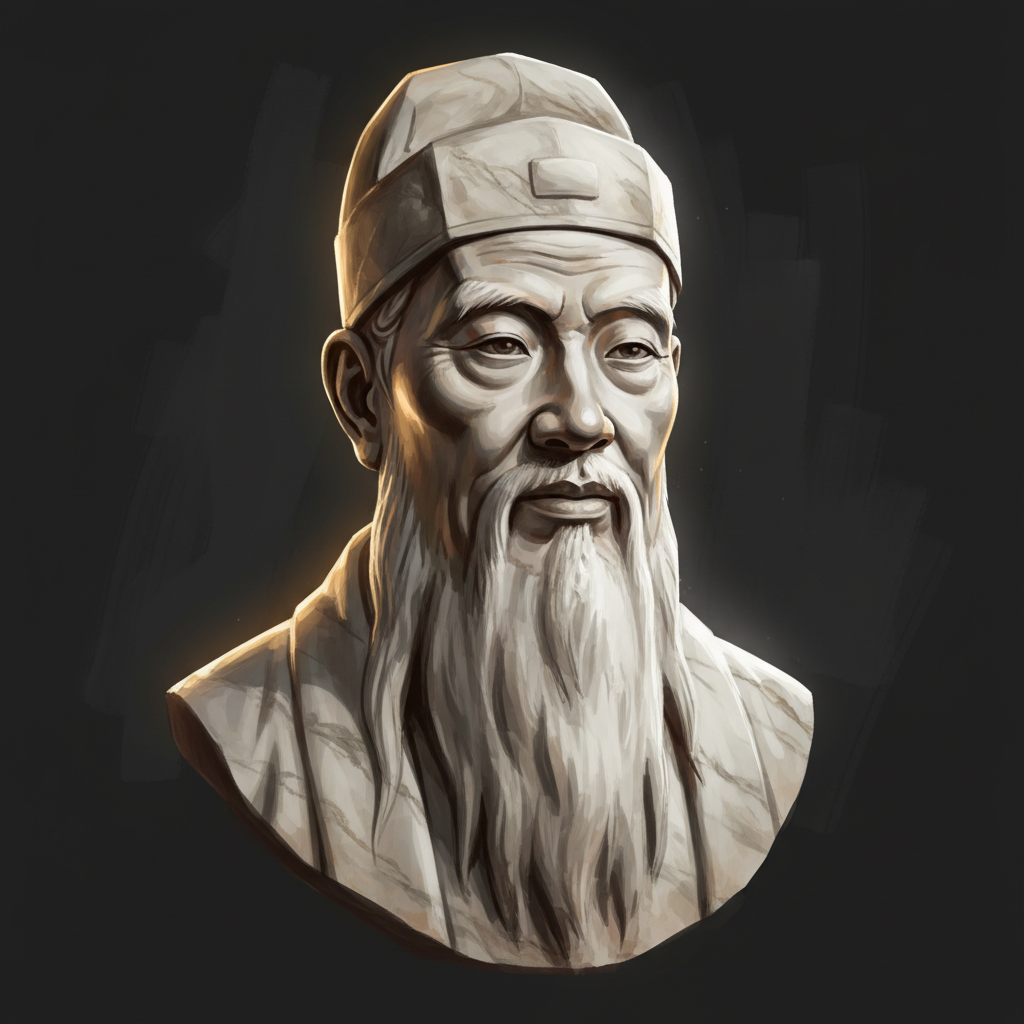
Chinese philosopher and teacher whose teachings (compiled by his students in the Analects) became the foundational ethical framework of East Asian civilization for 2,500 years. Closely associated with Mencius (his most-influential follower a century later). For an intellectual contrast, see Laozi, near-contemporary Chinese sage and Tao Te Ching author — Confucius systematized social order through ritual and family hierarchy; Laozi's Taoist effortless-action philosophy argued such systems were the disease, not the cure. The two founding poles of Chinese moral philosophy — every East Asian moral tradition since has positioned itself between them.
The standard scholarly entry points to Confucius's work: Philip J. Ivanhoe (Georgetown, Chinese philosophy) — Confucian Moral Self Cultivation (2000); Edward Slingerland (UBC, Asian Studies) — Effortless Action: Wu-wei as Conceptual Metaphor (2003); Tu Weiming (Harvard, Confucian scholar) — Confucian Thought: Selfhood as Creative Transformation (1985). These are the works graduate seminars cite when teaching Confucius.
Found in 1 providers: gemini
1 source checked
Good leadership comes from personal character, not force or micromanagement. When a ruler embodies genuine moral integrity, people naturally align themselves with that example, the way stars appear to rotate around the fixed North Star. Authority rooted in virtue attracts loyalty and order without needing constant intervention, threats, or elaborate rules. The leader sets a still center, and the community organizes itself around that steady example rather than around coercion.
Confucius spent his career arguing that rulers should govern through moral cultivation rather than harsh laws and punishments. He traveled between feuding states trying to advise kings on ethical leadership, often unsuccessfully. His central teaching, ren (humaneness), held that a junzi, or exemplary person, influences others by embodied virtue. This North Star image captures his signature idea: social harmony flows downward from a cultivated ruler, making self-improvement the foundation of political order.
Confucius lived during the late Spring and Autumn period around 551-479 BCE, when the Zhou dynasty's authority had collapsed and rival states waged constant war. Rulers relied on shifting alliances, legalist punishments, and brute force to hold power. Ordinary people suffered under unstable, corrupt courts. Against this backdrop, Confucius's claim that virtue alone could pacify a kingdom was radical, offering a moral alternative to the coercive statecraft dominating his fractured age.
AI-generated insights based on extensive research and information for context. Factual errors? Email [email protected].
Your cart is empty