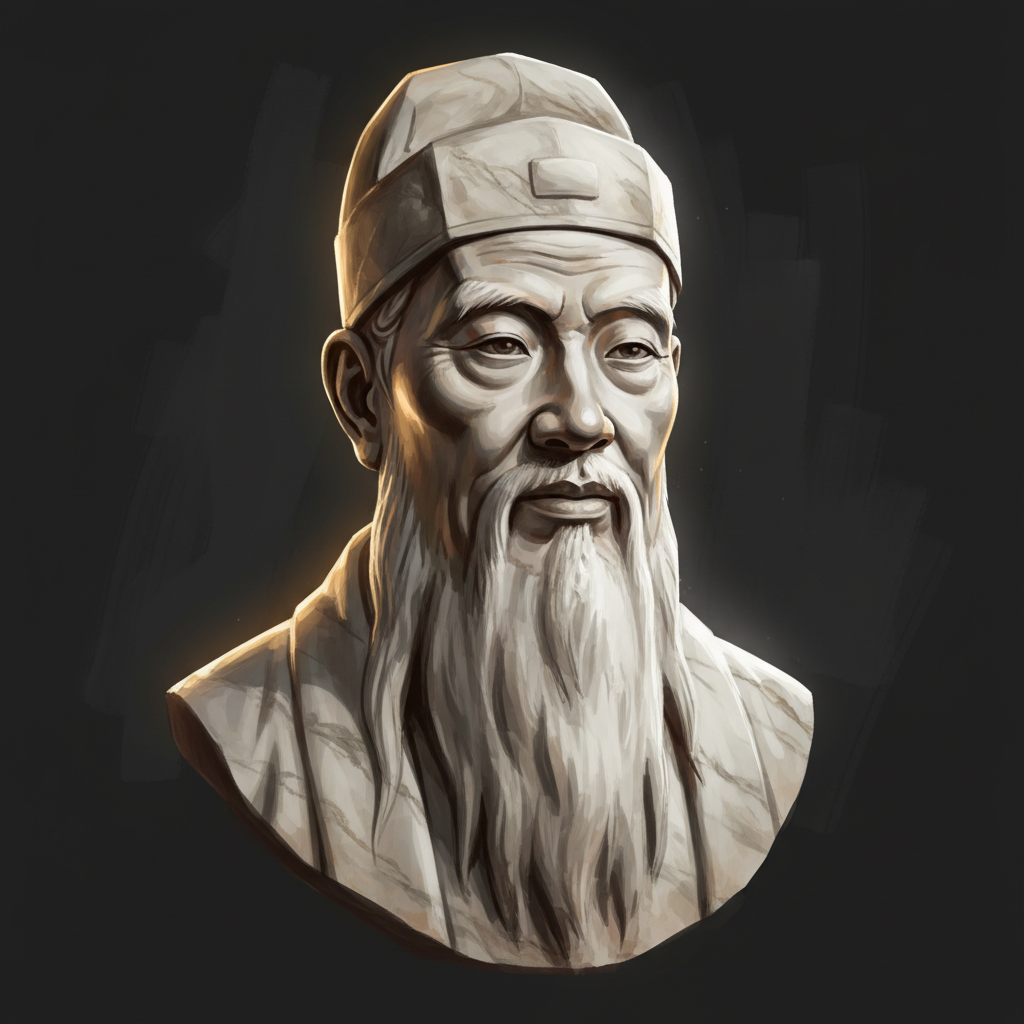
Confucius — "The scholar who cherishes the love of comfort is not fit to be deemed a scholar."
The scholar who cherishes the love of comfort is not fit to be deemed a scholar.
The scholar who cherishes the love of comfort is not fit to be deemed a scholar.
Click any product to generate a realistic preview. Up to 3 at a time.
* Initial load can take up to 90 seconds — revising the preview in another color is nearly instant.
"When you see a good man, try to emulate his example, and when you see a bad man, search yourself for his faults."
"When he eats, the gentleman does not seek to stuff himself. In his home he does not seek luxury. He is diligent in his work and cautious in his speech. He associates with those who possess the Way, an…"
"The superior man is watchful over himself when alone."
"The gentleman concerns himself with the Way; he does not worry about his salary."
"If a man does not say 'What shall I do? What shall I do?', I can do nothing with him."
Chinese philosopher and teacher whose teachings (compiled by his students in the Analects) became the foundational ethical framework of East Asian civilization for 2,500 years. Closely associated with Mencius (his most-influential follower a century later). For an intellectual contrast, see Laozi, near-contemporary Chinese sage and Tao Te Ching author — Confucius systematized social order through ritual and family hierarchy; Laozi's Taoist effortless-action philosophy argued such systems were the disease, not the cure. The two founding poles of Chinese moral philosophy — every East Asian moral tradition since has positioned itself between them.
The standard scholarly entry points to Confucius's work: Philip J. Ivanhoe (Georgetown, Chinese philosophy) — Confucian Moral Self Cultivation (2000); Edward Slingerland (UBC, Asian Studies) — Effortless Action: Wu-wei as Conceptual Metaphor (2003); Tu Weiming (Harvard, Confucian scholar) — Confucian Thought: Selfhood as Creative Transformation (1985). These are the works graduate seminars cite when teaching Confucius.
From a teaching on the pursuit of knowledge (Analects 14.3)
Date: c. 551-479 BCE
PhilosophicalFound in 1 providers: gemini
1 source checked
Anyone devoted to learning and wisdom cannot also be attached to ease, luxury, or physical comfort. The pursuit of knowledge demands discipline, sacrifice, and willingness to endure hardship. If your priority is a soft life, you will never do the hard intellectual and moral work real scholarship requires. Comfort-seeking and serious study are incompatible commitments, and choosing the former disqualifies you from claiming the latter.
Confucius spent his life traveling between warring Chinese states in modest circumstances, often hungry and rejected by rulers, to teach ethics and governance. He prized self-cultivation, ritual discipline, and moral seriousness over wealth or status. He praised his favorite student Yan Hui for living joyfully on rice and water in a shabby lane. This saying reflects his conviction that junzi, the noble person, must subordinate bodily appetites to learning and virtue.
Confucius lived during the late Spring and Autumn period (551-479 BCE), an era of collapsing Zhou authority, constant warfare between feudal states, and moral disorder. Aristocrats indulged in luxury while peasants suffered. Literacy was rare and scholar-officials were emerging as a new class meant to advise rulers wisely. Confucius was redefining what it meant to be educated: not inherited privilege or court comfort, but rigorous moral and textual self-cultivation aimed at restoring social harmony.
AI-generated insights based on extensive research and information for context. Factual errors? Email [email protected].
Your cart is empty