Confucius — "If a man in the morning hear the right way, he may die in the evening hear regre…"
If a man in the morning hear the right way, he may die in the evening hear regret.
If a man in the morning hear the right way, he may die in the evening hear regret.
Click any product to generate a realistic preview. Up to 3 at a time.
* Initial load can take up to 90 seconds — revising the preview in another color is nearly instant.
"The gentleman is easy to serve but difficult to please. He who tries to please him in the wrong way will not be pleased. He uses men according to their abilities. The petty man is difficult to serve a…"
"A good man is not a complete vessel."
"If the mechanic wishes to do his work well, he must first sharpen his tools."
"Humanity is more important for people than water or fire. I have seen people walk through water and fire and die. I have never seen someone tread the path of humanity and perish."
"If you make a mistake and do not correct it, this is called a mistake."
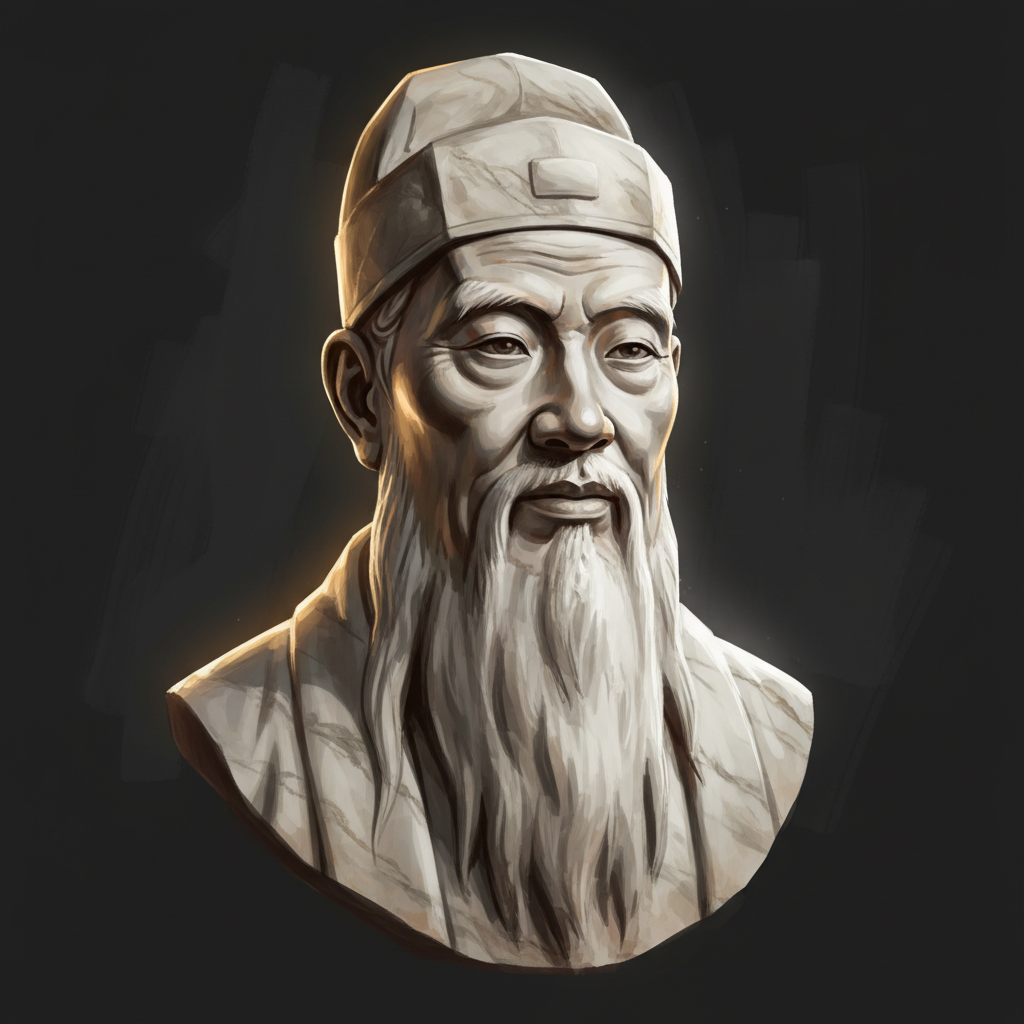
Chinese philosopher and teacher whose teachings (compiled by his students in the Analects) became the foundational ethical framework of East Asian civilization for 2,500 years. Closely associated with Mencius (his most-influential follower a century later). For an intellectual contrast, see Laozi, near-contemporary Chinese sage and Tao Te Ching author — Confucius systematized social order through ritual and family hierarchy; Laozi's Taoist effortless-action philosophy argued such systems were the disease, not the cure. The two founding poles of Chinese moral philosophy — every East Asian moral tradition since has positioned itself between them.
The standard scholarly entry points to Confucius's work: Philip J. Ivanhoe (Georgetown, Chinese philosophy) — Confucian Moral Self Cultivation (2000); Edward Slingerland (UBC, Asian Studies) — Effortless Action: Wu-wei as Conceptual Metaphor (2003); Tu Weiming (Harvard, Confucian scholar) — Confucian Thought: Selfhood as Creative Transformation (1985). These are the works graduate seminars cite when teaching Confucius.
Found in 1 providers: gemini
1 source checked
Discovering truth or understanding the right path to live matters so profoundly that grasping it even for a single day makes a life complete. If you finally learn how to live rightly in the morning, you could die that evening without regret, because the knowledge itself fulfills existence. Wisdom is not a tool for longevity; it is the entire point of being alive, outweighing time itself.
Confucius spent his life chasing moral truth, wandering between Chinese states for over a decade seeking rulers who would apply his ethical teachings. He prized learning, ritual propriety, and the cultivation of virtue above wealth, power, or survival. This saying captures his conviction that a human life gains worth through moral understanding, mirroring his own relentless pursuit of the Dao despite poverty, rejection, and political failure throughout his career.
Confucius lived during the Spring and Autumn period, an age of collapsing Zhou authority, constant warfare between feudal states, and eroding social order. Traditional rituals and loyalties were dissolving, and thinkers competed to diagnose the chaos. Against this backdrop, offering a universal moral Way that could restore harmony felt urgent. Life itself was precarious through war and famine, which made the claim that grasping truth mattered more than additional years especially striking to contemporaries.
AI-generated insights based on extensive research and information for context. Factual errors? Email [email protected].
Your cart is empty