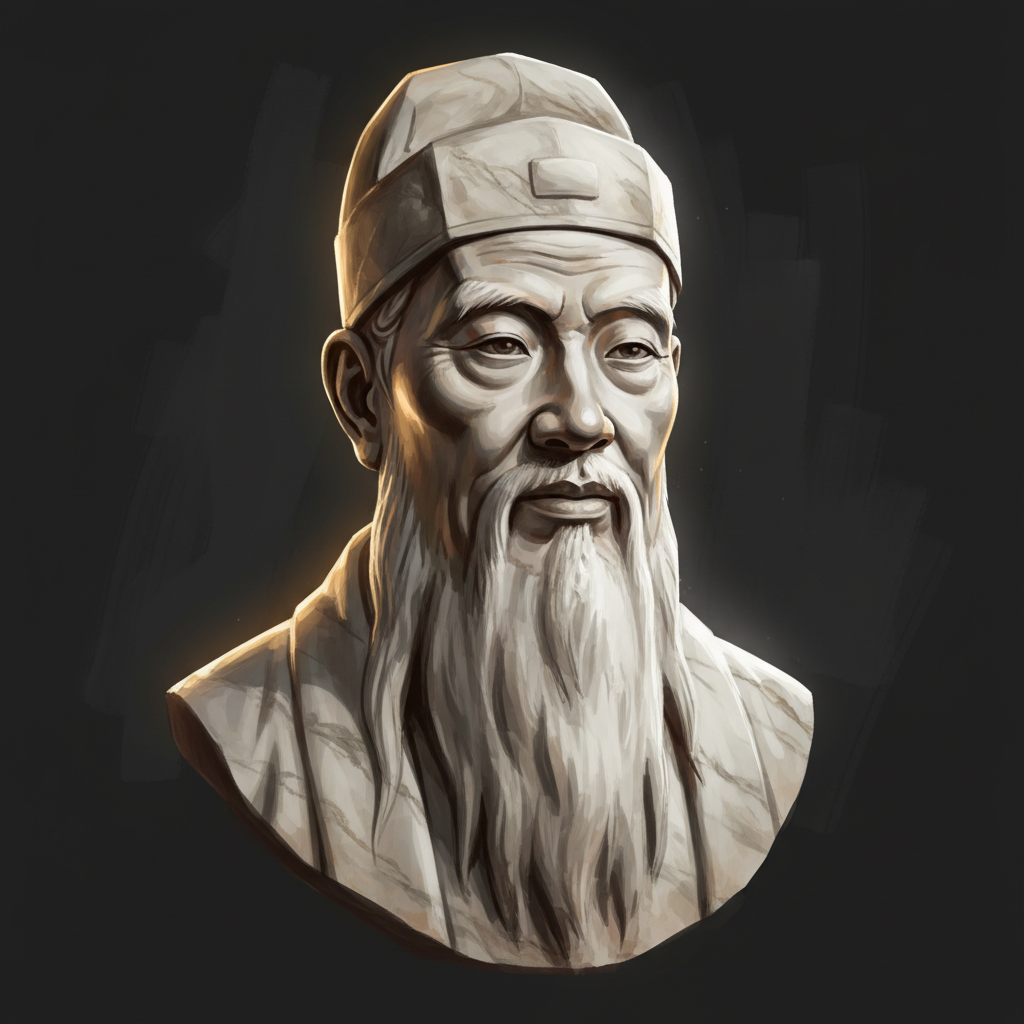
Confucius — "If a man does not say to himself, 'What shall I think of this? What shall I thin…"
If a man does not say to himself, 'What shall I think of this? What shall I think of this?' I can make nothing of him.
If a man does not say to himself, 'What shall I think of this? What shall I think of this?' I can make nothing of him.
Click any product to generate a realistic preview. Up to 3 at a time.
* Initial load can take up to 90 seconds — revising the preview in another color is nearly instant.
"The Master said, 'What I want to avoid is fixed ideas, obstinacy, narrow-mindedness, and egoism.'"
"The Master said, 'A man who is not a man of benevolence—what has he to do with ceremonies? A man who is not a man of benevolence—what has he to do with music?'"
"To govern is to rectify. If you lead the people by being rectified yourself, who will dare not be rectified?"
"The student of virtue has no time for idleness."
"The Master said, 'It is not easy to find a man who has learned for three years without having his thoughts bent on learning.'"
Chinese philosopher and teacher whose teachings (compiled by his students in the Analects) became the foundational ethical framework of East Asian civilization for 2,500 years. Closely associated with Mencius (his most-influential follower a century later). For an intellectual contrast, see Laozi, near-contemporary Chinese sage and Tao Te Ching author — Confucius systematized social order through ritual and family hierarchy; Laozi's Taoist effortless-action philosophy argued such systems were the disease, not the cure. The two founding poles of Chinese moral philosophy — every East Asian moral tradition since has positioned itself between them.
The standard scholarly entry points to Confucius's work: Philip J. Ivanhoe (Georgetown, Chinese philosophy) — Confucian Moral Self Cultivation (2000); Edward Slingerland (UBC, Asian Studies) — Effortless Action: Wu-wei as Conceptual Metaphor (2003); Tu Weiming (Harvard, Confucian scholar) — Confucian Thought: Selfhood as Creative Transformation (1985). These are the works graduate seminars cite when teaching Confucius.
From the Analects (15.16), on the importance of independent thought
Date: c. 551-479 BCE
PhilosophicalFound in 1 providers: gemini
1 source checked
Confucius is saying that a person who never questions, reflects, or examines what they encounter is essentially unteachable. If someone doesn't pause to ask themselves what something means or how they should interpret it, no teacher can guide them. Genuine learning requires active curiosity and self-inquiry. Without that internal drive to wrestle with ideas, instruction slides off and growth becomes impossible. The student must meet the teacher halfway.
Confucius spent his life as a traveling teacher, advising rulers and training disciples in ethics, governance, and ritual. He valued students who asked questions and rebuked passive listeners, famously refusing to re-explain a point to anyone who couldn't extend it themselves. His method relied on provoking reflection, not transmitting doctrine. This saying captures his core conviction that moral cultivation begins with self-examination, the same principle underlying his disciples' daily threefold self-review.
Confucius taught during the Spring and Autumn period of ancient China, roughly 551–479 BCE, when the Zhou dynasty was fracturing and warlords competed for power. Traditional rituals and social order were collapsing, and rival thinkers offered competing remedies. Literacy was rare and education largely restricted to aristocrats. Confucius broke that mold by accepting any earnest student, but insisted they bring active minds. In a chaotic age, cultivating reflective individuals was his proposed foundation for rebuilding society.
AI-generated insights based on extensive research and information for context. Factual errors? Email [email protected].
Your cart is empty