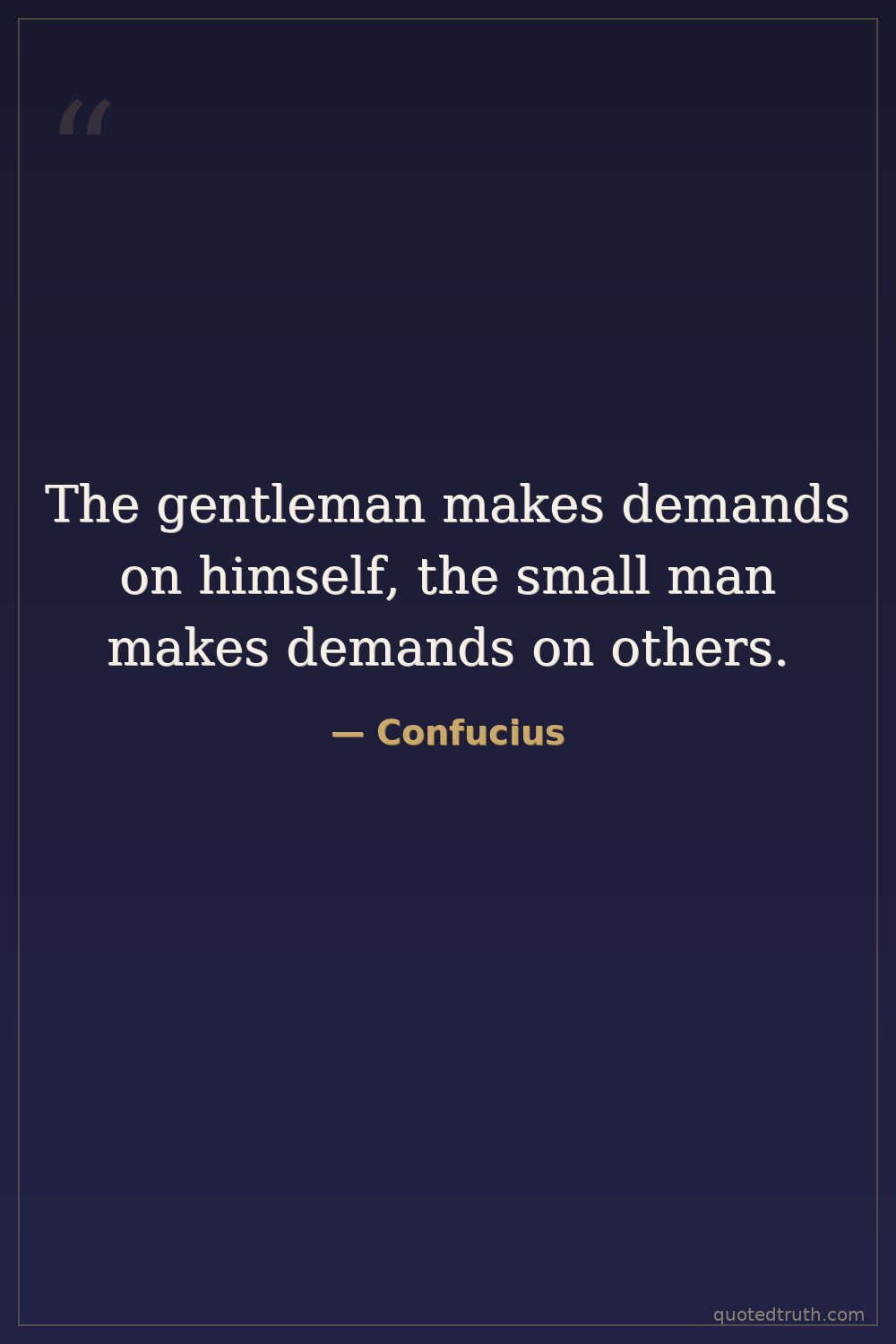
Confucius — "The gentleman makes demands on himself, the small man makes demands on others."
The gentleman makes demands on himself, the small man makes demands on others.
The gentleman makes demands on himself, the small man makes demands on others.
Click any product to generate a realistic preview. Up to 3 at a time.
* Initial load can take up to 90 seconds — revising the preview in another color is nearly instant.
"The superior man is distressed by his want of ability; he is not distressed by men’s not knowing him."
"It is not the failure of others to appreciate your abilities that should trouble you, but rather your own failure to appreciate theirs."
"The superior man is satisfied with himself; the inferior man seeks to please others."
"The cautious seldom err."
"He who exercises government by means of his virtue may be compared to the North Star, which keeps its place and all the stars turn towards it."
Chinese philosopher and teacher whose teachings (compiled by his students in the Analects) became the foundational ethical framework of East Asian civilization for 2,500 years. Closely associated with Mencius (his most-influential follower a century later). For an intellectual contrast, see Laozi, near-contemporary Chinese sage and Tao Te Ching author — Confucius systematized social order through ritual and family hierarchy; Laozi's Taoist effortless-action philosophy argued such systems were the disease, not the cure. The two founding poles of Chinese moral philosophy — every East Asian moral tradition since has positioned itself between them.
The standard scholarly entry points to Confucius's work: Philip J. Ivanhoe (Georgetown, Chinese philosophy) — Confucian Moral Self Cultivation (2000); Edward Slingerland (UBC, Asian Studies) — Effortless Action: Wu-wei as Conceptual Metaphor (2003); Tu Weiming (Harvard, Confucian scholar) — Confucian Thought: Selfhood as Creative Transformation (1985). These are the works graduate seminars cite when teaching Confucius.
Found in 1 providers: gemini
1 source checked
Mature, principled people hold themselves accountable for their actions, shortcomings, and growth. They look inward when something goes wrong and ask what they could do better. Petty or immature people do the opposite: they blame others, expect others to change, and demand that the world accommodate them. The dividing line between strong character and weak character is the direction responsibility flows—toward the self or away from it.
Confucius built his entire ethical system around the junzi, the 'gentleman' or exemplary person, contrasted with the xiaoren or 'small man.' As a teacher who failed to secure lasting political office, he emphasized self-cultivation over external blame. He taught that rulers and scholars must first perfect themselves before correcting others, a principle echoed throughout the Analects where this saying appears in Book 15.
Confucius lived during the late Spring and Autumn period (551–479 BCE), an era of collapsing Zhou authority, warring states, and rampant corruption among aristocrats who blamed peasants, rivals, and heaven for their failures. Nobles inherited status rather than earning it through virtue. Confucius's redefinition of 'gentleman' as a moral category rather than a hereditary one was radical, offering a merit-based ideal of character during political chaos and social decay.
AI-generated insights based on extensive research and information for context. Factual errors? Email [email protected].
Your cart is empty