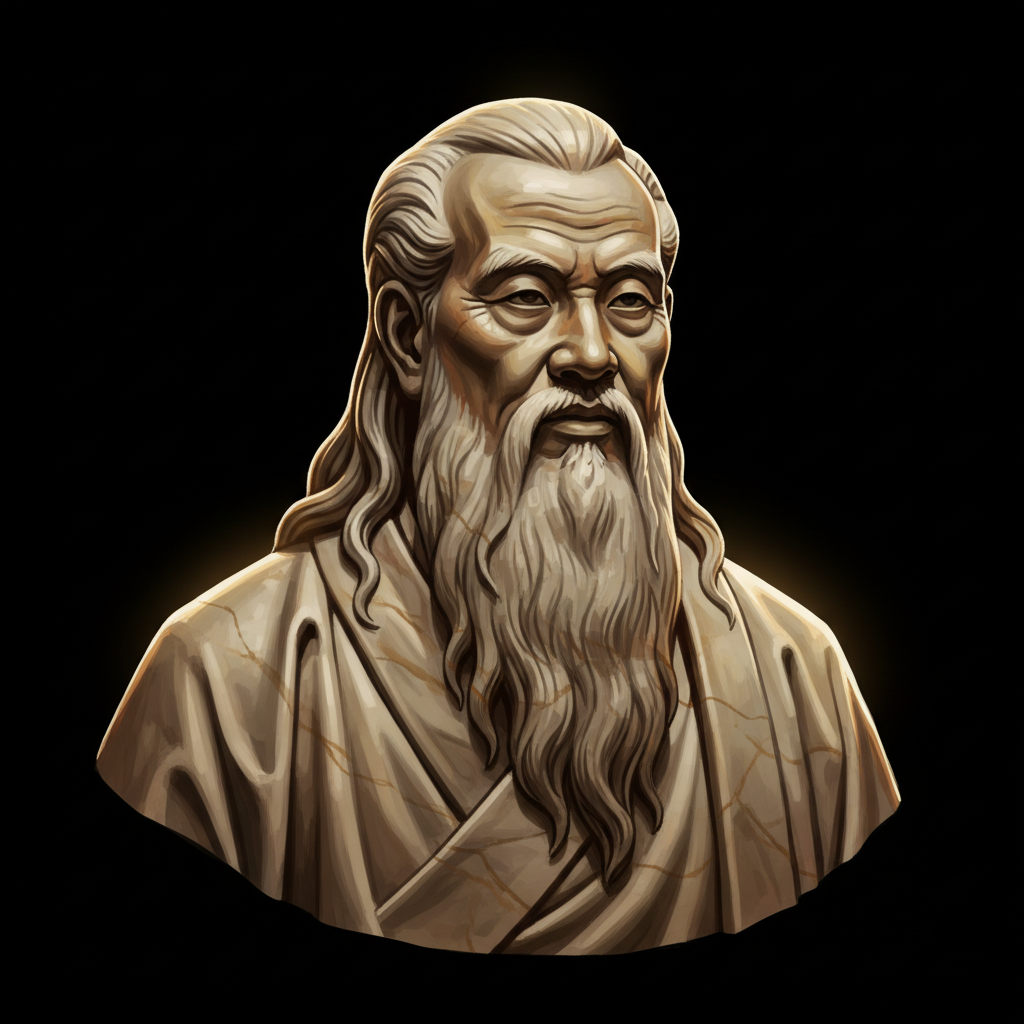
Laozi — "One who makes promises rashly rarely keeps good faith; One who is in the habit o…"
One who makes promises rashly rarely keeps good faith; One who is in the habit of considering things easy meets with frequent difficulties.
One who makes promises rashly rarely keeps good faith; One who is in the habit of considering things easy meets with frequent difficulties.
Click any product to generate a realistic preview. Up to 3 at a time.
* Initial load can take up to 90 seconds — revising the preview in another color is nearly instant.
"The reason why the river and the sea are able to be the lords of the hundred valleys is that they excel in taking the lower position. That is why they are able to be the lords of the hundred valleys."
"He who knows others is wise; he who knows himself is enlightened."
"Do not exalt the talented, so that people will not be contentious. Do not value rare treasures, so that people will not steal. Do not display what is desirable, so that people will not be confused."
"He who knows others is wise; he who knows himself is enlightened. He who conquers others is strong; he who conquers himself is mighty. He who is content is rich. He who acts with vigor has a will. He …"
"The best way to manage is to manage very little."
Reputed founder of Taoism and author of the Tao Te Ching, whose wu wei (effortless action) shaped East Asian philosophy. Closely associated with Zhuangzi (later Taoist who extended Laozi's framework). For an intellectual contrast, see Confucius, near-contemporary Chinese sage of social ritual and duty — Confucius systematized social order through ritual and hierarchy; Laozi argued that all such systems were the disease, not the cure — the two founding poles of Chinese moral philosophy.
Found in 1 providers: gemini
1 source checked
Rushing to commit without thinking tends to produce broken commitments, because the speaker never weighed what the promise actually demanded. The same pattern applies to judgment: treating problems as simple blinds you to their real complexity, so you keep hitting obstacles you could have anticipated. Slow down, measure the weight of what you're agreeing to or attempting, and your word and your work both become more reliable.
Laozi, credited founder of Taoism and reputed archivist at the Zhou royal court, spent his life observing how rulers and officials overreached. His core teaching of wu wei, effortless non-forcing action, rests on exactly this caution: speak little, act deliberately, respect the hidden difficulty in ordinary things. The Daodejing repeatedly warns that the sage treats the easy as hard, which is this saying in compressed form.
Laozi lived during the late Zhou dynasty around the 6th century BCE, as centralized authority crumbled into the Spring and Autumn period's constant warfare and shifting alliances. Rulers made and broke oaths, ministers promised reforms they could not deliver, and campaigns launched on the assumption of easy victory ended in ruin. Against that backdrop of reckless speech and underestimated consequences, a teaching about weighing promises and respecting difficulty carried direct political and survival weight.
AI-generated insights based on extensive research and information for context. Factual errors? Email [email protected].
Your cart is empty