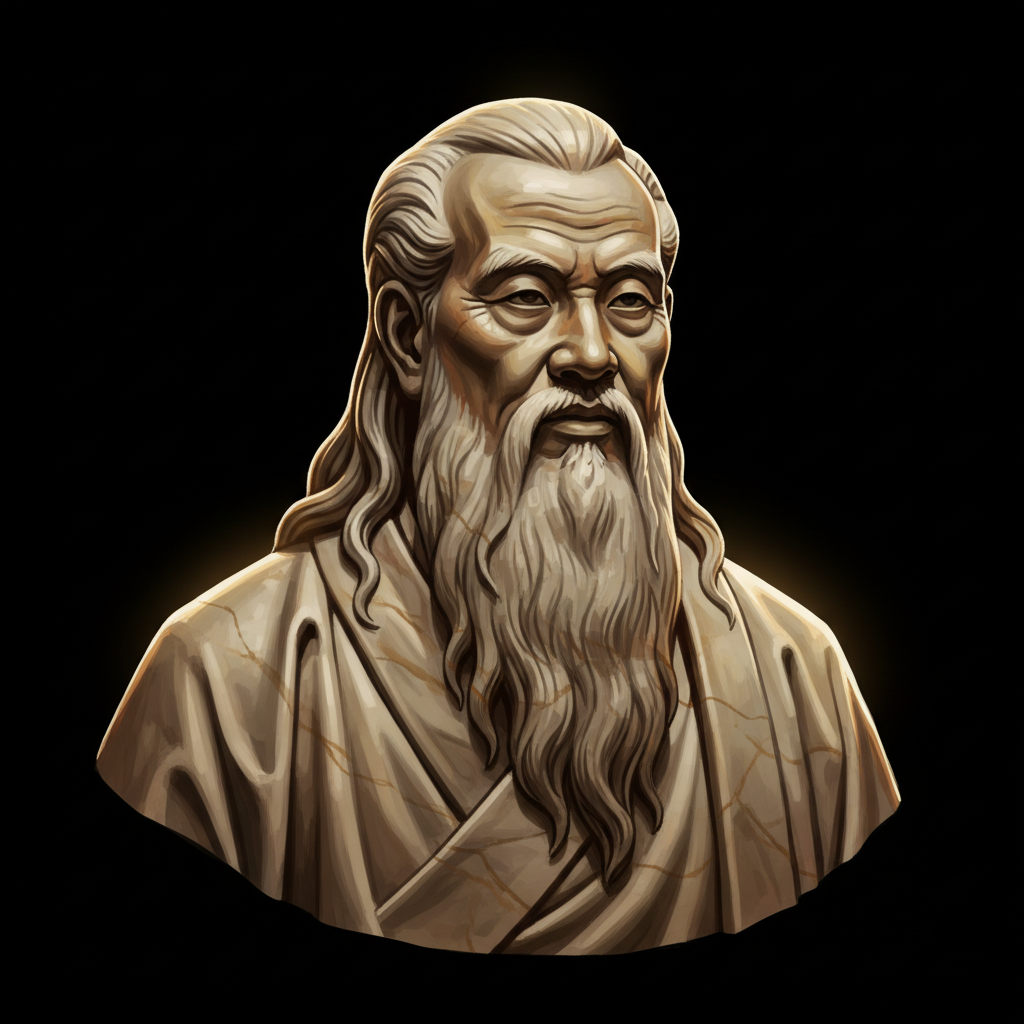
Laozi — "The sage knows without traveling, perceives without looking, completes without a…"
The sage knows without traveling, perceives without looking, completes without acting.
The sage knows without traveling, perceives without looking, completes without acting.
Click any product to generate a realistic preview. Up to 3 at a time.
* Initial load can take up to 90 seconds — revising the preview in another color is nearly instant.
"To know yet to think that one does not know is the highest [attainment]. Not to know yet to think that one knows is a disease."
"The five colors make one blind in the eyes; the five tones make one deaf in the ears."
"The sage is always without ambition."
"When there is no desire, all things are at peace."
"Taking things lightly must lead to big difficulties. The sage regards things as difficult, and thereby avoids difficulty."
Reputed founder of Taoism and author of the Tao Te Ching, whose wu wei (effortless action) shaped East Asian philosophy. Closely associated with Zhuangzi (later Taoist who extended Laozi's framework). For an intellectual contrast, see Confucius, near-contemporary Chinese sage of social ritual and duty — Confucius systematized social order through ritual and hierarchy; Laozi argued that all such systems were the disease, not the cure — the two founding poles of Chinese moral philosophy.
Found in 1 providers: gemini
1 source checked
True wisdom does not require physical movement, constant observation, or forceful effort. A deeply understanding person grasps reality through inner clarity and intuition, seeing patterns others miss. Great things happen not by pushing harder but by aligning with natural flow. Knowledge, insight, and accomplishment come from being still and receptive rather than rushing around chasing information or straining to make things happen.
Laozi worked as an archivist in the Zhou royal court, spending decades among texts rather than traveling. He championed wu wei, effortless action, and believed forcing outcomes produced worse results than yielding. Legend says he grew disillusioned with court corruption and rode west on an ox, dictating the Tao Te Ching at a border gate. This saying captures his conviction that the Tao reveals itself to those who stop grasping.
Laozi lived during the late Zhou dynasty, roughly the 6th century BCE, amid the Spring and Autumn period's political fragmentation and constant warfare between rival states. Confucian scholars promoted rigorous study, ritual, and active governance as remedies. Laozi offered a radical counterpoint: withdrawal, simplicity, and trust in nature. His teachings appealed to those exhausted by ambitious statecraft and endless conflict, planting seeds for Taoism's later flowering under the Han.
AI-generated insights based on extensive research and information for context. Factual errors? Email [email protected].
Your cart is empty