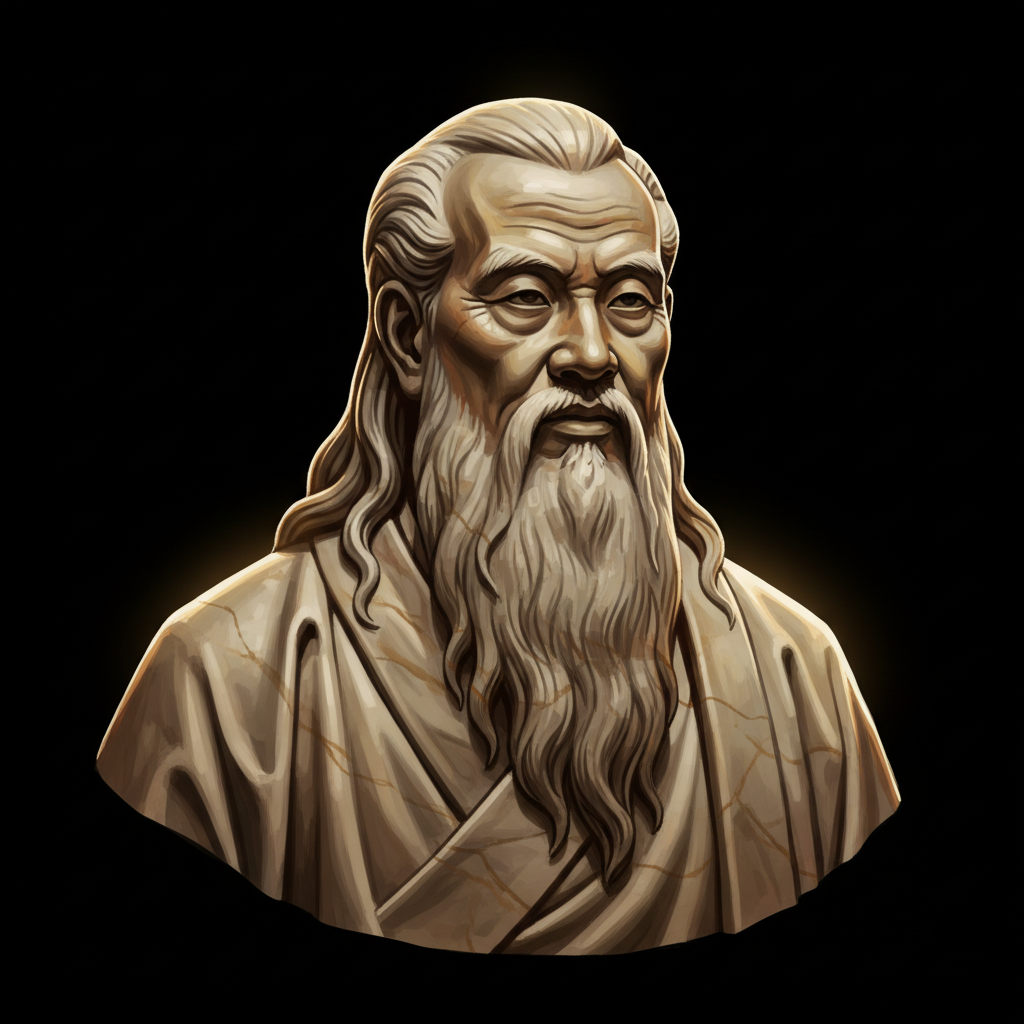
Laozi — "When there is no desire, all things are at peace."
When there is no desire, all things are at peace.
When there is no desire, all things are at peace.
Click any product to generate a realistic preview. Up to 3 at a time.
* Initial load can take up to 90 seconds — revising the preview in another color is nearly instant.
"The Way that can be told of is not an unvarying way."
"The great square has no corners. The great vessel takes a long time to complete. The great sound is faint. The great image has no form."
"No thought, no action, no movement, total stillness: only thus can one manifest the true nature and law of things... and at last become one with heaven and earth."
"Yield and overcome; Bend and be straight; Empty and be full; Wear out and be new; Have little and gain; Have much and be confused."
"Governing a large country is like frying a small fish."
Reputed founder of Taoism and author of the Tao Te Ching, whose wu wei (effortless action) shaped East Asian philosophy. Closely associated with Zhuangzi (later Taoist who extended Laozi's framework). For an intellectual contrast, see Confucius, near-contemporary Chinese sage of social ritual and duty — Confucius systematized social order through ritual and hierarchy; Laozi argued that all such systems were the disease, not the cure — the two founding poles of Chinese moral philosophy.
Found in 2 providers: gemini,grok
2 sources checked
Craving and restless wanting are what disturb your inner world and the world around you. When you stop chasing, grasping, and forcing outcomes, conflict dissolves on its own. Things settle into their natural state because you are no longer pushing against them. Peace is not something you achieve through effort; it appears automatically the moment you release the hunger that was creating the disturbance in the first place.
Laozi built Taoism around wu wei, effortless action, and the idea that striving corrupts what it touches. Legend says he grew disgusted with court ambition and rode west out of civilization, writing the Tao Te Ching only when a border guard insisted. This line distills his core teaching: desire generates the very turbulence people then try to fix with more desire. Withdrawal and stillness, not pursuit, were the profession and philosophy of his life.
Laozi lived during the late Zhou dynasty around the 6th century BCE, as feudal lords waged constant war and competing schools fought over how to restore order. Confucians prescribed ritual, duty, and active governance; Legalists pushed harsh law. Against this climate of striving and ambition, Taoism offered the opposite prescription: rulers and subjects causing chaos precisely because they wanted too much. Saying peace came from no desire was a radical political and personal stance.
AI-generated insights based on extensive research and information for context. Factual errors? Email [email protected].
Your cart is empty