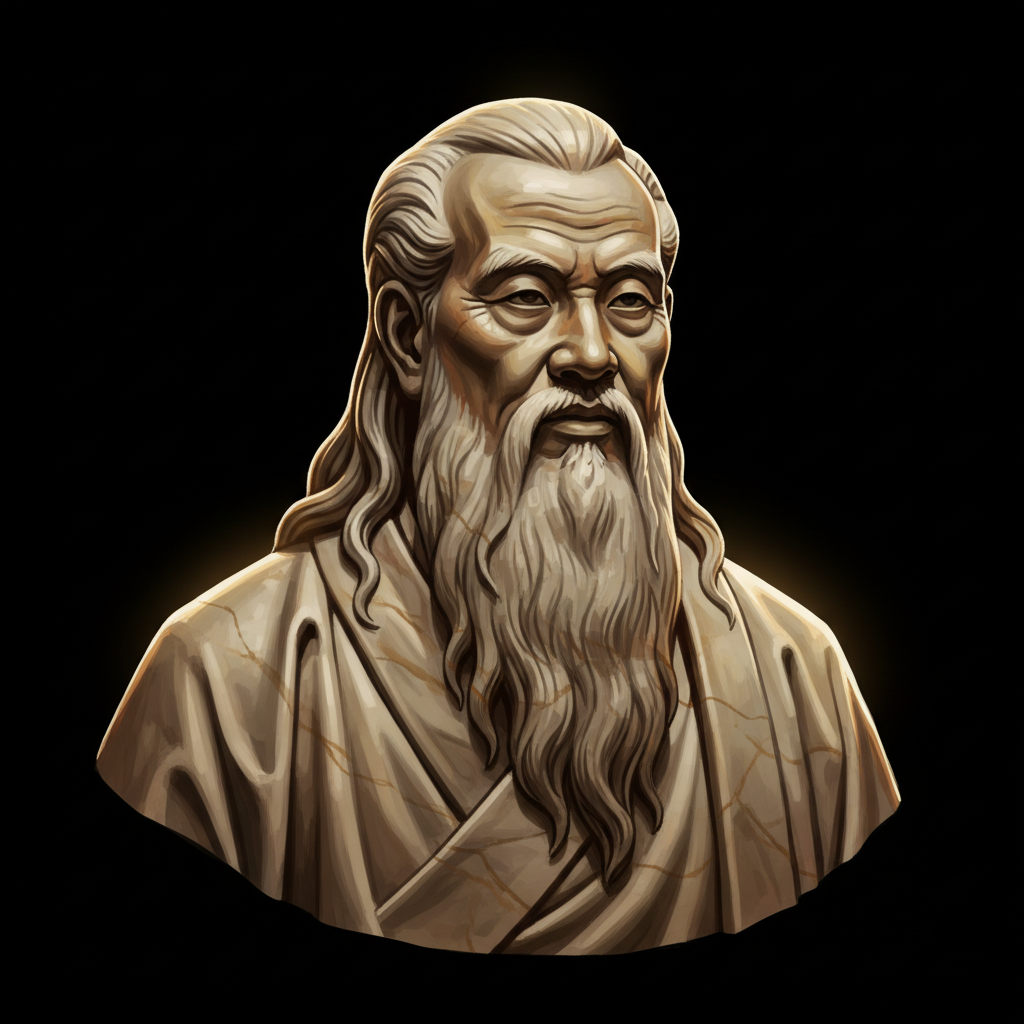
Laozi — "Pursue without interfering."
Pursue without interfering.
Pursue without interfering.
Click any product to generate a realistic preview. Up to 3 at a time.
* Initial load can take up to 90 seconds — revising the preview in another color is nearly instant.
"Deal with the small as with the large."
"The uncarved block, though small, is nowhere in the world inferior. If princes and kings could but hold on to it, all creatures would submit to them."
"Those who have the courage to dare will perish. Those who have the courage not to dare will live."
"Use justice to rule a country. Use surprise to wage war. Use non-action to govern the world."
"The sage knows without traveling, perceives without looking, completes without acting."
Reputed founder of Taoism and author of the Tao Te Ching, whose wu wei (effortless action) shaped East Asian philosophy. Closely associated with Zhuangzi (later Taoist who extended Laozi's framework). For an intellectual contrast, see Confucius, near-contemporary Chinese sage of social ritual and duty — Confucius systematized social order through ritual and hierarchy; Laozi argued that all such systems were the disease, not the cure — the two founding poles of Chinese moral philosophy.
Found in 1 providers: gemini
1 source checked
Move toward your goals without forcing outcomes or meddling in the natural flow of events. Act purposefully, but let things unfold on their own terms rather than controlling every detail. Engagement and non-interference are not opposites; you can be fully committed to a direction while still allowing circumstances, other people, and processes the space to develop without your constant intervention or manipulation.
This captures wu wei, the central Taoist principle Laozi articulated in the Tao Te Ching. As a legendary archivist in the Zhou court who reportedly withdrew from political life, Laozi observed how rulers and officials damaged what they touched through overreach. His teaching urged leaders to govern like water shaping stone, pursuing harmony through yielding rather than forcing, which became the philosophical backbone of Taoism.
Laozi lived during the late Zhou dynasty in ancient China, an era of collapsing feudal order that foreshadowed the Warring States period. Rulers competed through heavy taxation, rigid laws, and constant military campaigns, creating widespread suffering. Against this backdrop of aggressive statecraft and Confucian emphasis on strict social ritual, Laozi's counsel of restrained, non-interfering action offered a radical alternative, suggesting harmony came from aligning with the Tao rather than imposing human will.
AI-generated insights based on extensive research and information for context. Factual errors? Email [email protected].
Your cart is empty