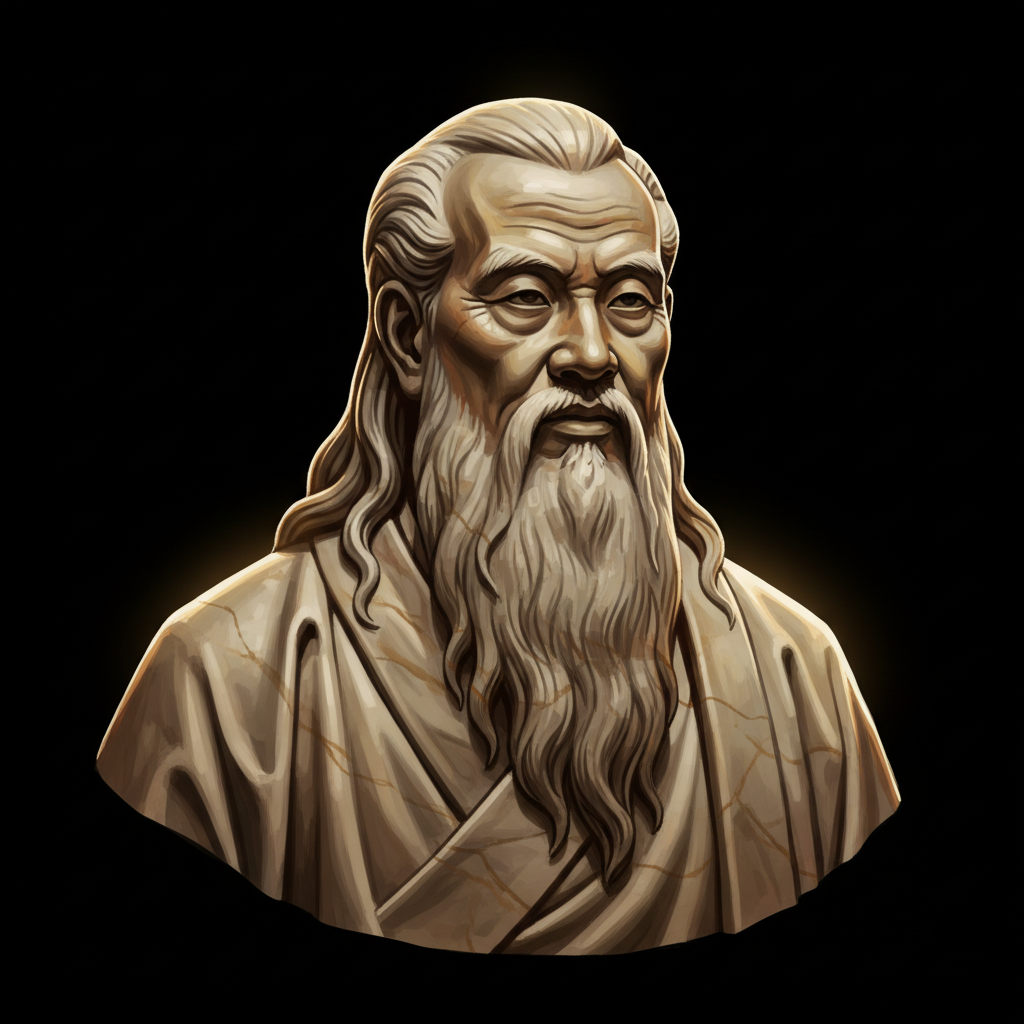
Laozi — "Lightly given promises must meet with little trust."
Lightly given promises must meet with little trust.
Lightly given promises must meet with little trust.
Click any product to generate a realistic preview. Up to 3 at a time.
* Initial load can take up to 90 seconds — revising the preview in another color is nearly instant.
"To know that you do not know is the best. To think you know when you do not is a disease."
"Governing a large country is like frying a small fish."
"Govern a great nation as you would cook a small fish. (Do not overdo it.)"
"The sage does not hoard. The more he helps others, the more he benefits himself."
"Water is fluid, soft, and yielding. But water will wear away rock, which is rigid and cannot yield. As a rule, whatever is fluid, soft, and yielding will overcome whatever is rigid and hard. This is a…"
Reputed founder of Taoism and author of the Tao Te Ching, whose wu wei (effortless action) shaped East Asian philosophy. Closely associated with Zhuangzi (later Taoist who extended Laozi's framework). For an intellectual contrast, see Confucius, near-contemporary Chinese sage of social ritual and duty — Confucius systematized social order through ritual and hierarchy; Laozi argued that all such systems were the disease, not the cure — the two founding poles of Chinese moral philosophy.
Found in 1 providers: gemini
1 source checked
Promises made casually or without careful thought deserve little confidence from those who hear them. When someone agrees too quickly or pledges too much without weighing the cost, their word carries no weight. Reliability comes from hesitation before committing, not from eagerness to please. A person who promises easily will break promises just as easily, so listeners should match their trust to the seriousness shown when the promise was made.
Laozi valued wu wei, effortless action rooted in sincerity rather than showy effort or empty speech. As a reputed archivist at the Zhou court, he observed officials who spoke grandly and delivered poorly. His Tao Te Ching repeatedly warns that true words are not beautiful and beautiful words are not true. This saying reflects his suspicion of glib rhetoric and his preference for quiet, deliberate conduct where actions outpace declarations.
Laozi lived during the late Zhou dynasty, roughly the 6th century BCE, as centralized authority crumbled into the Warring States era. Rival lords courted advisors with lavish oaths and alliances that collapsed overnight, and wandering ministers sold persuasive promises to whichever ruler paid best. Treaties were routinely broken, and verbal pledges had become currency cheapened by overuse. Against this backdrop of political double-dealing, Laozi urged a return to plain speech, restraint, and trustworthiness earned through measured action.
AI-generated insights based on extensive research and information for context. Factual errors? Email [email protected].
Your cart is empty