Laozi — "When people see some things as beautiful, other things become ugly. When people …"
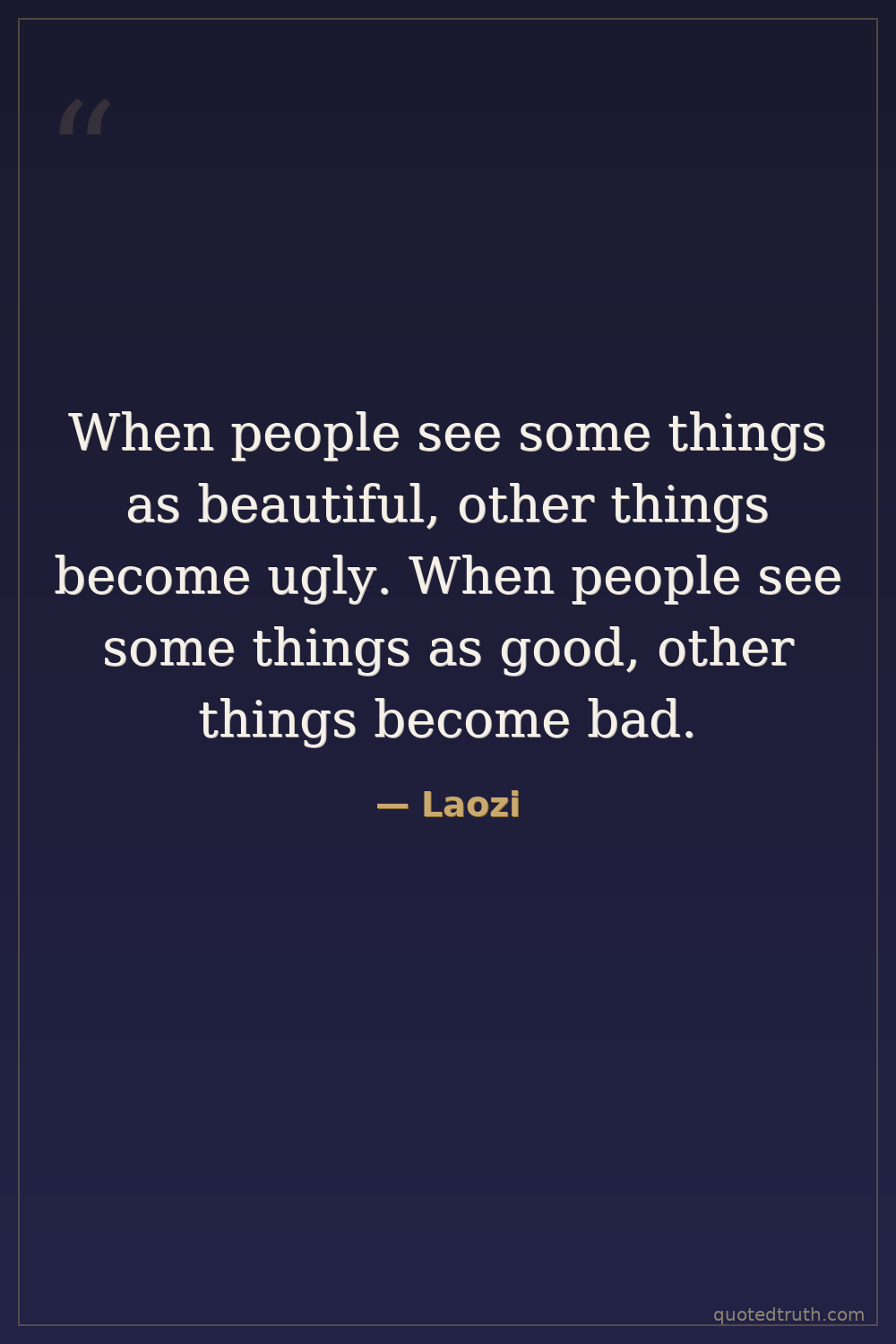
When people see some things as beautiful, other things become ugly. When people see some things as good, other things become bad.
When people see some things as beautiful, other things become ugly. When people see some things as good, other things become bad.
Click any product to generate a realistic preview. Up to 3 at a time.
* Initial load can take up to 90 seconds — revising the preview in another color is nearly instant.
"He who values himself more than the world can be entrusted with the world. He who loves himself more than the world can be charged with the world."
"The soft and the weak overcome the hard and the strong."
"Empty your mind of all thoughts. Let your heart be at peace. Watch the turmoil of the world, but let your serenity remain intact."
"The wise man's food is that which nourishes, not that which pleases the eye."
"Because of the great love, one is courageous."
Reputed founder of Taoism and author of the Tao Te Ching, whose wu wei (effortless action) shaped East Asian philosophy. Closely associated with Zhuangzi (later Taoist who extended Laozi's framework). For an intellectual contrast, see Confucius, near-contemporary Chinese sage of social ritual and duty — Confucius systematized social order through ritual and hierarchy; Laozi argued that all such systems were the disease, not the cure — the two founding poles of Chinese moral philosophy.
Found in 1 providers: gemini
1 source checked
Labels create their opposites. The moment you declare something beautiful, everything else is cast as ugly by comparison. Calling one act good automatically brands others as bad. These categories aren't discovered in the world; they're invented by the mind through contrast. Judgment manufactures the very divisions it claims to observe, and people then suffer chasing one side while fleeing the other.
Laozi taught that reality flows as an undivided whole, and human concepts carve it into false opposites. As the traditional founder of Taoism and reputed author of the Tao Te Ching, he urged wu wei, effortless action aligned with nature, and warned against rigid moral schemes. A keeper of Zhou court archives, he saw how rulers' labels bred conflict, and withdrew from society rather than impose more distinctions on it.
Laozi lived during the late Zhou period, as China slid toward the Warring States era of collapsing feudal order and constant warfare. Competing schools, especially Confucians, proposed elaborate rituals, hierarchies, and moral codes to restore harmony. Laozi's lines push back against that project, suggesting the codes themselves generate the strife they claim to cure. His quiet naturalism offered a radical alternative to the rule-bound reformers crowding his age.
AI-generated insights based on extensive research and information for context. Factual errors? Email [email protected].
Your cart is empty