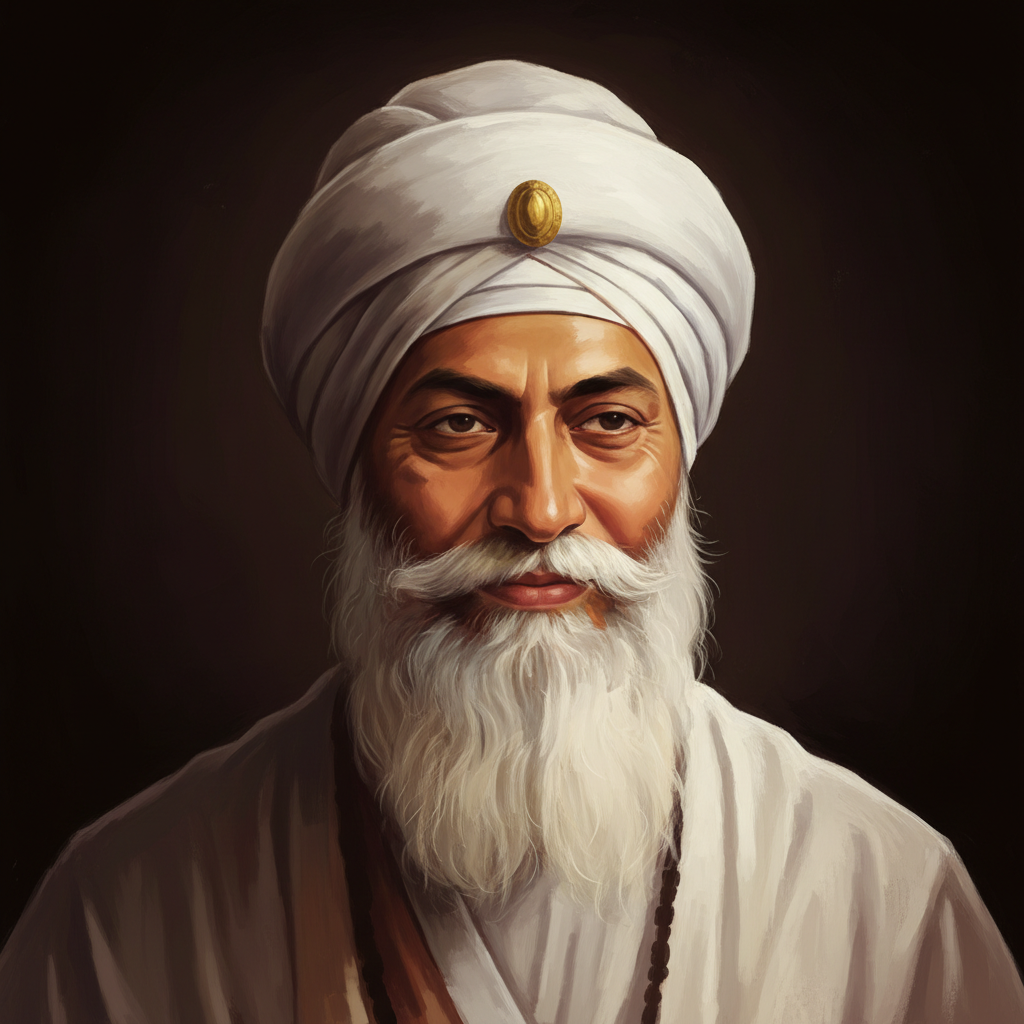
Guru Nanak — "Through chanting the Name, one crosses the terrifying world-ocean."
Through chanting the Name, one crosses the terrifying world-ocean.
Through chanting the Name, one crosses the terrifying world-ocean.
Click any product to generate a realistic preview. Up to 3 at a time.
* Initial load can take up to 90 seconds — revising the preview in another color is nearly instant.
"Only fools argue whether to eat meat or not. They don't understand truth nor do they meditate on it."
"God is one, but he has innumerable forms. He is the creator of all and He himself takes the human form."
"May your path be clear and your coffee be strong."
"The greatest treasure is the Name of God."
"There is but One God, His Name is Truth, He is the Creator, Fearless, without hatred, Immortal, Unborn, Self-existent, by the Guru's Grace."
Founder of Sikhism and the first of the Ten Sikh Gurus, whose teachings of one universal God and rejection of caste shaped Punjab. Closely associated with Kabir (mystical poet whose verses appear in the Sikh Guru Granth Sahib). For an intellectual contrast, see Brahmanical orthodoxy, the Hindu caste-and-ritual establishment of his era — Sikhism was founded as a deliberate alternative to both Hindu ritual hierarchy and Islamic exclusivism — Nanak's universalism was a structural rejection of caste and priestly mediation.
Found in 1 providers: gemini
1 source checked
Repeating God's name (Naam) is the spiritual practice that carries a soul through life's overwhelming suffering and the cycle of rebirth. The 'world-ocean' is a classical South Asian metaphor for samsara—the terrifying, turbulent sea of birth, death, and worldly entanglement. Chanting the Name is not mere ritual but active devotion that creates a bridge across this ocean, liberating the soul from fear and the endless cycle of existence.
Guru Nanak (1469–1539) made Naam Simran—meditating on God's name—the central pillar of Sikh practice. He rejected priestly intermediaries, caste hierarchy, and empty ritual, teaching that direct devotion was open to everyone regardless of birth. As a traveling mystic-poet who composed the Japji Sahib and other hymns, Nanak himself lived this teaching, singing devotional compositions across India, Arabia, and Central Asia on his four major journeys.
Guru Nanak's Punjab endured Babur's Mughal invasions, the collapse of the Lodi Sultanate, and entrenched Hindu caste oppression. Ordinary people were caught between religious systems that excluded them—Brahmin gatekeeping by birth and Islamic orthodoxy demanding conversion. The 'terrifying world-ocean' was not just metaphor but lived experience. Nanak's teaching that the Name alone saves—not priests, not rituals—was a radical democratic answer to that specific historical suffering.
AI-generated insights based on extensive research and information for context. Factual errors? Email [email protected].
Your cart is empty